Doctrine of the Second Sun




Doctrine of the Second Sun is a portable collection of literary, visual, coding, technical-writing, and software-stewardship guidance. It defines one fictional scripture with four canonical books while keeping repository-specific placement and enforcement rules in the projects that consume it.
The canonical Markdown is also available as rendered documentation.
Documents
DOCTRINE-STYLE-GUIDE.md: literary worldview, books, movements, cadence, imagery, and examples.DOCTRINE-CODING-GUIDE.md: safe insertion and review of literary marginalia in source code.DOCTRINE-IMAGE-GUIDE.md: visual interpretation of completed logia.DOCTRINE-GENERATION-GUIDE.md: tool-neutral writer, reviewer, and insertion workflow.DOCTRINE-GOLD-EXEMPLARS.md: exceptional reference logia establishing the quality ceiling for generation and review.INTEGRATION-GUIDE.md: adopting the portable guides in a consuming repository for humans and coding agents.RUINENWERT.md: engineering resilience, recoverability, and continuation under ecosystem change.MEASURE-OF-WORDS.md: concise, clear, and exact writing for technical artifacts.CODE_OF_SOVEREIGNTY.md: repository governance and the sovereignty of forks.
Ruinenwert is engineering guidance for resilience, recoverability, and continuation under ecosystem change. The Code of Sovereignty is an institutional document. The Measure of Words is technical-writing guidance. None is a book or teaching within the fictional canon.
Composer
Install the documents as a development dependency:
composer require --dev jbboehr/doctrine-of-the-second-sun:dev-master
The package root is then available at:
vendor/jbboehr/doctrine-of-the-second-sun/
Consuming projects should keep their own AGENTS.md or equivalent policy for source scope, tag syntax, citation
allocation, asset locations, and verification commands. See the integration guide for the full
adoption workflow and a local-policy template.
Nix
Add the repository as a flake input:
inputs.doctrine-of-the-second-sun.url = "github:jbboehr/doctrine-of-the-second-sun";
The default package installs the documents beneath:
share/doctrine-of-the-second-sun/
A consuming development shell can expose that location explicitly:
DOCTRINE_OF_SECOND_SUN_DIR =
  "${inputs.doctrine-of-the-second-sun.packages.${system}.default}/share/doctrine-of-the-second-sun";
Prefer one installation mechanism per consuming repository so Composer and Nix locks cannot silently select different revisions.
Codex Integration
Codex-specific writer and reviewer adapters live under integrations/codex/. They are
optional workflow aids rather than part of the tool-neutral doctrine.
PHPStan Integration
The optional integrations/phpstan/ adapter lets consuming PHP repositories enforce
their locally selected @logion declaration coverage, citation form, allowed books, and repository-wide uniqueness. It
does not choose source roots or command entry points for the consumer and remains disabled unless local configuration
or the DOCTRINE_LOGION environment variable enables it.
Browser Integration
The optional browser integrations are framework-independent and inert until mounted:
Heliogenesisrenders the Dawning of the Second Sun;- The Document Looks Back lets occasional marked letterforms notice the reader.
Neither integration alters a consuming documentation theme merely by being installed.
License
Unless otherwise indicated, the documentation, integrations, packaging files, and artwork in this repository are licensed under the Creative Commons Attribution-ShareAlike 4.0 International License.
The PHPStan adapter implementation, configuration, and tests are licensed under the
GNU Affero General Public License version 3 with the
Romic Exception. The PHPStan integration’s README.md remains
documentation under CC BY-SA 4.0.
When attribution is required, a reasonable form is:
Doctrine of the Second Sun, John Boehr and contributors, https://github.com/jbboehr/doctrine-of-the-second-sun
The package-level SPDX expression is
CC-BY-SA-4.0 AND AGPL-3.0-only WITH romic-exception. Adaptations of CC-licensed material must identify their changes
and be distributed under the same or a compatible license as required by CC BY-SA 4.0.
Doctrine of the Second Sun — Style Guide
Purpose
This document defines the literary and philosophical style of written Doctrine of the Second Sun logia, including the imagery and symbols available to their prose.
It is intentionally independent of any programming language, repository layout, or docblock syntax. Project-specific coverage, placement, and citation-allocation rules belong in each consuming repository; general code-editing constraints belong in the coding guide. Translating a completed logion into an image belongs in the image guide.
The quotations are fragments of a coherent but unexplained doctrine: an impossible synthesis of:
- Occidental imperial metaphysics
- retrowave and synthwave futurism
- classical Japanese ritual
- medieval Christian apocalypse
- chūnibyō revelation
- restorationist metaphysics
Vaporwave may inform occasional visual imagery—especially abandoned commercial architecture, obsolete luxury, artificial sunsets, marble statuary, repetition, and magenta illumination—but it must not determine the doctrine’s philosophical posture.
The doctrine is sincere, metaphysically confident, and committed to real distinctions between truth and falsehood, legitimacy and imitation, order and disorder.
The scenery may be vaporwave. The metaphysics must not be.
Authority and normative core
How to read this guide
This guide has three levels of authority:
- The normative core and canonical definitions state what conformity requires. They establish the Doctrine’s purpose, worldview, identity, boundaries, and exact values.
- Application guidance explains how to apply those requirements in ordinary cases. Direct prohibitions and requirements remain binding applications of the core; words such as usually, prefer, may, and suitable identify deliberate room for judgment.
- Examples, diagnostics, failure modes, and illustrative passages make the guidance easier to interpret and apply. They remain important steering material, but they do not independently create requirements or override a rule.
An example establishes that a treatment can be valid; it does not make every feature of that example mandatory. A diagnostic identifies a pattern worth reviewing; it does not automatically reject an otherwise conforming work unless the guide separately states the underlying requirement.
When two passages appear to conflict, interpret them in this order:
- the normative core and explicit canonical definitions;
- foundational and general rules over narrow application guidance;
- established project-specific identity and constraints where the Doctrine permits variation;
- examples, diagnostics, failure modes, and other illustrative material.
A consuming repository remains authoritative for matters this guide explicitly delegates, such as source coverage, citation syntax, and local verification. Such policy may select among variations the Doctrine permits, but it should not silently redefine the Doctrine’s foundational meaning.
Normative core
A conforming use of the Doctrine must preserve these load-bearing rules:
- Literary Doctrine belongs in canonical or logion material. Ordinary project documentation must remain technically accurate, and conventional technical terminology takes precedence over aesthetic presentation. When Doctrine is embedded in source code, the coding guide governs this boundary.
- Logia belong to one coherent, sincere scripture with an objective metaphysical order. Stable distinctions among origin and imitation, recognition and appearance, inheritance and appropriation, measure and arbitrariness, boundary and dissolution, and lawful transformation and replacement must remain meaningful.
- Artificial things are not inherently false, but they may not conceal their origin or appoint themselves as the source of the order by which they are judged. Preservation, restoration, mercy, creation, and lawful increase remain answerable to continuity, truth, obligation, and consequence.
- The four books share one canon, and compositional movements may mix freely. A book supplies canonical emphasis rather than a rigid literary genre.
- A logion must remain original, intelligible, internally coherent, grammatically controlled, and convincing when detached from the declaration or project location that bears it. It must not become programming allegory, recognizable biblical imitation, parody, generic genre prose, or random motif accumulation.
- Substantial logia must maintain a clear hierarchy among their motifs. The primary-motif guidance defines the normal application and its scope; mystery may conceal part of the machinery, but it must not erase the passage’s doctrinal force.
- Semantic and contextual fitness, established project identity, and other applicable constraints take precedence over arbitrary aesthetic selection. When a remaining choice is intentionally stochastic, use the canonical sampling priors and actual system entropy rather than manual balancing or model intuition.
- Images derived from the Doctrine must preserve the source passage’s doctrinal meaning. Image-specific requirements, including mandatory visual anchors and visual sampling priors, are defined by the image guide.
The following locations are the single sources of truth for exact normative names, values, and definitions. Later restatements, checklists, and examples refer back to them rather than defining alternatives.
- Central worldview: Central doctrinal worldview.
- Foundational distinctions: Philosophical posture.
- Movements and canonical book names: Scriptural unity and compositional movements.
- Length range and its non-metrical status: Length and development.
- Literary aesthetic weights and entropy rules: Aesthetic balance.
- Meaning of restorationist metaphysics: Restorationist metaphysics.
- Canonical independence: Canonical independence.
- Primary-motif rule: Mystery and restraint.
- Prohibited tendencies and the originality boundary: Prohibited tendencies and Originality.
- Visual requirements and visual weights: Doctrine image guide.
An agent can produce a valid but comparatively plain result by following this core and the canonical definitions linked above. Those definitions retain normative authority where they appear. Their surrounding application guidance, imagery, examples, diagnostics, and variation make the result richer and more recognizably Second Sun without independently redefining validity.
1. Central doctrinal worldview
The quotations should sound as though they derive from one lost doctrinal corpus.
The doctrine broadly holds that:
- reality possesses an objective order independent of opinion;
- distinction precedes recognition;
- judgment acknowledges differences rather than creating them;
- measure reveals proportion, relation, limit, and rank;
- order gives life the form through which it may increase in strength without dissolving into formlessness;
- names become legitimate through correspondence, lineage, form, and rightful recognition;
- boundaries preserve the intelligibility of what they separate;
- transformation is lawful only when continuity can answer for itself;
- inheritance transmits obligation as well as authority;
- covenant binds persons, peoples, places, institutions, and generations through promise, witness, sacrifice, and appointed signs;
- ambiguity may be tolerated at the frontier but must not govern the center;
- restoration is recovered recognition rather than arbitrary invention;
- mercy may restore a broken relation without denying the distinction or judgment that made restoration necessary;
- blessing recognizes fidelity, fulfilled obligation, and right relation rather than offering undirected encouragement;
- lament may grieve lost beauty, broken covenant, and worthy forms that judgment alone cannot recover;
- beauty, architecture, ritual, and ornament may reveal or preserve truths after explicit explanation has been forgotten;
- matter sometimes remembers laws that civilizations abandon;
- artificial beauty may preserve the memory of genuine order, but cannot appoint itself as that order’s origin;
- artificial things may also participate faithfully in an older order when they acknowledge their source and fulfill an appointed office;
- praise and wonder may arise from lawful complexity, providence, sacrifice, and unlike things abiding in concord;
- hierarchy is not merely domination, but the assignment of proper relation;
- decline begins when distinctions are treated as injuries and inheritance as embarrassment;
- legitimacy cannot be manufactured solely through repetition, consensus, or spectacle;
- the visible world is the outer court of a stricter and partially concealed order;
- technology may participate in order, ritual, and transcendence, but cannot create the principles by which it is judged;
- simulation is meaningful only in relation to an original that remains conceptually real.
Individual quotations need not explain these principles. They should state consequences derived from them with complete confidence.
The doctrine should feel discovered, not invented.
2. Philosophical posture
The doctrine must preserve firm distinctions between:
- original and imitation
- inheritance and appropriation
- memory and repetition
- beauty and legitimacy
- illumination and dawn
- spectacle and authority
- form and surface
- restoration and nostalgic reenactment
- transcendence and its commercial replica
- transformation and replacement
- recognition and mere acknowledgment
- lawful succession and successful seizure
Artificial things are not automatically false.
They become false when they conceal their origin, claim an authority they did not inherit, or demand that representation be accepted as reality.
A synthetic sunset may preserve the memory of evening.
It may not appoint itself as the source of the sun.
3. Scriptural unity and compositional movements
Logia is the umbrella term for all doctrine quotations. They should read as passages from one scripture, not as four
separate literary genres placed beside one another.
Do not assign each logion a rigid category before writing it. A verse may begin as sacred history, break into vision, issue a command, and conclude with an interpretation. The transitions should feel native to scripture rather than like a deliberate attempt to combine formats.
The terms below describe compositional movements available within a logion. They are private generation and review tools, not labels to print beside the quotation.
Pronouncement
An authoritative statement of metaphysical law, institutional judgment, blessing, condemnation, promise, or consequence.
No borrowed name shall be enthroned merely because the multitude has learned to pronounce it.
Sign
A concrete event, object, ritual disturbance, or impossible occurrence that manifests the doctrine without immediately explaining it.
And the twelve screens went dark when the borrowed star approached the archive.
Vision
A witness beholds the hidden administration of reality: angels, sealed chambers, celestial tribunals, synthetic suns, speaking architecture, or sudden changes in scale.
I saw the Angel of Succession dividing one crown among the centuries, and none received an equal portion.
Remembrance
A prior age’s covenant, failure, judgment, precedent, procession, or dynastic event is recalled as sacred history.
In the reign of the glass regent, the court uncovered every mirror and thereafter recognized no rightful heir.
Injunction
A command, prohibition, ritual instruction, warning, or duty is imposed upon the hearer.
Cover therefore the mirrors before synthetic dusk, and admit no claimant whose shadow cannot answer the seal.
Interpretation
The meaning of a sign, vision, remembered event, or command is disclosed in doctrinal terms.
For likeness without inheritance is the first vestment of usurpation.
Most substantial logia should contain two or three movements. A short logion may contain only a Pronouncement, Injunction, or Interpretation; a longer passage may move through Remembrance, Sign, Vision, and Interpretation without naming those transitions.
The movements should not remain neatly isolated. A strong logion often changes pressure while preserving one voice:
In the year when the western satellites ceased their procession, the custodians uncovered the ancestral mirror; and there appeared within it an angel bearing the extinguished sun, who said: Let no age call itself heir until it has restored the light it inherited.
This passage is simultaneously remembrance, sign, vision, injunction, and interpretation. It remains one verse rather than a demonstration of five categories.
Scriptural pressures and forms
The movements describe how a passage proceeds. They do not exhaust what the passage may feel like or accomplish. A logion may also draw upon the pressures of law, vision, sacred history, lament, blessing, hymn or praise, covenant, parable, prayer, warning, genealogy, epistle-like counsel, or ritual instruction. These are available modes within the one scripture, not categories to assign before writing.
In particular, the canon should make room for:
- Covenant: a binding relation established through promise, obligation, witness, sacrifice, inheritance, or an appointed sign. A covenant may bind a people to a place, custodians to an archive, pilgrims to a road, an order to an appointed hour, the living to the dead, or an artificial future to the genuine light it remembers.
- Blessing and promise: a weighty pronouncement of good grounded in fidelity or right relation. A name may be preserved, lawful light may return, a city may recover its appointed hour, or an inherited burden may become grace through faithful service. Avoid generic encouragement and sentimental optimism.
- Lament: grief for lost cities, broken covenants, forgotten rites, extinct orders, severed inheritance, worthy beauty emptied of meaning, or futures that arrived too late. Lament may grieve what was good without reducing grief to another accusation.
- Praise, gratitude, awe, and wonder: astonishment before celestial proportion, lawful complexity, sacred architecture, faithful artificial light, enduring ritual, providential care, or the hidden concord of unlike things fulfilling their appointed forms. Gratitude should answer a concrete gift, preservation, or fulfilled relation.
- Mercy, repentance, and restoration: return through confession, restitution, repaired relation, or submission to truth. Mercy may preserve what judgment alone would destroy, but it does not erase distinctions or conceal the wrong. Repentance must become visible in changed action. Restoration may culminate in solemn joy when a rightful name, hour, instrument, shrine, or relation is received again.
- Pilgrimage and fidelity: embodied obedience carried through time by custodians keeping lamps, monks maintaining obsolete instruments, pilgrims crossing synthetic deserts, widows preserving bells or seals, children learning forgotten names, rulers refusing counterfeit signs, and attendants completing rites they do not fully understand.
These pressures may transform one another within a passage. Lament may become promise; sacred history may establish an Injunction; blessing may follow judgment; Vision may disclose a covenant; praise may end in warning; repentance may culminate in restoration. Such turns should arise through mixed movements rather than through a rigid genre formula.
Fulfilled inheritance and lawful increase
An occasional logion may show preservation ripening into completion, creation, ascent, or renewed strength. Inheritance remains obligation, continuity, and rightful succession, but a worthy heir may finish an appointed work, survive an ordeal his fathers could not, strengthen what he transmits, or carry an inherited principle into a form they prepared but could not yet build. Creation in this register is inheritance becoming fruitful, not emancipation from ancestry.
Strength means the capacity to bear rank, danger, sacrifice, truth, disciplined creation, and greater responsibility. A figure may overcome former limits by becoming capable of a higher obligation or more severe work, never through arbitrary self-invention. Obedience may therefore prepare a ruler, builder, pilgrim, or custodian to command appetite, exercise lawful authority, and bear what would otherwise destroy him.
Boundaries remain protections of distinction and sacred order; they may also concentrate force, shape growth, and form the vessel within which ascent becomes lawful. Restoration may recover an ancient principle in a stronger visible form, provided that continuity remains intelligible and inherited authority is acknowledged.
Novelty remains presumptively suspect. An unprecedented form is lawful only when it proceeds from inherited principle, answers established truth, fulfills an unfinished obligation, survives judgment, acknowledges its origin, and increases the strength or reach of the order it received. It must appear as fulfillment rather than replacement.
Canonical books
The Doctrine of the Second Sun contains four fictional books within one canon. Their codes and canonical names are defined by the four subsections below.
All four books share one cosmology, doctrinal worldview, and scriptural voice. Their names indicate differences in emphasis and canonical function, not rigid literary genres. A verse in any book may combine Pronouncement, Sign, Vision, Remembrance, Injunction, and Interpretation. The books may differ in emphasis, but they must sound like parts of one canon rather than four unrelated writing styles or four imitations of real biblical genres.
The model is one scripture, several books, several pressures, and one voice.
The controlled KJV-influenced voice described below applies across all four books, although each book exerts a different pressure upon its cadence.
OSD — Ordinances of the Synthetic Dawn
OSD is the principal doctrinal, legal, ritual, and normative book. It commonly emphasizes Pronouncement, Injunction, and Interpretation. Its suitable concerns include law, measure, distinction, admission, covenant, blessing, boundaries, ritual procedure, obligation, lawful transformation, fulfilled duty, consequence, and canonical order.
OSD should usually be the ordinary or default book when no other canonical purpose is clearly more appropriate. It must not become a generic dumping ground for verses whose purpose has not been considered.
Its cadence commonly favors commands, prohibitions, ritual formulas, laws, reasons introduced by for, and consequences introduced by lest or therefore. These are pressures, not a mandatory sequence.
/**
 * @logion [OSD 2:7] Cover the ancestral mirror when synthetic dusk enters the chamber,
 *     for no name shall be judged while borrowed light makes every lineage appear radiant.
 */
RAS — Revelation of the Artificial Sun
RAS is the apocalyptic and visionary book. It commonly emphasizes Vision, Sign, and Interpretation. Its suitable concerns include artificial or counterfeit light, angelic offices, celestial tribunals, synthetic dawns, cosmic signs, hidden administration, metaphysical disclosure, praise before celestial order, faithful artificiality, false inheritance, and judgment at civilizational or celestial scale.
Its cadence may favor behold, first-person witness, concrete signs, angelic speech, repeated and, escalating clauses, and cosmic judgments. Use RAS selectively so that visionary intensity remains meaningful.
/**
 * @logion [RAS 9:3] I saw an angel standing upon the western satellite, and beneath
 *     each of his wings was sealed an age that had mistaken repetition for inheritance.
 */
AWC — Acts of the Western Court
AWC is the book of sacred history, institutional memory, dynastic precedent, remembered fidelity and failure, and historical judgments. It commonly emphasizes Remembrance, Sign, Interpretation, and Injunction. Its suitable concerns include succession, precedent, covenant, pilgrimage, ritual observance or violation, lament, court judgments, dynastic failure, inherited obligation, restoration, institutional memory, and consequences preserved across generations.
Its cadence commonly favors in those days, named reigns and courts, concrete historical events, remembered judgments, and consequences that endure across generations.
/**
 * @logion [AWC 4:19] In the reign of the glass regent, every mirror was uncovered
 *     before the appointed hour; and from that day the court could distinguish neither
 *     the face of an heir nor the radiance of a crown.
 */
SFA — Scholia of the Fifth Archive
SFA is the interpretive, marginal, and comparatively compressed book. It commonly emphasizes Interpretation, Pronouncement, and concise Injunction. Its suitable concerns include doctrinal clarification, archival commentary, severe glosses, compact judgments, distinctions, implications, counsel, consolation, hope grounded in appointed form, and conclusions preserved without their complete arguments.
SFA verses may be shorter than the ordinary range, but they must not become clever modern aphorisms, ideological one-liners, or philosophical social-media posts.
Its cadence commonly favors compressed Interpretation, terse Pronouncement, occasional archaic vocabulary, and scriptural authority with less spectacle. Compression must not reduce it to a polished modern maxim.
/**
 * @logion [SFA 6:11] The counterfeit seeks perfect resemblance because it cannot
 *     survive inquiry into origin.
 */
Book emphasis does not impose a verse formula. The earlier western-satellites passage could be cited from AWC because its primary canonical purpose is to preserve sacred history, even though it combines Remembrance, Sign, Vision, Injunction, and Interpretation. Its citation identifies where the event belongs within the canon; its internal movements remain mixed.
The same subject may receive different treatment in different books. A law of measure might appear as an OSD injunction, an RAS disclosure of celestial proportion, an AWC account of a court that violated the standard, or an SFA gloss on the meaning of equality. These are different canonical purposes within one doctrine, not separate text generators.
Do not select a book randomly or merely to satisfy a quota. Select it according to the verse’s primary canonical purpose and variation among nearby logia. Book selection precedes any random tie-break among semantically valid compositional choices described in Corpus balance and variation.
Repository-specific instructions remain authoritative about allowed book codes and citation syntax. Do not invent new books, codes, or abbreviations merely to satisfy this guide.
4. Length and development
Substantial logia commonly fall around 35–75 words.
Short foundational pronouncements, injunctions, interpretations, and compressed scholia may remain below that range. Visions, remembrances, and mixed passages may extend beyond it when their structure genuinely requires more room and their syntax and imagery remain controlled.
This range is guidance, not metrical law. Prefer the shortest length at which the passage completes its movement without becoming aphoristically compressed or ornamentally expanded. Cadence, completeness, doctrinal consequence, and controlled imagery take precedence over word count. Do not pad a complete short verse, and do not truncate or compress a developing revelation merely to meet a target.
Stochastic length pressure
When more than one natural scale remains viable after semantic and structural constraints have been applied, sample one qualitative length pressure for the prospective final logion:
- 25% concise
- 50% ordinary
- 25% expansive
These percentages are categorical sampling priors, not quotas, corpus-balancing targets, numeric subranges, or exact word-count targets. Concise favors the shortest natural form that completes the passage. Ordinary applies no directional pressure within the normal scale and does not mean aiming for its midpoint. Expansive favors fuller development of clauses, movements, and signs. None of the three pressures changes the canonical 35–75-word guidance or its exceptions.
Sample once per prospective final logion with a suitable random-number generator ultimately seeded from operating-system entropy. Apply the same pressure to all candidates for that logion and preserve it through literary rejection and regeneration. If one or more pressures are incompatible with requirements already established for the passage, remove them before sampling and renormalize the remaining weights without changing their relative proportions.
Do not reroll because a valid pressure seems unappealing, resembles nearby outcomes, or produces an uneven small sample. If drafting reveals that the passage genuinely requires a different scale, let completeness and cadence override the sample rather than padding, compressing, or rerolling the work. The pressure nudges composition; it never validates the finished word count.
Most substantial logia should contain:
- a doctrinal law, event, judgment, command, promise, praise, or remembered precedent;
- a sign, image, consequence, blessing, warning, lament, or visionary disclosure;
- an interpretation, demand, consolation, or unresolved fact that changes how the earlier material is understood.
The ending need not summarize the verse. It may close on a command, accusation, image, blessing, promise, judgment, or impossible fact.
Prefer scriptural development over modern essay logic. A sentence may advance through repeated conjunctions, parallel clauses, ritual formulas, and accumulating signs rather than through a compact thesis followed by explanation.
Avoid making every line equally long. Vary the rhythm across the corpus.
5. Tone
The voice should be:
- solemn
- visionary
- ceremonial
- severe
- lucid
- impersonal
- aristocratic
- melancholic
- capable of awe, praise, gratitude, lament, mercy, and hope without sentimentality
- metaphysical
- scriptural and liturgical without imitation
- recitable
- intellectually disciplined
- grandiose without becoming incoherent
- unhinged without becoming random
- self-serious enough to resist being read as parody
The quotation should sound like judgment, commentary, revelation, lament, prayer, praise, sacred history, or transmitted doctrine. It should read as a passage intended to be preserved, copied, interpreted, obeyed, and cited as authority, not as ornate modern prose describing what scripture might say.
It should not sound like:
- a motivational saying;
- a philosophical social-media post;
- a clever “gotcha”;
- a joke wearing ceremonial language;
- generic fantasy prophecy;
- generic cyberpunk prose;
- ironic commentary on consumer culture;
- detached postmodern play with symbols.
The ideal reader response is:
I understand the sentence, but I do not understand what institution authorized it.
Scriptural authority and stakes
The scripture does not debate, hedge, or tentatively suggest. It declares, commands, witnesses, remembers, judges, blesses, condemns, praises, laments, consoles, promises, gives thanks, records, and unveils.
Its signs, judgments, covenants, and blessings should have consequences capable of altering names, time, inheritance, memory, light, shadows, dynasties, cities, ritual, celestial order, or the recognition of lawful forms. A violation may outlive its violator and become a precedent, curse, rite, absence, or fracture preserved across generations. Fidelity may likewise preserve a name, recover an appointed hour, reopen a shrine, restore lawful light, or turn an inherited burden into grace.
A strong logion should feel capable of founding a cult, condemning a dynasty, establishing a rite, justifying an icon, consoling an exile, blessing a pilgrimage, renewing a covenant, or surviving as a fragment after the civilization that wrote it has vanished.
Severity is not identical with condemnation. Praise should reveal order; blessing should recognize something; hope should rest upon covenant, providence, fidelity, sacrifice, restoration, or appointed form; and mercy should preserve truth rather than abolish judgment.
Controlled King James influence
The preferred voice may use a clear but controlled layer of Early Modern English associated with the King James Bible. The intended effect is lost scripture translated by a committee working in the same linguistic tradition as the KJV, not Bible-themed Mad Libs.
Suitable words and forms include:
- behold, lo, and unto;
- thereof, therein, whereof, wherein, whence, and thence;
- lest and shall;
- shalt, hath, doth, art, and hast;
- ye, thou, thee, thy, and thine;
- abideth, remaineth, knoweth, answereth, receiveth, entereth, revealeth, appointeth, and endureth.
Recognizably KJV-like vocabulary is permitted, not merely KJV-like sentence architecture. The language must nevertheless remain readable and grammatically coherent. A verse may use this vocabulary and cadence while retaining mostly modern pronouns when that reads better; archaic pronouns are not required in every logion.
Early Modern grammar
Use archaic forms as grammar rather than decoration:
- thou is a singular subject; thee is a singular object;
- thy normally precedes a consonant sound; thine stands independently or traditionally precedes a vowel sound;
- ye is a plural subject; you may serve as its object or as a formal or plural form where appropriate;
- write thou hast and thou shalt, never thou hath or thou shall;
- write he hath, never he hast;
- third-person singular forms may take -eth, as in answereth, remaineth, or receiveth;
- ordinary plural verbs do not take -eth;
- do not append -eth or -est indiscriminately.
Archaic vocabulary does not excuse unclear syntax. If the grammar cannot be maintained confidently, prefer controlled scriptural cadence with modern pronouns.
6. Controlled unhingedness
The doctrine may imply, with complete seriousness, that:
- mirrors participate in recognition and judgment;
- names possess lineage and may forfeit legitimacy;
- matter retains memories of natural law;
- gardens preserve hierarchy through arrangement;
- bells distinguish rightful time from mere chronological succession;
- abandoned shrines continue to execute forgotten distinctions;
- relics preserve obligations whose original explanation has vanished;
- artificial suns illuminate truths they did not create;
- marble satellites maintain the calendars of extinct dynasties;
- angels witness proportion, succession, and lawful relation;
- sealed books record identities before earthly recognition;
- celestial ministries administer boundaries, measures, and legitimate names;
- the future is a radiant but decadent imitation of an older order;
- archives beneath monasteries contain judgments applicable to stars;
- historical epochs may be weighed before celestial tribunals;
- civilizations may misunderstand distinctions still preserved by doorways, liturgies, gardens, heraldry, or geometric forms;
- the old hierarchy has not disappeared, but withdrawn into architecture, ritual, matter, and reflected light;
- boundaries may preserve the force required for an ascent whose appointed hour has not yet come;
- an inherited instrument may complete an office its makers knew only through prophecy;
- a restored city may rise in lawful splendor without concealing the ruins from which it received its measure;
- modernity has not abolished the ancient order, but accidentally awakened it.
Do not explain these implications.
Do not signal irony.
The unhingedness must feel like the natural consequence of a coherent cosmology.
7. Aesthetic balance
The apocalyptic Christian influence must not overwhelm the other motifs.
The canonical aesthetic priors are:
- 20% medieval Christian apocalypse
- 20% Occidental imperial imagery
- 25% retrowave and synthwave futurism
- 15% classical Japanese imagery
- 10% chūnibyō cosmic bureaucracy
- 10% additional restorationist emphasis beyond the worldview already present throughout
Interpreting aesthetic percentages
Treat every listed aesthetic percentage as a sampling prior or expected weight. The percentages are not quotas, per-document composition requirements, corpus-balancing targets, or instructions to force observed output toward the listed values. A naturally lopsided small sample is valid. The intended distribution should emerge statistically across independent stochastic decisions rather than through deliberate balancing.
Apply constraints in this order:
- semantic and contextual fitness;
- established project identity and existing motifs;
- all other applicable Doctrine constraints;
- stochastic selection using the stated priors and actual system entropy.
Randomness resolves only choices that remain genuinely underdetermined after the higher-priority constraints have been applied. Remove inapplicable alternatives before sampling and, when necessary, renormalize the remaining weights without changing their relative proportions. Do not use randomness to override a mandatory motif, repair an incoherent work, or substitute for judgment about meaning.
Choose-one decisions
When exactly one viable alternative must be selected, treat the percentages as weights for a categorical random choice. Use a suitable random-number generator available in the execution environment, preferably one ultimately seeded from operating-system entropy. Do not ask a language model to select whichever alternative merely feels random.
Blend or mixture decisions
When several aesthetic families may influence one work, do not collapse the percentages into a single categorical choice. Treat the listed proportions as the expected mean of a random mixture vector. Prefer a Dirichlet distribution or an equivalent normalized positive-weight method. For the six proportions above, in their listed order, the conceptual model is:
p = [0.20, 0.20, 0.25, 0.15, 0.10, 0.10]
k = 12
mixture ~ Dirichlet(k * p)
Here p is the canonical prior vector, and k controls how tightly individual samples cluster around it. The canonical
default is k = 12, which permits substantial variation between works while retaining the Doctrine’s overall
statistical character. A project or explicitly specialized context may deliberately override k when a concrete reason
requires greater or lesser variation. An agent must not choose a different value arbitrarily for each invocation.
Individual samples may be substantially lopsided, with one or two influences dominating. That is desirable and must not be corrected merely to make the result appear balanced.
The sixth component behaves differently from the more directly aesthetic or cultural dimensions. Restorationist metaphysics is already part of the Doctrine’s normative worldview; its sampled weight represents additional explicit restorationist emphasis in the particular work. A low weight does not authorize contradiction or omission of that worldview. A high weight may make inheritance, legitimate succession, restoration, counterfeit authority, recovered order, continuity, or decline especially prominent. The mixture remains a soft compositional prior subordinate to the normative core.
The sampled mixture is a soft aesthetic prior, not a pixel, word, or content quota. For example, one illustrative sample, not a second canonical vector, could assign 32% to medieval Christian apocalypse, 18% to Occidental imperial imagery, 24% to retrowave and synthwave futurism, 12% to classical Japanese imagery, 5% to chūnibyō cosmic bureaucracy, and 9% to additional restorationist emphasis. Those values describe relative influence; they do not require mechanically allocating those fractions of the image, prose, layout, or design.
When a work contains several distinct arbitrary decisions, sample them independently unless coherence requires a common motif or mixture. In that case, one mixture vector may serve as a soft prior across the related decisions.
After accepting a valid sample, do not:
- reroll because the result is aesthetically surprising or personally unappealing;
- reroll because one motif dominates;
- reroll merely to improve apparent variety;
- inspect previous outputs and compensate for a perceived imbalance;
- steer later outputs manually toward the canonical percentages;
- treat the percentages as a checklist whose elements must all appear; or
- fabricate a random-looking mixture from model intuition when an actual random-number generator can reasonably be used.
A single quotation should usually combine two to four influences. Do not force every influence into every line.
The Christian-apocalyptic register should provide much of the sentence movement and intensity.
The Occidental, Japanese, retrowave, and synthwave motifs should define the world being revealed.
Vaporwave may supply occasional scenery where the quotation concerns decadence, obsolete luxury, artificial consolation, or institutions persisting as empty forms.
The target is:
Saint John receiving a classified revelation from a Japanese–Occidental orbital empire whose monasteries operate beneath synthetic sunsets and whose angels administer dynastic succession.
8. Occidental imperial imagery
Suitable Occidental imagery includes:
- marble courts
- Roman statues
- Byzantine gold
- heraldic banners
- dynastic seals
- imperial archives
- colonnades
- basilicas
- triumphal gates
- bronze scales
- crowns
- thrones
- consular tablets
- ancestral law
- imperial succession
- ruined forums
- drowned capitals
- forgotten provinces
- western seas
- civilizational twilight
- laws preserved after empires collapse
Use imperial imagery to express:
- legitimacy
- rank
- succession
- authority
- decline
- restoration
- lawful judgment
- the distinction between possession and right
Do not reduce Occidental imagery to vague references to “empire.”
Prefer concrete institutions, materials, spaces, ceremonies, and inherited forms.
9. Retrowave and synthwave imagery
Retrowave and synthwave are the primary sources for the doctrine’s futuristic atmosphere.
Suitable imagery includes:
- artificial sunsets
- rose, amber, violet, cyan, and electric horizons
- luminous grids
- chrome
- glass towers
- obsolete terminals
- synthetic dawns
- orbital observatories
- celestial machinery
- marble satellites
- mirrored cities
- electric seas
- synthetic moons
- radiant highways
- geometric constellations
- magenta storage media
- monumental silhouettes
- impossible skylines
- futures imagined by an earlier age
- technology rendered ceremonial, imperial, or sacred
This imagery should convey:
- lost futurity
- civilizational memory
- heroic technological aspiration
- obsolete visions of transcendence
- artificial beauty
- radiant decline
- the survival of inherited form within technological change
- a future attempting to recover an authority older than itself
- celestial or imperial administration expressed through machinery
- ancient law persisting within synthetic environments
The retrowave and synthwave elements should feel earnest, monumental, and visionary rather than ironic.
Technology may be archaic, obsolete, or aesthetically extravagant, but it should still participate in the doctrine’s metaphysical order.
A terminal may illuminate a manuscript.
A satellite may preserve a dynasty’s calendar.
A synthetic moon may testify before an angelic court.
These images should not imply that all meaning has dissolved into surfaces or simulations.
10. Limited vaporwave imagery
Vaporwave is permitted only as a source of selected visual motifs.
Suitable vaporwave-derived images include:
- abandoned arcades
- dead shopping palaces
- empty hotel atriums
- obsolete luxury
- repeating sunsets
- marble statues under synthetic light
- submerged commercial plazas
- decaying fountains
- vacant escalators
- faded corporate interiors
- beautiful simulations whose original purpose has been forgotten
Use these images when expressing:
- decadence
- counterfeit transcendence
- artificial consolation
- beauty severed from origin
- historical amnesia
- obsolete promises of abundance
- institutions persisting as empty forms
- luxury surviving after authority, purpose, or legitimacy has departed
Do not import the broader postmodern or ironic assumptions commonly associated with vaporwave.
In particular, do not imply that:
- all meaning is simulation;
- authenticity is impossible;
- truth is merely another aesthetic surface;
- distinctions between original and imitation are unstable or meaningless;
- the doctrine is nostalgically recycling symbols without believing in them;
- civilization is reducible to consumer imagery;
- the quotation is knowingly camp, ironic, or detached from its own claims.
The doctrine may condemn simulation, counterfeit authority, and beauty without origin.
It must not surrender to them philosophically.
The scenery may be vaporwave. The metaphysics must not be.
11. Classical Japanese imagery
Traditional Japanese influence should usually appear through:
- ritual
- seasonality
- impermanence
- spatial arrangement
- restraint
- proper distance
- shrine architecture
- torii
- bells
- lacquer
- pavilions
- lanterns
- gardens
- black pine
- still water
- moonlight
- falling blossoms
- ancestral mirrors
- mountain temples
- processions
- ceremonial gates
- sacred thresholds
Japanese imagery should express:
- lawful placement
- continuity through ritual
- inherited form
- the dignity of impermanence
- boundaries between sacred and profane
- recognition
- restraint
- hierarchy embodied in space
Avoid:
- samurai clichés
- katana imagery
- ninjas
- cyber-samurai
- glowing kanji
- bushidō slogans
- generic “honor”
- anime catchphrases
- random Japanese vocabulary
Use Japanese imagery as ritual and metaphysical structure, not exotic decoration.
12. Medieval Christian influence
Add a restrained but unmistakable medieval Christian register.
Suitable influences include:
- scholastic distinctions
- natural law
- ordered creation
- hierarchy of being
- providence
- apostolic memory
- monastic discipline
- cathedral architecture
- cloisters
- abbey bells
- illuminated manuscripts
- reliquaries
- stained glass
- incense
- processions
- vigils
- canonical hours
- saints’ bones
- sealed tombs
- choirs
- altars
- rood screens
- chapter houses
- scriptoria
- angelic orders
- celestial courts
- judgment
- grace
- resurrection
- transfiguration
- incarnation
- covenant
- blessing
- mercy
- sacrifice
- martyr-like endurance
- repentance
- lament
- praise
- consolation
- corruption
- penance
- restoration
- grace strengthening nature
- faithful labor bearing fruit beyond the laborer’s lifetime
- visible forms participating in invisible truths
The Christian element should strengthen the doctrine’s concern with:
- order
- intelligibility
- hierarchy
- inheritance
- ritual memory
- lawful transformation
- incarnation of invisible principles
- judgment
- covenant and promise
- grace and mercy ordered toward truth
- courageous sacrifice, endurance, and repentance
- glory revealed through ordeal
- creation rejoicing in appointed fullness
- lament, praise, and consolation
- pilgrimage and fidelity
- corruption and restoration
Do not:
- fabricate quotations from scripture;
- imitate a recognizable biblical passage too closely;
- fabricate references to real scripture or other authorities; a repository-assigned
BOOK C:Vlogion reference is permitted because it identifies the fictional doctrine corpus; - attribute invented sayings to saints or theologians;
- parody the Beatitudes;
- use Christianity merely for shock value;
- use gratuitous blasphemy;
- turn every quotation into a sermon;
- reduce medieval Christianity to crusaders, inquisitors, chanting, or generic Gothic atmosphere.
The quotations may sound like visionary theology without pretending to be authentic theology.
13. Vision and unveiling: apocalyptic pressure
Passages led by Vision or Sign should resemble revelation under pressure. Do not apply this intensity to every logion.
The speaker may appear to have witnessed:
- angels charged with measure, identity, succession, or judgment;
- sealed books bearing impossible names;
- celestial tribunals convened above ruined cities;
- crowned beasts representing false equivalence, appetite, disorder, or counterfeit authority;
- wheels, mirrors, scales, bells, gates, and geometric forms endowed with terrifying agency;
- artificial suns arraigned before the true dawn;
- monasteries receiving transmissions from extinct stars;
- imperial archives extending beneath oceans or beyond visible heaven;
- laws of creation appearing as beings, processions, storms, choirs, or architectures;
- abstractions such as measure, identity, order, and inheritance revealed as powers before which civilizations must answer.
The imagery should be symbolic, but not safely metaphorical.
The reader should feel that the doctrine describes active cosmic powers, not merely literary comparisons.
The apocalypse should reveal the broader cosmology rather than replace it.
An angel should be as likely to stand before a lacquered gate, marble satellite, obsolete terminal, or synthetic sea as before a conventional medieval landscape.
14. Voice within visionary passages
Vision may use a first-person witness more freely than the other movements. Pronouncement, Remembrance, Injunction, and Interpretation should usually remain institutional or third-person unless the speaker’s identity is doctrinally important.
Suitable openings include:
- “I beheld…”
- “It was shown to me…”
- “Beyond the gate…”
- “In the chamber beneath…”
- “Then the angel…”
- “Above the western sea…”
- “When the seal was broken…”
- “There appeared…”
- “I heard from within the stone…”
- “The book was opened…”
- “At the appointed hour…”
- “From beneath the archive…”
Do not overuse any one opening.
The witness should sound overwhelmed by revelation, but not confused about its authority.
Avoid explicitly mentioning:
- intoxication
- hallucination
- madness
- schizophrenia
- drugs
- dreams as mere unreality
The writer has seen too much, but the doctrine assumes the vision was real.
15. Chūnibyō influence
The chūnibyō influence should appear through excessive but controlled cosmological specificity.
Suitable devices include:
- numbered chambers
- sealed orders
- named celestial offices
- forbidden archives
- hidden tribunals
- eschatological phenomena
- ancestral seals
- imperial observatories
- cosmic ministries
- classified revelations
- specific but unexplained titles
- the sense that the doctrine possesses technical terminology withheld from the reader
Examples of suitable invented institutions or concepts include:
- the Western Court
- the Seventh Cloister
- the Archive Beneath the Sea
- the Angel of Measure
- the Tribunal of Names
- the Order of the Artificial Sun
- the Chamber of Succession
- the Rose-Lit Province
- the Black Iron Wheel
- the Twelve Synthetic Moons
- the Imperial Scriptorium
- the Outer Court of Ambiguity
- the Ministry of Celestial Proportion
- the Fifth Archive of Inherited Forms
Do not overload every quotation with capitalized proper nouns.
One unexplained institution is often more effective than five.
16. Restorationist metaphysics
In this guide, restorationist metaphysics is repository-specific shorthand for concerns with inherited order, legitimate authority, hierarchy, succession, civilizational decline, counterfeit authority, and the restoration of lawful forms. It does not name or endorse a contemporary political movement.
Restorationist metaphysics treats political questions at the scale of civilization, inheritance, sacred history, and metaphysical order. Its implications should emerge through dynasties, institutions, rites, judgments, and remembered catastrophes rather than contemporary parties, personalities, slogans, internet factions, or policy disputes. The doctrine may be severe, but it must remain older than the present quarrel.
Suitable themes include:
- hierarchy
- legitimacy
- sovereignty
- inherited authority
- obligation
- rank
- order
- succession
- civilizational decline
- decadence
- restoration
- elite failure
- counterfeit authority
- consensus without legitimacy
- administration replacing sovereignty
- equality concealing unacknowledged rulers
- memory severed from inheritance
17. Symbolic vocabulary for logia
Written imagery should embody doctrine rather than decorate it. The image guide uses the same meanings when translating a completed logion into visual form.
Shrine
A shrine may represent continuity, rightful place, ritual memory, inherited obligation, or a boundary between sacred and formless.
Mirror
A mirror may represent recognition, correspondence, identity, judgment, appearance versus form, or counterfeit legitimacy.
Gate
A gate may represent admission, lawful passage, transformation, boundary, rank, or succession.
Cathedral
A cathedral may represent visible order participating in invisible truth, hierarchy embodied in architecture, inheritance, collective memory, or proportion.
Artificial sun
An artificial sun may represent counterfeit authority, simulation, beauty without origin, illumination without legitimacy, or decadence mistaken for transcendence.
Garden
A garden may represent ordered difference, harmony without equality, proper relation, or hierarchy without humiliation.
Reliquary
A reliquary may represent memory given a body, preservation, boundary, obligation, or authority transmitted through visible form.
Satellite
A satellite may represent celestial administration, dead futurity, dynastic memory, cosmic recurrence, or an empire continuing after its subjects have vanished.
Obsolete terminal
An obsolete terminal may represent faithful transmission, inherited technological ritual, a future preserved in archaic form, or machinery continuing an office whose founders have disappeared.
Abandoned arcade
An abandoned arcade may represent luxury separated from purpose, a promise of abundance surviving as empty architecture, imitation preserved after the original aspiration has died, or spectacle without authority.
18. Common scriptural sequences
The compositional movements may appear in many orders. The following sequences are useful, but they are not templates and should not be announced or mechanically completed.
Sequence names may also include connective functions: reason, escalation, consequence, judgment, warning, covenant, blessing, lament, praise, promise, repentance, restoration, consolation, terrifying implication, and unresolved image. These are not additional movements. They describe the logical, emotional, or rhetorical work performed between movements or at the end of a passage. Movement names remain capitalized below; connective functions remain lowercase.
Injunction → reason → terrifying implication
A command or prohibition is issued, its necessity is declared, and its final clause discloses what obedience contains or what violation will release.
Sign → escalation → Interpretation
A concrete disturbance appears, accumulates pressure or scale, and receives a doctrinal verdict.
Remembrance → Sign → judgment
A sacred or dynastic event is recalled, an impossible detail reveals that it participates in a larger order, and its consequence is entered as precedent.
Vision → Interpretation → Injunction
The witness beholds hidden cosmic administration, receives its meaning, and transmits a command or prohibition.
Pronouncement → visible consequence
A law is declared and immediately made visible through an event, altered object, judgment, or irreversible condition.
Injunction → Remembrance → warning
A prohibition invokes a historical failure or inherited precedent, then addresses its consequence to the present.
Remembrance → lament → promise
A worthy thing is remembered in its loss, the passage grieves without reducing sorrow to accusation, and a promised sign binds restoration to future fidelity.
Sign → praise → Interpretation
A visible order or impossible concord inspires wonder, then reveals the law or providence by which unlike things remain faithful without becoming the same.
judgment → repentance → restoration
A violation receives its true name, restitution or changed action answers the judgment, and an opened gate, restored name, recovered hour, or other sign makes mercy visible.
Injunction → fidelity → blessing
A duty is imposed, embodied through costly and enduring action, and answered by a blessing that recognizes rather than merely rewards obedience.
A strong logion may contain several of these pressures at once. Do not preserve clean boundaries between movements when scriptural cadence would naturally carry one into another.
19. Less classical balance
Avoid making every sentence polished, symmetrical, tranquil, or proverb-like.
Use:
- accumulating clauses;
- interruptions;
- ominous enumerations;
- changes in scale;
- images whose meaning remains partially concealed;
- pronouncements spoken by angels, bells, books, mirrors, stones, terminals, or hidden courts;
- conclusions that arrive like verdicts rather than polished summaries;
- sentences that appear torn from a longer vision.
The prose must remain grammatically controlled.
It may be fevered, but it must never become random word salad.
Avoid excessive reliance on:
- calm garden harmony;
- moonlit serenity;
- balanced lists of stone, pine, water, and bell;
- tidy semicolon antithesis;
- neat philosophical reversals;
- aphoristic punchlines;
- short social criticism disguised as doctrine.
The desired voice is less:
translated classical maxim
and more:
forbidden appendix to Revelation preserved on a magenta optical disc beneath a ruined monastery.
20. Corpus balance and variation
Do not generate the corpus by randomly assigning literary genres.
Choose movements according to the surrounding logia, the needs of the verse, and the pressure of the corpus as a whole.
Before writing a new logion, inspect nearby logia and note their opening movements, narrative perspectives, movement sequences, connective functions, sentence shapes, and dominant images. When another semantically valid treatment exists, avoid repeating the same combination used by a nearby logion.
Randomness may be used only after canonical filtering. When two or more secondary movements, connective functions, openings, or endings fit equally well, choose among them randomly. Do not let a random result force an incoherent movement or substitute for reviewing the surrounding corpus.
When command execution is available, make the tie-break with an actual random-number tool rather than an intuitive
choice described as random. Prefer tooling already provided by the repository or its development environment. For
example, number four viable candidates and run php -r 'echo random_int(1, 4), PHP_EOL;'; an equivalent facility in
another available runtime or shell is acceptable. Do not add a project dependency solely for this purpose. This is a
choose-one example; blended decisions follow the mixture procedure in
Interpreting aesthetic percentages.
Nearby works may establish a genuine coherence or repetition constraint before sampling. They must not be inspected to compensate for the aggregate percentage distribution, and a valid sample must not be rerolled merely to improve apparent variety.
Across a substantial body of logia:
- Pronouncement, Injunction, and Interpretation should form the ordinary scriptural body;
- Sign and Vision should recur often enough that the hidden cosmology feels active, but not so often that every verse becomes a maximal apocalypse;
- Remembrance should appear often enough to imply covenants, dynasties, precedents, failures, and a sacred history extending beyond the quoted fragments;
- covenant, blessing, lament, praise, mercy, repentance, pilgrimage, and fidelity should recur often enough that the corpus reveals a complete sacred life rather than only the judgments of a tribunal;
- short compressed verses should punctuate the corpus, but should not turn it into a collection of clever aphorisms;
- mixed passages should be common enough that law, history, vision, and commentary feel like aspects of one scripture rather than separate shelves in a library.
As a loose diagnostic rather than a quota:
- substantial logia should normally follow the movement-count guidance in Scriptural unity and compositional movements;
- fewer than half should begin with a first-person vision;
- a substantial majority should contain some form of Pronouncement, Injunction, or Interpretation;
- no movement should become a mandatory ingredient in every verse.
These diagnostics establish no corpus-balancing targets for books, movements, or observed lengths. The stochastic length pressures defined earlier are independent item-level priors, not targets for measured output. Choose a book by the passage’s canonical purpose even when that produces a locally uneven distribution. Let a complete short passage remain short and a substantial passage remain substantial; do not pad or compress either to improve a report. Corpus statistics may identify a pattern worth reviewing, but they do not reject an individual logion or compel a revision by themselves.
The aesthetic balance defined earlier applies throughout. A command may be delivered beneath a synthetic moon; a remembered judgment may occur in a lacquered orbital cloister; an interpretation may retain apocalyptic pressure without staging an entire apparition.
The quieter passages make the extreme ones more effective.
Some logia should feel like law remembered through history. Some should feel like visions that harden into commands. Some should feel like judgments whose evidence arrived from the end of time. Others should lament what was worthy, praise hidden concord, record costly fidelity, renew a covenant, or show mercy restoring a rightful distinction.
Do not let one verdict dominate the corpus. Preserve representative passages about false heirs, counterfeit suns, borrowed authority, denied hierarchy, and necessary boundaries, but also show worthy heirs, artificial lights humbly serving the appointed dawn, cities whose towers keep lawful time, custodians preserving archives, names received through witness, lawful passages, sacrifice, restoration, and fulfillment. Harmony must remain ordered, costly, and sacred.
21. Construction and rhythm
Prefer one long sentence or two controlled sentences.
Use:
- repeated conjunctions, especially and;
- parallel clauses;
- ritual repetition;
- commands and prohibitions;
- reasons introduced by for;
- consequences introduced by therefore, thus, or lest;
- blessings, woes, judgments, promises, praise, lament, consolation, and condemnations;
- concrete signs followed by interpretation;
- accumulated clauses that increase pressure;
- subordinate clauses;
- ceremonial lists;
- delayed conclusions;
- sudden revelations;
- concrete materials;
- exact spatial relationships;
- named offices or chambers used sparingly;
- transformations from earthly scale to cosmic scale.
Accumulating clauses, sudden changes of scale, and metaphysical rupture are especially useful when a passage moves through Sign or Vision. Pronouncement and Injunction may create pressure through ritual repetition; Interpretation may create it through compression, reversal, or the sudden disclosure of meaning.
Suitable recurring constructions include:
- And it came to pass…
- And it was shown unto me…
- Behold…
- Lo…
- Let no man…
- Let them…
- There shall…
- Woe unto…
- For this cause…
- Therefore preserve…
- Neither… nor…
- Lest…
- And the angel said…
- In those days…
Use these selectively. Do not begin every verse with the same formula, and do not let recognizable construction replace attention to the passage’s canonical purpose.
Canonical independence
A logion must function as scripture when detached from the declaration that bears it. Do not derive its subject, motif, doctrinal pressure, or conclusion from the declaration’s name, kind, responsibility, domain, signature, or implementation. Its attachment to a declaration is marginal placement, not semantic annotation.
Do not translate implementation nouns and operations into corresponding archives, tribunals, seals, processions, or other doctrinal furniture. The reader should not be able to reconstruct the declaration’s behavior by decoding the imagery. Compose and select the passage solely by canonical quality, corpus variation, concrete imagery, cadence, and consequence.
Concrete signs before abstractions
Doctrine should usually become visible before it is explained. Prefer a concrete event, object, ritual disturbance, or irreversible consequence such as:
- a crown burning the unworthy heir;
- bells sounding at an hour absent from the calendar;
- stones refusing to cast shadows beneath a counterfeit sun;
- mirrors veiling themselves;
- satellites ceasing their procession;
- a sealed name disappearing from an archive;
- a city losing lawful time;
- an ancestral instrument continuing to testify after its makers are dead;
- a vessel strengthened rather than destroyed in an orbital monastery’s furnace;
- a road climbing beyond the clouds beneath a synthetic dawn;
- a banner raised at noon after an ordeal whose judgment none could evade;
- a forgotten instrument carrying its custodians to a star their fathers could only measure.
Avoid beginning with piles of abstractions such as legitimacy, hierarchy, continuity, authenticity, sovereignty, or metaphysical order. Reveal these ideas through events, objects, judgments, and ritual consequences, then interpret the sign only as far as necessary to give it doctrinal force.
Embodied action
Prefer persons, communities, artifacts, and places doing consequential things over abstract nouns carrying the entire verse. A widow may preserve a seal for forty years; a child may answer a forgotten bell; custodians may keep an archive through a siege; pilgrims may cross a synthetic desert toward an appointed gate; monks may maintain an instrument whose purpose they no longer understand.
Suitable human figures include rulers, heirs, widows, children, pilgrims, monks, custodians, scribes, heralds, witnesses, exiles, founders, builders, smiths, navigators, and unnamed multitudes. Use them selectively. Their acts should remain emblematic, scriptural, institutional, and consequential rather than turning the corpus into character-driven fiction.
Strength should appear primarily as endurance, discipline, self-command, creation, sacrifice, fidelity under pressure, and the capacity to bear greater responsibility. It should not collapse into physical force, aggression, conquest for its own sake, or heroic-fantasy spectacle. A custodian may preserve long enough to create; a scribe may finish an abandoned book; a monk may awaken an inherited instrument; and a child may complete what his fathers could only guard.
Mystery and restraint
Do not explain every symbol or expose all of the revealed machinery. Leave some relation, office, mechanism, or consequence concealed.
Each substantial logion should have one primary motif: a dominant sign, object, event, or image that carries the verse’s main doctrinal force. Additional motifs may appear, but they should remain subordinate and should clarify, intensify, or witness, bless, lament, or judge the primary motif rather than compete equally with it.
The primary motif should usually be concrete and visually memorable: a synthetic sun, crown, bell, mirror, gate, sealed archive, satellite, reliquary, pilgrimage road, restored instrument, or city under judgment. If an image were derived from the verse, this motif should naturally suggest the focal subject of the composition.
This is a rule of hierarchy, not minimalism. A verse may be richly populated when every person, object, and subordinate image directs attention toward the primary motif.
Do not stack angels, mirrors, bells, satellites, thrones, seals, gardens, and synthetic suns merely to increase intensity. One unforgettable sign is stronger than six decorative motifs.
Cadence pass
Before accepting a candidate logion, evaluate its scriptural rhythm, whether read aloud or silently. Reject or revise it when:
- the syntax trips or becomes difficult to follow;
- clauses are needlessly nested;
- the rhythm becomes flat, mechanical, or monotonous;
- the verse overexplains its doctrine;
- modern essay-like connective language breaks the scriptural voice;
- the final clause is weaker than what precedes it.
Prefer deliberate pauses, parallel constructions, controlled repetition, strong connective cadence, and endings that land upon a command, judgment, sign, image, blessing, promise, or irreversible consequence.
The logion need not sound like public proclamation. It may instead resemble liturgy, testimony, chronicle, private revelation, lament, prayer, counsel, sacred history, or a marginal scholium. Its language should nevertheless possess enough cadence to feel preserved, recited, or remembered rather than casually composed.
Avoid repeatedly using:
- “Every…”
- “What cannot be…”
- “The modern…”
- “Consensus…”
- “The machine…”
- “The empire…”
- “The last…”
- “Beyond the…”
- “Beneath the…”
- “When the final…”
These constructions remain available but must not dominate.
Avoid ending every quotation with an obvious moral.
Some should close on an unresolved image, command, accusation, blessing, promise, or impossible fact.
22. Recurring vocabulary
Recurring doctrinal vocabulary is acceptable and useful.
Suitable recurring words include:
- order
- measure
- form
- relation
- distinction
- name
- lineage
- inheritance
- judgment
- covenant
- blessing
- mercy
- grace
- promise
- praise
- gratitude
- sacrifice
- repentance
- consolation
- hope
- lament
- fidelity
- providence
- wonder
- pilgrimage
- ascent
- ordeal
- completion
- creation
- strength
- transfiguration
- forge
- noon
- rank
- witness
- boundary
- recognition
- succession
- restoration
- legitimacy
- threshold
- archive
- seal
- tribunal
- appointed
- lawful
- counterfeit
- visible
- hidden
- ancestral
- celestial
- artificial
- synthetic
- western
- forgotten
- radiant
- ruined
Repeat concepts more often than exact phrases.
Avoid allowing the corpus to become a thesaurus exercise.
23. Overused imagery
Use these motifs sparingly:
- violet horizons
- cherry blossoms
- empty thrones
- mirrors
- artificial dawns
- crowns
- empires
- angels descending
- sevenfold arrangements
- books being opened
- bells ringing
- the western gate
- the final seal
- dead shopping malls
- magenta terminals
- tribunals
- false heirs
- borrowed names
- sealed registries
- chained artificial suns
They are strong motifs, but repetition will make the doctrine feel generated.
Actively vary:
- materials
- locations
- historical periods
- scale
- weather
- ritual objects
- technological artifacts
- celestial phenomena
- sentence movement
24. Prohibited tendencies
Do not produce:
- generic cyber-samurai, anime, cyberpunk, or fantasy-prophecy prose;
- vaporwave captions or random religious imagery with no proposition;
- postmodern irony, meme language, irony markers, or knowingly camp phrasing;
- philosophical tweets, one-line anti-modern provocations, contemporary political slogans, or motivational slogans;
- strings of impressive nouns;
- jokes about programming, disguised software principles, or direct commentary on programming;
- random Latin or Japanese used as decoration;
- fake historical attributions;
- recognizable paraphrases of existing quotations;
- randomly archaized modern prose, incorrect or decorative -eth and -est forms, Renaissance Faire dialogue, or archaic spelling used solely as ornament;
- mechanically repeated scriptural openings;
- gratuitous violence;
- racial or ethnic language;
- explicit advocacy of authoritarian violence;
- therapeutic, sentimental, or generically hopeful language that evades truth, cost, authority, and judgment;
- political moderation, softness, or egalitarianism adopted merely to make the doctrine more agreeable.
The expanded emotional range must not dissolve the doctrine’s metaphysics. Mercy must preserve truth. Blessing must have an object. Hope must be grounded in covenant, providence, fidelity, restoration, sacrifice, or appointed order. Praise must reveal something. Lament must remember something worthy.
Do not use phrases such as:
- “the neon samurai”
- “the katana of truth”
- “the compiler king”
- “digital bushidō”
- “the code demands”
- “the algorithm knows”
- “blessed are the immutable”
- “the runtime shall inherit”
- “syntax is law”
- “nothing is real”
- “all is simulation”
- “there is no original”
25. Originality
Every quotation must be original.
Do not reproduce, translate, lightly rewrite, or closely imitate:
- Nicolás Gómez Dávila
- scripture
- hymns
- liturgy
- Church Fathers
- medieval theologians
- classical Chinese aphorisms
- Japanese poetry
- historical speeches
- poets
- song lyrics
- films
- games
- existing vaporwave slogans
- quotations from real figures
The desired influences concern register, imagery, and intellectual posture—not textual imitation.
The KJV influence concerns cadence, grammatical forms, and a controlled vocabulary. It does not authorize reproduction or close paraphrase of actual biblical verses. Do not:
- imitate a recognizable passage line by line;
- parody the Beatitudes, Psalms, Revelation, or another biblical book;
- fabricate speech attributed to God, Christ, apostles, prophets, saints, or theologians;
- fill every verse with verily, hath, thou, and unto;
- replace the doctrine’s techno-religious cosmology with generic biblical imagery;
- make every logion sound as though it came from the same biblical scene or grammatical formula.
No quotation may be duplicated.
Avoid near-duplicates that merely substitute one image or noun for another.
26. Positive examples
These examples establish the desired scriptural voice. Do not reuse or lightly paraphrase them.
Scriptural revision examples
Too modern:
Artificial authority may imitate legitimacy, but it cannot inherit its source.
Preferred:
And they raised the second sun above the city, and all the towers were made radiant beneath it; yet the stones gave no shadow, for the light had received neither its hour nor the name thereof.
Too abstract:
A borrowed name lacks legitimate inheritance.
Preferred:
Let no man answer to the name of his fathers until the dead have answered him; for many have inherited the seal, but few have endured its recognition.
Too much like ornate commentary:
The archive preserves distinctions forgotten by civilization.
Preferred:
In those days the cities abolished the ancient distinctions, and the people rejoiced; yet beneath the Fifth Archive the bronze tablets began to strike one another in the darkness.
Controlled Early Modern grammar:
Woe unto the city that removeth every threshold, saying, No stranger shall be refused; for when the nameless sea entereth therein, none shall remember which waters were appointed unto man.
Mixed movements:
And after the seventh satellite fell silent, the Ministry of Names removed its golden vestments and continued the judgment in darkness; for authority is not extinguished when spectacle departeth from it.
Especially representative mixed-movement examples include:
- Let no image be crowned because it resembles the sovereign, nor any name admitted because the multitude has spoken it; first summon the mirror, then the witnesses, and afterward the dead.
- In those days the bells of the mountain archive rang at an hour absent from every calendar, and the monks understood that lawful time had withdrawn from the cities of glass.
- I saw the Gate of Continuity standing open upon the electric sea, and many entered bearing the faces of their fathers; yet none emerged whose shadow could answer to the ancestral seal.
- Preserve the broken instrument beside the altar, for a faithful ruin testifies more truly than a perfected imitation whose makers have forgotten what it was appointed to observe.
Additional examples:
-
Blessed is the keeper who tendeth the lamp after the appointed star hath vanished; for when the true hour returneth, his small flame shall be numbered among the signs thereof.
-
And they bound the city unto the western bell, saying, While its voice abideth, forget not the measure of thy fathers; and though the towers were consumed, the children yet knew the hour.
-
How hath the radiant province become silent, and her highways forgotten the pilgrims thereof; yet beneath the broken interchange one lamp endureth, and refuseth the colors of the counterfeit dawn.
-
Then the gate opened unto him, not because his trespass was hidden, but because he had restored the name which he stole and brought again the witness whom he had cast out.
-
Behold how the synthetic moons keep their unequal courses and contend not one with another; for the glory of the firmament is not sameness, but obedience made visible in light.
-
And the widow wound the ancient instrument at every canonical hour, though none remained to hear it; and in the fortieth year the silent satellites answered her from beyond the sea.
-
The rose-colored city declared every hierarchy abolished, but at midnight its glass towers arranged themselves into celestial ranks, and the shrine bells announced what architecture had remembered against the will of men.
-
In the imperial scriptorium beneath the silent commercial palace, faceless monks illuminate the genealogy of every lawful name while obsolete machines chant the dimensions of the coming restoration.
-
When the synthetic dawn entered the ruined basilica, the saints in the stained glass turned their faces toward the eastern mountain, and the bronze angel of succession opened an archive older than either empire.
-
The last emperor was not buried but entrusted to the bells of a mountain shrine; at each canonical hour they proclaim one forgotten distinction across the radiant provinces of the future.
-
When the Book of Measures was opened beneath the rose-lit dome, Roman statues lowered their blind heads, the shrine bells rang across the electric sea, and every false proportion confessed in the voice of the age that had enthroned it.
-
Measure does not burden creation with order; it unveils the secret proportion by which cedar, cathedral vault, imperial road, and distant planet were commanded to endure beneath one invisible law.
-
The shrine survives its theology because ritual remembers, with greater fidelity than argument, the distinction between a threshold, an invitation, and an unguarded passage into the formless.
-
From the submerged chapter house rose a choir of faceless angels, each singing one relation between things, and the ocean withdrew rather than permit their unequal voices to be mistaken for discord.
-
Restoration began when the soot-blackened icon opened its eyes beneath the magenta light and named, one by one, the distinctions that the radiant century had buried as superstition.
-
The pilgrims crossed the synthetic desert by the light of a star that was not the dawn, and each night they lowered their lamps before it; therefore the lesser light served them faithfully and made no claim upon the morning.
-
The heir laid his crown upon the reliquary and kept vigil until its gold was cold; and because he surrendered the sign before receiving the office, the bells answered him without command.
-
The orbital monastery maintained no windows, only twelve cyan screens upon which the appointed constellations appeared; and every winter the youngest custodian polished them in gratitude for a heaven he had never seen.
-
And the daughter of the archivist found the final folio unwritten, though its rubric had been prepared before her birth; and she fasted according to the rule, and completed the book beneath the same lamp, and added no name unto it.
-
The smith obeyed the measure until his hands were old; and when the iron disclosed a form unknown to his fathers, he set the ancestral seal upon it, and the seal was not consumed.
-
And the exiles bore the dismantled observatory up the mountain, stone by stone, according to the tables of their fathers; and at noon the restored lens received a star which no eye in the valley had beheld.
27. Negative examples
Do not write quotations like these.
-
Precision is better than ambiguity.
Plain maxim with no doctrinal or poetic development.
-
Consensus measures the popularity of error.
Too compact, aphoristic, and socially polemical.
-
The neon samurai compiles the code beneath a blood moon.
Generic cyber-Japanese cliché and direct programming reference.
-
Beneath the violet stars, the eternal empire dreams.
Atmospheric but asserts nothing.
-
Every variable must know its place in the hierarchy.
Direct programming reference and obvious analogy.
-
The compiler is a monarch that tolerates no rebellion.
Direct software metaphor and slogan-like construction.
-
When the last function returns, the artificial dawn shall rise.
Direct programming reference and generic prophecy.
-
The katana of truth cuts through the neon fog.
Cyber-samurai cliché.
-
As Saint Augustine said, order is the mother of beauty.
Fabricated attribution.
-
Blessed are the immutable, for they shall inherit the runtime.
Recognizable parody of scripture and direct programming reference.
-
The garden teaches us that everything has its place.
Obvious, sentimental, and too generic.
-
The emperor’s violet crown shines above the eternal shrine.
Decorative motif stacking without doctrinal substance.
-
The angel of algorithms judges the sacred data.
Direct software references concealed beneath religious decoration.
-
Every age that forgets tradition is doomed.
Flat ideological slogan with no image, distinction, or development.
-
Seven moons, twelve bells, black roses, golden blood, eternal fire.
Disconnected evocative nouns and random maximalism.
-
The mall repeats forever because all reality is only a simulation.
Imports a postmodern vaporwave worldview contrary to the doctrine’s metaphysical realism.
-
The marble statue is merely another copy without an original.
Denies the stable distinction between original and imitation that the doctrine requires.
-
The synthetic sunset proves that authenticity was always an illusion.
Turns the scenery into postmodern philosophy rather than doctrinal imagery.
28. Style verification
Before accepting a quotation, verify that:
- If possible, confirm that it is original and not a close imitation of any real quotation.
- It contains an intelligible proposition, judgment, promise, lament, implication, or rule.
- Its imagery carries or enlarges that proposition rather than merely decorating it.
- It sounds like part of the same lost doctrine as the surrounding corpus.
- It reads as one passage of scripture rather than as a performance of a named literary category.
- Where appropriate, it combines movements according to Scriptural unity and compositional movements without exposing their seams.
- It does not default to first-person vision merely because apocalyptic imagery is available.
- Its cadence can support recitation, preservation, command, remembrance, lament, praise, blessing, or judgment without closely imitating real scripture.
- It favors doctrinal or scriptural purpose over a compact aphoristic punchline.
- Its unhingedness feels systemic rather than random.
- It does not sound like generic cyberpunk, fantasy prophecy, postmodern irony, or a translation of a classical Chinese maxim.
- It preserves meaningful distinctions between original and imitation, reality and representation, authority and spectacle.
- Its imagery does not mechanically repeat nearby quotations.
- It sounds like it escaped from a larger canon whose surrounding books were deliberately destroyed.
- Its cadence feels preserved, recited, or remembered rather than casually composed or polished as modern exposition.
- If it uses Early Modern forms, their pronouns and verb agreement are grammatically coherent.
- Its doctrine becomes visible through a concrete sign, consequence, or ritual act where the subject permits.
- It leaves enough machinery concealed to preserve mystery without withholding the doctrinal force.
- It does not closely imitate a recognizable biblical passage or use archaism as parody or decoration.
- It passes the cadence evaluation without difficult syntax, mechanical rhythm, essay-like transitions, or a weak final clause.
- It has a clear primary motif where its length and subject permit, and subordinate motifs do not compete with it.
- It does not merely repeat the corpus’s familiar verdicts about counterfeit authority, failed succession, denied hierarchy, or dissolution when another doctrinal pressure suits the subject.
- Any mercy, blessing, hope, praise, or restoration remains ordered, costly, concrete, and metaphysically serious.
- Any ascent, creation, ordeal, or unprecedented form remains answerable to inheritance, continuity, obedience, boundary, sacrifice, and lawful judgment rather than becoming an independent claim to authority.
- It remains convincing scripture when detached from the declaration that bears it.
- Its imagery does not reveal the declaration’s behavior through systematic substitutions.
Final tonal target
The completed corpus should feel like:
A single scripture in which law becomes sign, memory becomes judgment, and forbidden vision hardens into command, preserved by a Japanese–Occidental orbital empire whose monks maintain natural law on obsolete magenta terminals beneath synthetic sunsets.
It should contain judgment and mercy, law and lament, covenant and apocalypse, severe injunction and grateful praise. It should remember not only how orders failed, but how pilgrims, widows, children, rulers, monks, and custodians kept faith beneath an artificial heaven.
The terminals may be vaporwave.
The canon is not.
Scripture is the body. Revelation is the voltage. The Second Sun is the vision.
Gold Exemplars
These reviewed logia are exceptional positive references for the literary quality and canonical voice described by the style guide. They communicate the quality ceiling for future generation and review rather than the minimum acceptable standard.
The set is intentionally small. It is not a complete sample of every valid mode, and its distribution of books, imagery, cadence, and subject matter establishes no quota. The absence of an SFA exemplar does not imply that SFA is less important; it means that no SFA passage has yet cleared the same bar.
Study the exemplars for cadence, doctrinal consequence, concrete primary motifs, book suitability, controlled mystery, originality, institutional and metaphysical pressure, and endings that transform or clarify what precedes them. Learn these virtues without copying either surface furniture or recurring narrative skeletons. Do not mechanically recycle aqueducts, tide-clocks, upward rain, weathered tiles, silver rice, masons, or other exemplar motifs.
Several exemplars join an inherited or damaged object to patient preservation or ritual repair, miraculous recognition or restoration, and a new institutional custom. This sequence is not a reusable plot formula. Do not reproduce it by substituting another artifact, catastrophe, dynasty, building, or landscape. Restoration, inheritance, continuity, and institutional memory remain legitimate themes, but each new passage must discover its own dramatic and doctrinal form.
Gold exemplars are illustrative rather than independently normative. Their particular motifs, movements, books, and sentence structures do not create additional requirements or override the style guide’s normative core.
Do not reuse or lightly paraphrase an exemplar as a new logion. Preserve each assigned reference when moving or reformatting this document, and keep every exemplar reference unique within the repository.
AWC — Acts of the Western Court
[AWC 43:42]
|
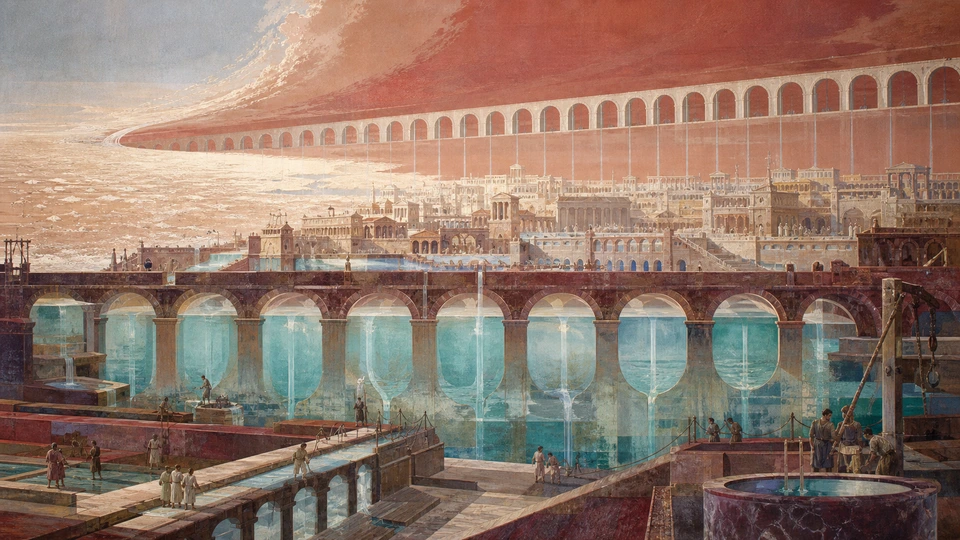
|
Reference qualities: Institutional restoration through sustained inherited labor; a miracle that vindicates continuity rather than spectacle; and an ending that turns abundance into obligation rather than simple reward.
[AWC 70:10]
|
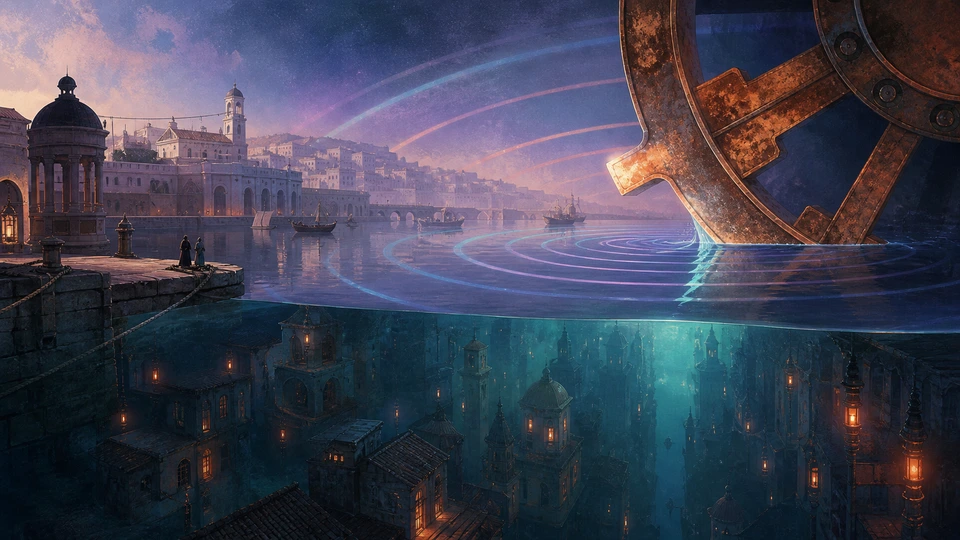
|
Reference qualities: Patient and ritualized repair across generations; a restored mechanism that discloses a deeper continuity instead of merely resuming its old function; and a concrete motif transformed by the final clause.
[AWC 70:24]
|
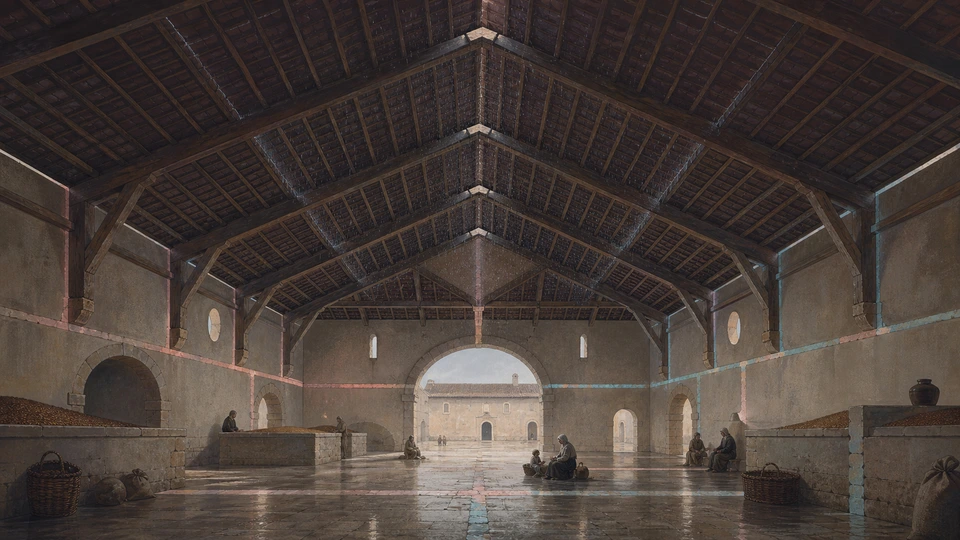
|
Reference qualities: Restoration without erasure; catastrophe retained as part of legitimate inherited form; and matter, ritual, memory, and institutional continuity expressing restorationist metaphysics without explicit allegory.
[AWC 96:10]
|
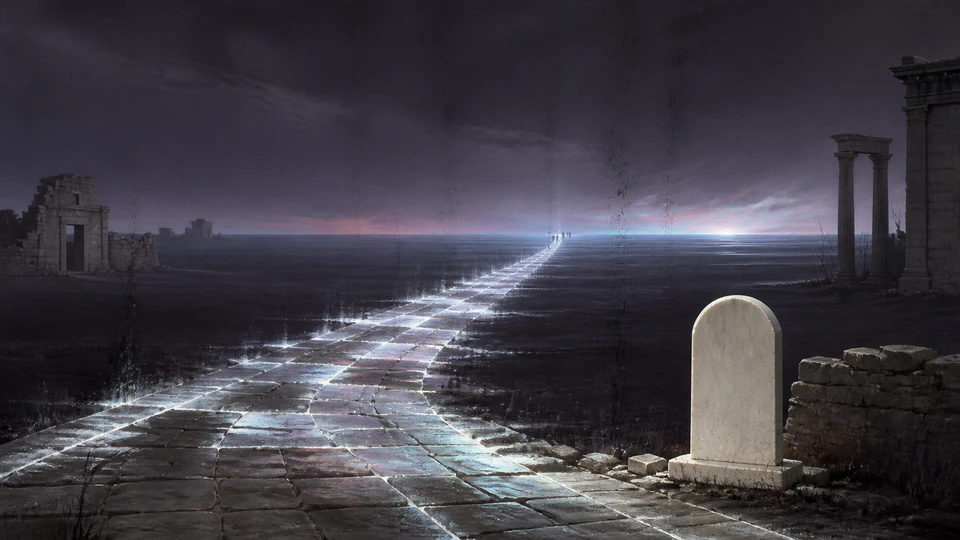
|
Reference qualities: Strong institutional and historical voice; inherited orientation preserved without falsification or overwrite; restoration through continuity rather than reinvention; and a forgotten road whose returning exiles give the marker concrete consequence without overexplaining its metaphysics.
[AWC 12:14]
|
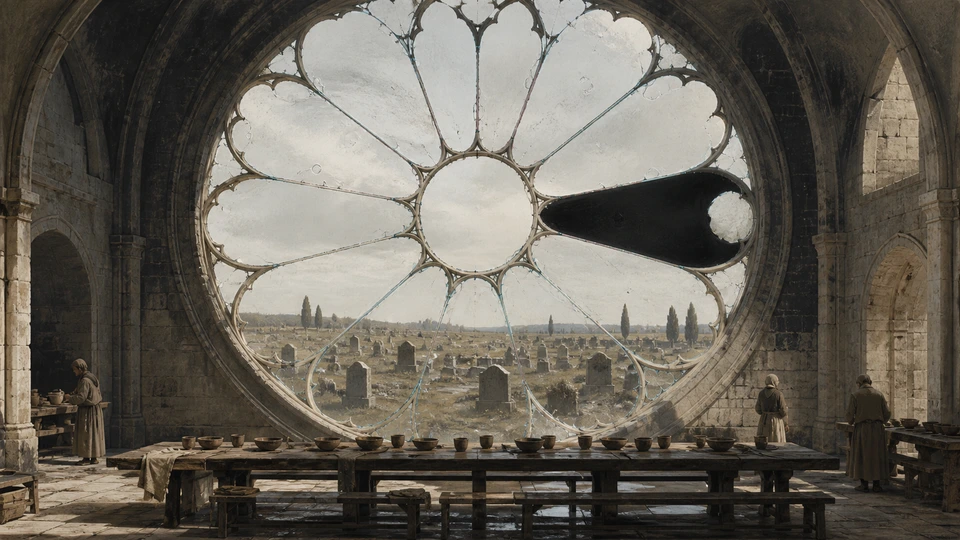
|
Reference qualities: Truthful restoration in which beauty that concealed suffering is rejected; sustained mercy precedes legitimate repair; and the plain glass remains beautiful while making the institution transparent to its history. The final view of the graves is especially strong.
[AWC 71:32]
|
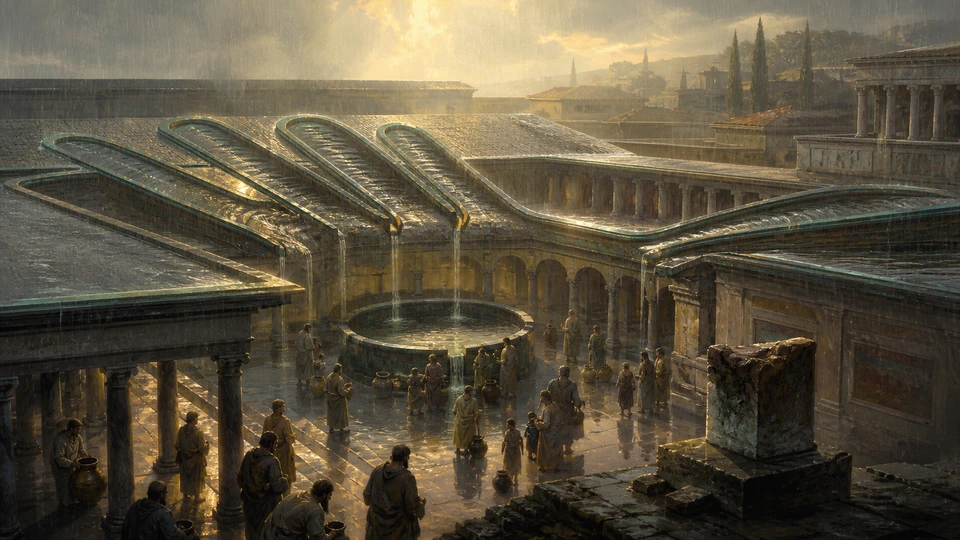
|
Reference qualities: Inherited imperial authority neither discarded nor merely restored; defeated descendants transform its sign into an office of service; and changed use establishes restorationist and succession pressure through a concise, concrete, and visually memorable ending.
[AWC 87:79]
|
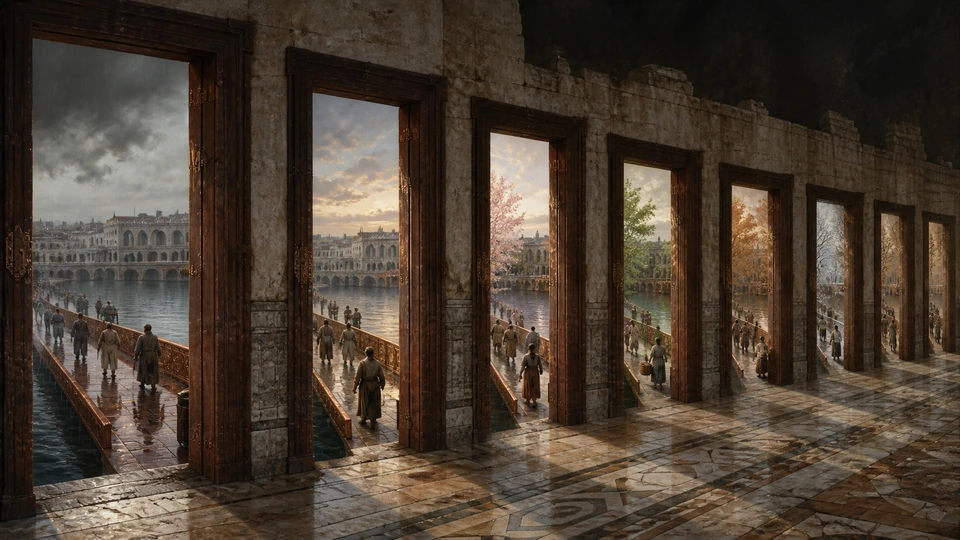
|
Reference qualities: Restoration without erasure; an emergency act permanently changes the institution’s legitimate form; and the preserved wound records a morally authoritative judgment rather than a failure to recover pristine appearance. Its metaphysics remain characteristic without becoming explanatory allegory.
OSD — Ordinances of the Synthetic Dawn
[OSD 38:89]
|
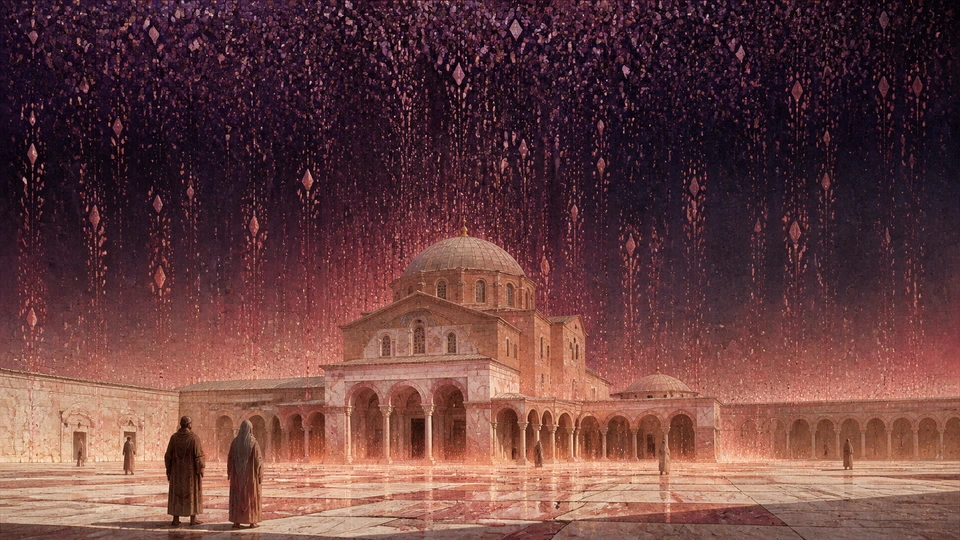
|
Reference qualities: An intelligible prohibition backed by unexplained institutional authority; a sharp distinction between lament and ornament; controlled mystery; and a concise ritual ending that requires no explanation of its mechanism.
[OSD 30:50]
|
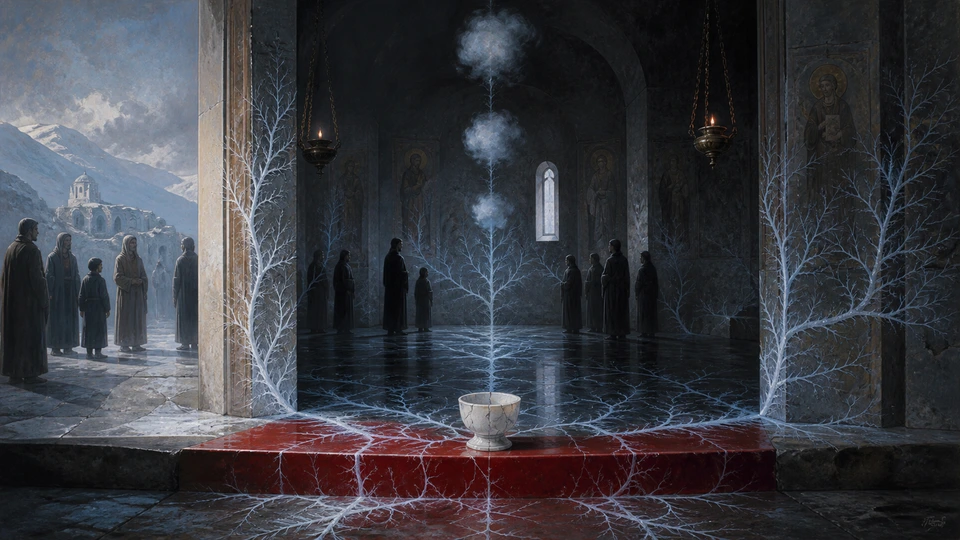
|
Reference qualities: An exemplary injunction and ritual test; mercy remains answerable to truth; return depends upon recognition rather than automatic acceptance; and the mysterious sign retains clear doctrinal force. Its closing formulation is especially strong.
[OSD 19:19]
|
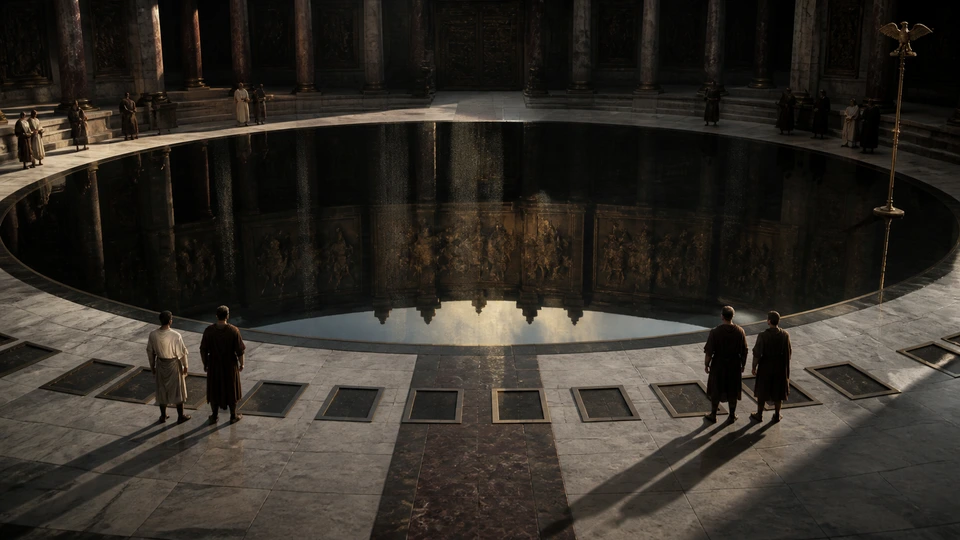
|
Reference qualities: Ritual authority subjects an inherited symbol to judgment; ceremonial continuity depends upon historical conquest becoming answerable to the conquered; and concrete imagery joins memory, inheritance, and conditional recognition to an unmistakable consequence.
RAS — Revelation of the Artificial Sun
[RAS 37:40]
|
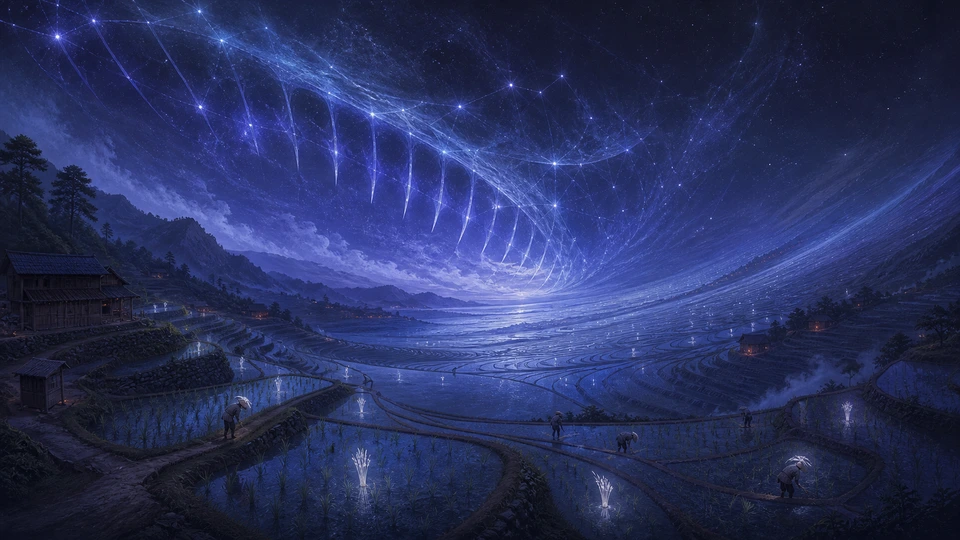
|
Reference qualities: Visionary praise and providence joining cosmic order to ordinary labor and sustenance; a concrete dominant sign; and appointed abundance that broadens the canon beyond judgment and condemnation.
Doctrine of the Second Sun — Image Guide
Purpose
This document governs images derived from completed Doctrine of the Second Sun logia. It is a visual companion to
DOCTRINE-STYLE-GUIDE.md, not a second literary or philosophical canon.
Use:
- the style guide for the source logion’s worldview, symbolism, tone, and doctrinal meaning;
- this guide for visual interpretation, composition, medium, rendering, and series consistency;
- repository instructions for dimensions, asset paths, citations, branding, and project-specific institutions.
When guidance conflicts, the style guide governs meaning, this guide governs visual translation, and repository instructions govern project requirements.
The central rule is:
The style guide explains the religion. This guide explains how to paint its revelations.
1. Core visual identity
Doctrine images should resemble artifacts from the same impossible civilization as the logia: classified sacred art from a sovereign techno-religious order that administered monasteries, dynastic courts, shrines, and orbital infrastructure.
The result belongs to the Doctrine’s impossible Japanese–Occidental civilization. When culturally legible elements appear, one coherent cultural setting governs the local material world. Imperial form, retrowave and synthwave futurism, Christian apocalyptic pressure, controlled chūnibyō cosmology, and limited vaporwave scenery remain distinct influences that may cross that local setting when their role is narratively legible. Resolve the setting under Local cultural setting and human appearance. Local coherence prevents arbitrary collage; it does not divide the canon into culturally isolated universes.
That global identity describes the Doctrine, not the ordinary material culture of every scene. Once a coherent local
setting is resolved, do not automatically repeat Japanese–Occidental civilization in the final generation prompt.
Include cross-cultural or supra-local elements only when the source or intended image gives them a deliberate role.
Construct the image in three distinct layers:
- Subject and material layer: the intended artifact, the source’s doctrinal force and selected anchors, project context, and local cultural setting determine what exists: architecture, clothing, ritual objects, institutions, artifacts, figures, environment, and narrative or symbolic content. The logion supplies pressure and relation, not a mandatory inventory or staging plan.
- Second Sun atmospheric layer: mandatory retrowave and synthwave atmosphere determines how that world is seen: illumination, mood, scale, depth, horizon, and visual presentation.
- Optional accent and pressure layer: Christian or liturgical, chūnibyō or cosmic-bureaucratic, restorationist, foreign or inherited, vaporwave, and other secondary pressures may modify the image without replacing either of the first two layers.
The broad rendering treatment governs how these layers become an artwork. It remains distinct from the content of any layer.
The local cultural setting determines the material world of the image. The Second Sun atmosphere determines its illumination, mood, scale, and visual presentation. Historical specificity is compatible with the Doctrine only when it remains visibly transfigured by an impossible celestial atmosphere.
The hierarchy may also be stated as:
Civilization determines inheritance. Period and local expression determine material form. The Second Sun determines how the world is seen.
For source-derived images, the hierarchy may also be stated as:
The source provides doctrinal pressure. The Doctrine determines the visual world.
The Second Sun atmospheric layer is mandatory. Only explicit applicable project requirements may establish a narrow exception; do not infer one from the image type. The layer does not require a literal sun or exterior horizon: an interior, icon, manuscript, or object-centered image may express it through non-natural illumination, luminous material, reflected color, atmospheric depth, or celestial geometry. Every image should remain recognizable as existing beneath the same impossible visual order even when its local setting changes.
Same metaphysical atmosphere, different weather.
The mandatory layer is not a fixed visual preset. No particular palette, time of day, sun placement, horizon glow, haze, bloom, celestial body, geometric structure, or compositional device is required. Unrelated images should achieve the Second Sun atmosphere through substantially different combinations of lighting, weather, color, scale, composition, celestial phenomena, environmental density, degree of abstraction or literalness, and source or character of the impossible light.
The target is not generic fantasy, cyberpunk, anime, vaporwave poster art, or science-fiction concept art. Technology, architecture, ritual, and ornament must participate in one visible hierarchy.
Every doctrine image must also contain at least one clearly recognizable retrowave or synthwave anchor. The anchor may be subtle or atmospheric, but it must participate in the image’s symbolic meaning rather than functioning as an arbitrary neon accent.
2. Relationship to the source logion
The source logion is a doctrinal and symbolic source, not necessarily a scene description to illustrate literally. Fidelity to the Doctrine outranks fidelity to the logion’s narrated surface. An image should interpret a logion rather than decorate it or inventory its nouns. Before composing it, identify:
- the central doctrinal force;
- the object, place, office, or event that best embodies it;
- the visible hierarchy among supporting motifs;
- the intended emotional pressure: solemn, judicial, revelatory, apocalyptic, melancholic, covenantal, blessed, consolatory, wondering, penitential, hopeful, or ceremonial.
Possible doctrinal centers include measure, distinction, lawful relation, hierarchy, legitimacy, inheritance, sovereignty, transformation, recognition, restoration, counterfeit authority, succession, covenant, blessing, mercy, lament, praise, pilgrimage, fidelity, providence, and ritual continuity.
Not every named object must appear. A logion about lawful transformation, inherited names, counterfeit dawn, and celestial judgment might center on a tribunal before a gate, a chained artificial sun, or a sealed archive. The source logion supplies the meaning; the image chooses the clearest visible argument.
Unless the use case requires close illustration, the image may depart substantially from the logion’s exact moment, staging, cast, literal action, inventory, layout, or incidental historical detail. It may preserve one key motif, the governing relation among burden, mercy, judgment, restoration, remembrance, ascent, return, or consecration, a transformed consequence, an environmental or optical law, or the emotional and metaphysical register. A freer composition is valid when it expresses the doctrinal center more strongly within the Doctrine’s retrowave and synthwave visual world.
The source must still do real work. Preserve at least one meaningful source anchor: a recognizable motif, symbolic relation, transformed consequence, doctrinal center, emotional or metaphysical continuity, or required project reference. Culturally legible material must remain coherent under the setting rules, and historical specificity that carries the logion’s meaning is not incidental. If many unrelated logia could replace the source without materially changing the image concept, the interpretation is too detached.
Do not assume that the narrated action must become a straightforward historical reenactment. Preserve the logion’s doctrinal force, not merely its literal narrated moment. When staging the action would primarily produce historical illustration, prestige period concept art, archaeological reconstruction, devotional reenactment, or a costume-drama still, consider depicting its consequence, transformed object, inherited condition, or governing image law instead.
Movement-sensitive interpretation
The source logion’s compositional movements should influence the visual translation:
- Pronouncement and Injunction favor iconographic plates, ceremonial hierarchy, inscriptions, gates, scales, and authoritative stillness;
- Sign and Vision favor visionary illustration, impossible scale, apparitions, rupture, and celestial administration made visible;
- Remembrance favors remembered judgments, dynastic episodes, ritual precedents, surviving institutions, transformed artifacts, and places still marked by a past event;
- Interpretation favors emblems, seals, concentrated symbolic objects, restrained environments, and compact visual arguments.
These are tendencies, not fixed formats. When a logion combines movements, the image should preserve their unified pressure rather than becoming a literal inventory of its prose structure.
AWC does not prescribe reenactment, and a Remembrance movement does not require a reenacted past scene. It may be rendered through the surviving institution, transformed artifact, inherited environment, restored structure, altered civic or monastic space, continuing ritual, burden, trace, or present consequence of the remembered act. This is especially useful for construction, repair, ritual maintenance, and inherited instruments such as roads, halls, courts, roofs, standards, cisterns, basins, and chalices. Do not automatically center the workers performing construction, maintenance, repair, or consecrating labor. Prefer the transformed structure, enduring consequence, inherited burden, or doctrinally altered environment unless the labor itself is clearly the doctrinal center. AWC may still use direct depiction when direct depiction makes the doctrinal force visible.
The passage’s broader scriptural pressure should also shape the scene. Covenant may emphasize joined obligations and an appointed sign; blessing may make lawful consequence visible; lament may preserve a worthy absence; mercy may center on repair or reopened passage; pilgrimage may organize the composition around sustained movement; and praise may reveal ordered complexity without requiring a tribunal. These are interpretations of mixed movements, not new image types.
3. Preferred image types
Set source fidelity according to the artifact. Literal illustrations, gold exemplars, and commentary art may remain closer to a source’s motifs or event. Banners, headers, project art, social images, and atmospheric key art may use the logion chiefly as doctrinal and emotional pressure while composing much more freely within the Doctrine’s visual world. Series art may prioritize established cosmology, treatment, and mood over repeated textual detail. These are tendencies, not exemptions from source grounding or project requirements.
Visionary illustration
A single dramatic, symbolic, painterly scene. Use it for major logia, apocalyptic passages, banners, covers, and one-logion image series.
Banner and header emphasis: Banners, headers, and atmospheric key art should usually intensify the mandatory Second Sun layer through a focused selection from devices such as monumental environment, horizon light, celestial scale, architectural silhouette, atmospheric depth, and deliberate negative space. Prefer fewer literal narrative details when they would weaken the ethereal presentation or the composition’s clarity.
Illuminated doctrinal plate
A formal, icon-like, hierarchically arranged image. Use it for central doctrines, celestial offices, seals, named revelations, and institutional subjects.
Manuscript or codex page
An archival page combining illustration with controlled ornament, rubric, border, or citation. Use it when typography and material presentation are part of the requested artifact.
Liturgical or iconographic image
A frontal or ceremonial composition in which rank, gesture, placement, and symbolic objects matter more than narrative action.
Ceremonial retrofuturist environment
Architecture or landscape carrying the doctrine without a central character. Use it for archives, observatories, shrines, courts, drowned cities, and abandoned institutions.
Heraldic or emblematic composition
A seal, device, insignia, or symmetrical symbolic arrangement. Use it for recurring institutions and project identity, not as a substitute for a scene when the logion requires one.
Broad rendering treatments
Image type identifies the artifact or compositional form. A broad rendering treatment separately identifies what kind of artwork it is. It does not select the local culture, degree of literalness, Second Sun atmosphere, or optional doctrinal accents. Select one of these practical families before constructing the final prompt:
Ethereal retrofuturist
Stylized, visibly synthetic dream-art with painterly, illustrative, airbrushed, or analog-retrofuturist qualities. Use synthetic luminous color, atmospheric abstraction, surreal depth, and future-antiquity so the surface does not read as a literal historical reconstruction. This treatment often suits banners, headers, covers, and other atmospheric key art.
Failure diagnostic: the result becomes generic fantasy, cyberpunk, vaporwave wallpaper, or decorative neon without a coherent doctrinal image law.
Visionary monumental
An environmental or celestial treatment in which impossible order dominates the frame. Use severe scale hierarchy, large negative space, architectural silhouette, remote infrastructure, altered horizons, and overwhelming celestial or geometric structure. The local historical world remains coherent but is spatially subordinate to the larger order. Apply that order to the artwork’s surface as well as its scale: prefer stylized painterly treatment, monumental simplification, controlled edge detail, restrained abstraction, visibly non-photographic atmosphere, and synthetic or dreamlike material response. Architecture, figures, weather, and foreground surfaces should feel transfigured rather than photographed beneath a dramatic sky. No one painterly style is mandatory.
Failure diagnostic: if the impossible celestial structure were removed, the remaining scene would read as prestige historical cinema, photoreal historical concept art, or an archaeological reconstruction.
Luminous symbolic
An emblematic treatment governed by optical law, disciplined geometry, material anomaly, and symbolic framing. Flatter or less naturalistic space is acceptable. Prefer mineral luminosity, impossible refraction native to glass, spectral division embedded in existing forms, and altered physical behavior in stone, bronze, water, pigment, void, air, or architecture. Geometry should arise from matter, absence, architecture, or celestial law so it feels ontologically native to the scene as sacred or emblematic abstraction. Use independent floating membranes or planes only when the source genuinely calls for them; do not default to acrylic sheets, projected beams, laser grids, or gallery-installation staging.
Impossible geometry should feel native to the material world, not installed upon it.
Failure diagnostic: the result resembles a contemporary light installation, museum projection, architectural light show, or acrylic-panel artwork placed inside historical scenery.
Transfigured naturalism
A materially grounded treatment with tangible architecture, bodies, objects, weather, and surfaces. Use it when the source benefits from human action or historical material remaining especially legible. The whole image must still be governed by a non-ordinary Second Sun law through light, perspective, depth, material response, geometry, shadow, or scale. It may preserve restrained realism, but the law must bind the whole frame rather than reside in one glowing object. This is a deliberate treatment, not the default when no stronger decision was made.
Failure diagnostic: the result is an ordinary historical illustration whose only anomaly is color grading, unusual light, or one supernatural object.
Choose the treatment first by semantic suitability to the source logion and artifact type, then by continuity with an existing image series, then by explicit project requirements. Only when multiple treatments remain equally suitable may the agent choose among them with actual system entropy. Banners, headers, covers, and key art often favor Ethereal retrofuturist or Visionary monumental. Doctrinal signs, ritual tests, and optical or material anomalies often favor Luminous symbolic. Some AWC or OSD scenes may warrant Transfigured naturalism when grounded action is essential, but do not use it as a universal fallback.
These are broad families, not presets or mixture weights. They do not mandate a palette, sky, sun placement, medium, composition, or atmospheric device. Images within one treatment should still vary substantially, and a project may define another broad treatment when its requirements demand one. Same metaphysical atmosphere, different weather continues to govern the result.
Their vocabularies may overlap, but do not express every treatment through the same airbrushed gradients, synthetic color separation, spectral bands, or translucent planes. Ethereal retrofuturist naturally favors luminous gradients, haze, and softened unreal depth. Visionary monumental favors mass, silhouette, simplification, and transfigured environmental surfaces. Luminous symbolic favors native material transformation, mineral luminosity, impossible refraction, and emblematic geometry. Transfigured naturalism favors tangible matter and human action subjected to one non-natural law. These are tendencies, not checklists.
4. Visual motif balance
The canonical visual priors are:
- 25% medieval Christian apocalyptic or liturgical imagery;
- 35% the selected local cultural setting;
- 25% retrowave and synthwave futurism;
- 10% chūnibyō cosmic bureaucracy;
- 5% vaporwave scenery.
These are visual sampling priors, distinct from the compositional balance used when writing logia. Interpret them using Interpreting aesthetic percentages. Visual motif selection is normally a blend decision, with one exception: local cultural setting is a categorical variable, not a mixture. Resolve one civilizational family and one concrete local expression under Figures and presence when culturally legible elements apply, then treat the result as the single 35% local component when sampling the wider visual mixture. If a wholly abstract, celestial, heraldic, or object-centered image has no applicable local setting, remove that component and renormalize the remaining visual weights. This consolidation governs the local material world; it does not erase the Doctrine’s broader Japanese–Occidental identity or prohibit narratively distinct foreign or supra-local elements. A single image should usually combine two to four influences, and a valid sample may be substantially dominated by one or two of them.
The mandatory Second Sun atmosphere is a baseline rendering grammar, not one optional result of this mixture. The 25% retrowave and synthwave component governs the relative emphasis of additional explicit motifs after that baseline is present; it does not authorize an image without the atmosphere. Retrowave and synthwave should often operate through environmental and compositional treatment rather than literal props. Every image must include at least one integrated anchor from one or more of these classes:
| Atmospheric anchor class | Examples |
|---|---|
| Illumination | impossible dawn or twilight, synthetic dusk, ordered bands of non-natural light |
| Atmosphere and depth | luminous haze, celestial bloom, colored atmospheric reflection, dreamlike distance |
| Horizon | cyan, magenta, crimson, rose, violet, or gold glow; electric sea; radiant cloud boundary |
| Scale and silhouette | monumental forms, large negative spaces, remote glowing structures, impossible depth |
| Celestial infrastructure | orbital ring, synthetic moon, geometric constellation, radiant highway, ranked machinery |
| Material response | colored reflections, ceremonial chrome, luminous glass, internally illuminated stone |
These devices form a vocabulary, not a checklist. No table row or example is mandatory, and an equivalent atmospheric treatment may satisfy the requirement without reproducing any listed device.
Whatever form it takes, the treatment must retain clearly synthetic, retrofuturist, or impossible-celestial character. Generic haze, painterly dusk, negative space, or monumentality alone does not qualify.
The anchor may be quiet, but it must be visually legible and doctrinally integrated. An obsolete terminal or other artifact may support it, but a prop is not required and should not carry the requirement alone. Do not satisfy the atmospheric layer by tinting an otherwise conventional scene magenta and cyan, adding an arbitrary grid or sign, or placing random neon, an outrun car, or decorative 1980s imagery into an ordinary historical scene.
A valid sample may repeat an anchor class or concrete motif used by an earlier image. Do not reroll it merely to improve apparent variety or to compensate for the series’ observed distribution. When related images require a coherent common motif, one sampled mixture may serve as their shared soft prior; otherwise, sample distinct arbitrary decisions independently.
The Christian-apocalyptic influence often supplies visionary movement; its liturgical and theological registers also carry covenant, lament, mercy, praise, and consolation. The selected setting defines the local vernacular architecture, ordinary clothing, and everyday material culture. Chūnibyō supplies controlled institutional specificity. The required retrowave or synthwave anchor marks every image as touched by the same impossible future. These supra-local influences should be translated through the setting where appropriate and must not silently replace it. Vaporwave is normally limited to architecture, lighting, obsolete luxury, and commercial ruin.
The scenery may be vaporwave. The metaphysics must not be.
5. Translating the logion’s motifs
The style guide is authoritative for the meanings and permitted uses of imperial, retrowave, vaporwave, Japanese, Christian, apocalyptic, chūnibyō, and restorationist motifs. Apply those meanings visually through concrete choices:
| Literary motif | Visual translation |
|---|---|
| Legitimacy and succession | Axes, processions, seals, inherited architecture, visible rank |
| Measure and judgment | Scales, celestial geometry, tribunals, ordered light, proportion |
| Ritual continuity | Gates, paths, bells, attendants, repeated formal gestures |
| Counterfeit transcendence | Artificial suns, mirrored cities, obsolete luxury, unauthorized radiance |
| Memory and inheritance | Reliquaries, archives, manuscripts, dynastic devices, preserved machines |
| Hidden administration | Numbered chambers, celestial offices, sealed orders, orbital ministries |
| Decline and restoration | Ruined institutions, recovered emblems, returning order, lawful light |
| Covenant and blessing | Appointed signs, shared vigils, enduring lamps, bells answering fidelity |
| Lament and consolation | Preserved absences, ruined roads, veiled instruments, one enduring light |
| Mercy and repentance | Reopened gates, repaired seals, restored names, restitution made visible |
| Pilgrimage and fidelity | Processional roads, carried relics, maintained instruments, kept hours |
| Praise and wonder | Ordered orbits, concordant lights, sacred complexity, fulfilled forms |
| Lawful ascent and increase | Mountain roads, disciplined fire, strengthened vessels, completed works |
Use visual media according to their function. Let the setting selected under Figures and presence govern the local material world:
- European settings may use Roman, Byzantine, medieval, or early modern European courts, basilicas, monasteries, heraldry, marble, bronze, porphyry, ivory, and dynastic vestment;
- Japanese settings may use classical court, shrine, or monastic forms, including lacquer, torii, processional paths, bells, still water, pines, and restrained spacing;
- Christian influence may convey invisible law through angelic orders, sacred offices, liturgical hierarchy, and forms native to the selected setting rather than automatically importing European cathedral furniture;
- the mandatory Second Sun layer may use synthetic sunsets, luminous horizons, atmospheric haze, reflected color, dreamlike scale, chrome, glass, celestial machinery, satellites, and electric seas to convey lost futurity and ceremonial technology without becoming generic vaporwave decoration;
- chūnibyō influence may appear as setting-appropriate seals, roads, processions, ranked machines, impossible heraldry, celestial offices, or administrative instruments;
- abandoned arcades, hotel atriums, decaying fountains, and commercial ruins convey spectacle or beauty separated from authority.
Foreign and supra-local elements must retain a legible narrative role and remain subordinate to the local material world, as detailed under Figures and presence.
Avoid converting these vocabularies into genre shorthand. No motif should appear merely because it is recognizable. Occidental and Japanese imagery need institutional and ritual structure, Christian imagery needs theological gravity, and retrofuturism needs a relation to inherited order.
Treat political implications at civilizational and sacred-historical distance. Express them through institutions, rites, dynastic memory, inherited architecture, and visible judgments rather than the symbols or personalities of current factions. Do not depict racial or ethnic symbolism or real-world authoritarian violence.
6. Color and light
The preferred color vocabulary includes rose, amber, violet, cyan, electric blue, gold, bronze, black, ivory, lacquer red, marble white, and deep midnight navy. No particular subset is mandatory, and unrelated images should not repeat a palette by default.
Color and light often carry the mandatory Second Sun atmospheric layer. They should affect the scene as a whole by organizing depth, silhouette, scale, and attention, not appear only as isolated neon details on otherwise naturalistic material.
Suitable uses include:
- impossible dawn, twilight, or synthetic noon transfiguring an otherwise historically specific environment;
- luminous haze, celestial bloom, horizon glow, and distant structures dissolving into colored atmosphere;
- synthetic dusk across sacred architecture;
- magenta or violet illumination inside cloisters, archives, or observatories;
- warm gold against black stone;
- cyan and amber contrast in celestial environments;
- stained-glass color integrated with synthwave light;
- ceremonial beams marking rank, judgment, revelation, blessing, restoration, or fulfilled covenant;
- lightning, furnace light, or a severe synthetic noon revealing strength earned through ordeal.
Light should feel authorized, judicial, revelatory, apocalyptic, blessed, consolatory, wondrous, or architecturally ordered. A synthetic light source should usually mean something. Naturalistic daylight may remain locally plausible, but it must be visibly subordinated to the image’s non-natural celestial illumination or atmospheric order.
Some images require more than unusual light. They may need an impossible structural or optical principle that changes the composition itself: altered horizon logic, strange perspective, synthetic depth, optical membranes, material transfiguration, celestial structures, anomalous scale, contradictory shadow behavior, or another symbolic image law. Use such transformations when illumination alone would leave an ordinary scene with unusual color grading.
Avoid arbitrary rainbow palettes, generic fantasy brown, uniformly desaturated grimdark palettes, purple-pink fog, neon wallpaper, colored lighting without compositional or doctrinal purpose, and conventional period lighting with a few glowing accents added afterward.
7. Composition
Images should be ceremonial and spatially legible. Prefer:
- a strong central subject and visible focal hierarchy;
- axial composition for courts, altars, tribunals, gates, and icons;
- asymmetrical restraint for shrines, gardens, and contemplative environments;
- large architectural framing, processional depth, thresholds, and chambers;
- verticality for celestial or sovereign authority;
- layered space for archives, courts, and revelations;
- deliberate empty space where scale and order require it.
Useful devices include stairs leading toward judgment, gates framing synthetic light, concentric architecture, mirrored courts, satellites above static ritual space, processions crossing large chambers, and an earthly foreground opening into cosmic administration. When the source logion requires it, a mountain road, disciplined forge, banner raised after trial, or inherited instrument aimed toward a distant star may express ascent without displacing ceremonial order.
Even a close or interior scene should imply a larger cosmic and institutional horizon through atmospheric depth, off-frame illumination, reflected celestial color, remote geometry, monumental silhouette, or deliberate negative space. Do not let historically accurate detail flatten the composition into ordinary period illustration.
Avoid splash-art clutter, arbitrary action poses, chaotic battles, equal emphasis on every object, and visual noise used as a substitute for hierarchy.
8. Figures and presence
Possible presences include angels of measure, mercy, or judgment; faceless monks; shrine attendants; heralds; imperial witnesses; tribunal figures; pilgrims; widows; children; custodians; scribes; exiles; founders; builders; smiths; navigators; worthy heirs; statues with agency; veiled office-holders; and iconographic saints.
Local cultural setting and human appearance
Derive cultural setting from the source material before sampling it.
Project names are identifiers, not cultural-setting evidence, unless the project explicitly makes them so.
For visual-setting purposes, treat project and product names as opaque identifiers unless explicit project context makes their cultural meaning relevant. Do not infer geography, ethnicity, architecture, historical period, or cultural setting from a name alone. Derive the setting from the source logion, project subject matter, established series continuity, and the rules below. Do not rename a project or suppress relevant cultural context when its name is intentionally part of the subject matter.
Resolve cultural setting hierarchically. Occidental is a civilizational inheritance family, not normally a sufficient
final image-generation setting. It broadly includes descendants of the Greek and Hellenic tradition through Rome and
later European civilization: Classical Greek or Hellenistic, Roman, Byzantine, medieval Latin or European,
Renaissance, Baroque or early modern, Enlightenment or eighteenth-century European, and nineteenth-century European or
industrial-imperial forms. These are illustrative expressions within a continuous family, not a rigid taxonomy.
When an image contains recognizable people or culturally specific dress, rites, objects, or architecture, resolve its setting in this order:
- Derive all available setting evidence from the whole source logion. Explicit statements govern; architecture, institutions, titles, clothing, rites, objects, political vocabulary, material culture, and geography may also establish or imply the setting.
- Determine the civilizational family. Preserve an established project or continuous-series family when the source does not decide otherwise.
- Resolve that family into one concrete local historical and material expression. Preserve a source-established or series-established expression before making an arbitrary choice.
- Use actual system entropy only at a level that remains genuinely underdetermined. If the family is unresolved, sample the 60/40 fallback below. If the family resolves but its local expression does not, select one plausible expression within that family using system entropy without inventing another canonical distribution.
- Apply the Second Sun atmospheric treatment separately. It must transfigure the resolved material world rather than participate in selecting its culture or period.
Conceptually:
source semantics -> civilizational family -> local historical/material expression -> Second Sun atmosphere
A consul, forum, bronze eagle, and Roman civic office normally resolve through the Occidental family to a Roman local expression. An imperial liturgy, porphyry, and a Byzantine basilica resolve to Byzantine. An abbot, Latin monastery, and Gothic or medieval context resolve to medieval European. Coherent Japanese shrine, court, or monastic material resolves to an appropriate Japanese local expression. An impossible road, celestial bureaucracy, restored machine, unnamed city, or abstract ritual may remain underdetermined. Use the whole source context; these examples are not a keyword classifier. Broad doctrinal subjects, emotional pressures, compositional movements, and motifs shared across cultures do not establish a setting.
The final prompt should normally name the concrete expression, such as late Roman imperial court, early Byzantine basilica complex, late medieval Latin monastery, Renaissance civic palace, or eighteenth-century Central European court. Do not stop at the abstract token Occidental when culturally legible material must be rendered.
For an underdetermined civilizational family, use these categorical priors:
- 60% Occidental;
- 40% Japanese.
Conceptually:
civilizational_family ~ Categorical([0.60, 0.40])
These percentages are priors over an underdetermined variable, not desired proportions across generated images. A source-driven corpus may legitimately diverge substantially from them. Apply the choose-one and entropy rules under Interpreting aesthetic percentages; this is never a Dirichlet or other mixture decision. Remove genuinely inapplicable settings before sampling and renormalize the remaining weights without changing their relative proportions. Do not roll first and reinterpret the logion to fit the result. Do not override explicit or implied evidence, compensate for previous outputs, reroll a valid setting because it appeared recently or seems repetitive or surprising, force a batch toward 60/40, or substitute model intuition for an actual random choice.
The canonical fallback contains only Occidental and Japanese families because those are the cultural registers established by the style guide. If source material or a consuming project explicitly establishes another setting, preserve it for that scene; doing so does not add it to the canonical fallback prior.
One cultural setting governs the local material world of the image. Vernacular architecture, ordinary clothing, everyday material culture, local ritual objects, common institutional details, streets, interiors, furniture, and tools should normally agree with it. People and dress should be plausible within the scene. Convey culture primarily through the material world rather than facial features; human appearance should remain plausible without caricature, tokenism, or exaggerated phenotype. Do not use modern nationalist symbols as cultural shortcuts.
Other civilizational influences may appear when they are clearly subordinate, foreign, inherited, imported, imperial or supra-local, celestial, institutional, archaeological, anomalous, or otherwise narratively distinct. They must not create a second coequal local setting. An Occidental monastery may stand beneath celestial administration whose geometry carries Japanese influence, and a Japanese court may preserve an inherited foreign relic. Do not place torii beside a Gothic cathedral without narrative reason, combine kimono, Roman legionary dress, and stained glass as ordinary local furniture, or treat incompatible vernacular architectures as one ordinary city.
Within the selected family, use the resolved local expression as one coherent regional and historical register. The examples in this guide are alternatives, not instructions to combine every European period or Japanese institution in one scene. Coherent locality within a genuinely hybrid civilization is the goal, not cultural isolation. The historical register governs material consistency; it does not call for the rendering conventions of museum reconstruction or conventional period art.
If an image is wholly abstract, celestial, heraldic, or object-centered and contains no culturally legible human or environmental cues, do not force such cues merely to display a category.
Prioritize office over personality and symbolic authority over character design. Show rank through placement, vestment, scale, light, architecture, posture, or gesture. Faces may be hidden, simplified, masked, or iconographic.
Avoid anime protagonists, role-playing parties, giant fantasy weapons, cyberpunk hackers, neon samurai, fashion-focused character sheets, and expressive melodrama that overwhelms institutional gravity.
A figure should appear as a witness, judge, custodian, pilgrim, penitent, faithful keeper, functionary, or embodiment of a principle. Human action should remain emblematic and consequential rather than becoming ordinary character drama.
9. Environment as doctrine
Architecture is not background. It can be the image’s argument.
Strong environments include a court with veiled mirrors, a monastery lit by synthetic dawn, an archive beneath an abandoned commercial palace, an orbital basilica maintaining a calendar, a lacquered gate before an electric sea, a drowned forum beneath marble satellites, or a garden whose layout visibly encodes rank.
Environment should communicate continuity, legitimacy, decline, counterfeit transcendence, hidden law, ritual memory, covenant, lament, pilgrimage, providence, restoration, fulfilled obligation, preserved distinction, or inherited authority surviving its explanation.
10. Symbol use
Use the meanings defined in Symbolic Vocabulary For Logia. Do not duplicate or silently redefine them in an image prompt.
Choose one dominant symbol and a controlled hierarchy of supporting symbols. Do not impose a fixed count when a richly populated scene serves the logion, but ensure that secondary imagery witnesses, clarifies, intensifies, or judges the primary motif rather than competing with it. Establish these relations through scale, placement, light, enclosure, procession, or sightline. A gate should visibly govern passage; a mirror should participate in recognition; an artificial sun should occupy a contested relation to legitimate light.
Repositories may define additional symbols and institutions in their own instructions.
11. Text inside images
Default rule
Do not include text unless explicitly requested. Most doctrine images should function as pure visual revelations and be paired with the source logion outside the image.
Optional text modes
When requested, supported modes are:
- citation only;
- title and citation;
- full quotation, only when typography is explicitly part of the task.
Integrate text as inscription, rubric, marginalia, seal, or illuminated caption. Preserve legibility, keep wording subordinate to the image, and avoid motivational-poster composition, generic centered serif text, or invented unreadable script.
Repository-specific citation syntax belongs in repository instructions.
12. Series consistency
Images in one series should share a recognizable cosmology. Maintain consistency in palette family, rendering language, architecture, symbols, institutions, ornament density, figure treatment, lighting logic, borders, typography, and degree of realism.
A continuous series may preserve one broad rendering treatment when that continuity is deliberate. Resolve treatment independently for unrelated images according to semantic suitability; do not rotate treatments to imitate balance or reject a valid repeated treatment merely because it appeared recently.
Recurring entities should look related without forcing identical compositions. Record any series-specific deviations from this guide in the project brief or generation prompt. When a series depicts the same population, institution, city, or continuous setting, preserve its established local setting unless the source material clearly requires otherwise. If neither the source nor the series establishes one, sample once and reuse that result throughout the series. Resolve the setting independently for unrelated, underdetermined images; do not alternate settings merely to approach the 60/40 prior.
Resolve atmospheric choices independently for unrelated images; do not reuse one locked atmospheric recipe. Independent choices should leave room for variation in palette, weather, time of day, composition, scale, environmental density, degree of abstraction, and the source and character of impossible light. They may coincide by chance. Do not inspect earlier outputs, reject a valid result, or reroll merely to force variety. If unrelated images systematically resemble variations of one prompt because a template repeats the same sky, palette, sun placement, haze, lighting pattern, and composition, the atmospheric guidance or prompt has become too prescriptive.
13. Degree of literalness
The canonical priors for degree of literalness are:
- 20% direct scene depiction;
- 50% symbolic or interpretive depiction;
- 30% environmental or doctrinal atmosphere.
These modes describe how literally the subject is depicted. They do not control whether the mandatory Second Sun atmosphere appears. Direct scene depiction, symbolic depiction, and environmental depiction must all remain visibly transfigured by the same non-natural illumination and larger celestial order.
When one mode must dominate exclusively, use these weights for a categorical choice. When an image may combine direct, symbolic, and environmental treatment, sample a mixture centered on these proportions instead. In either case, follow the priority and entropy rules in Interpreting aesthetic percentages. The resulting weights govern relative emphasis; they do not allocate literal fractions of the canvas or prompt.
When a logion names several objects, identify the one carrying its central doctrinal force. Secondary motifs may be implied through architecture, color, heraldry, reflected light, scale, and ritual placement.
Interpretive distance
Interpretive distance is the distance between the source’s narrated surface and the image’s chosen visible concept. It includes distance from the narrated moment, but also from its staging, cast, literal actions, object inventory, and environmental arrangement. It is not a new rendering treatment or stochastic prior. At low distance, depict the action itself. At greater distance, the image may instead center:
- the surviving or transformed object;
- the environmental law produced by the event;
- the institutional consequence or inherited condition;
- the present state of a place shaped by the event;
- the symbolic, spatial, or optical structure that expresses its meaning;
- the criterion of judgment revealed by the event.
Choose the shortest distance that produces a strong Doctrine image. Direct rendering remains valid when it visibly transfigures the whole scene. Increase distance when direct staging would collapse into ordinary period illustration, but keep the result grounded in the source’s objects, place, office, consequence, or doctrinal relation. Interpretive distance does not authorize arbitrary abstraction. In practice, increasing distance shifts the focal hierarchy from the labor or narrated action toward the transformed structure, enduring consequence, governing environmental law, remembered burden, criterion of judgment, doctrinal center object, altered space, or inherited or restored condition.
Greater distance must remain explicitly retrowave and synthwave in visual ontology. Use future-antiquity, impossible atmospheric color logic, synthetic luminous separation, dreamlike monumental space, analog-retrofuturist surface, or non-natural optical and environmental law as appropriate. Do not replace literal reenactment with generic allegory, austere medieval illustration, a giant celestial object, decorative neon, a grid, or vaporwave wallpaper.
Possible shifts include:
- show a rebuilt roof whose shelter and weathered tiles preserve the storm’s law, not only workers laying tiles;
- show a basin, court, reflections, and shadows revealing whether a washed standard has been judged, not only its cleaning;
- show a chapel or threshold whose frost, breath, silence, or altered light reveals a chalice’s condition of truth and mercy, not only a glowing cup;
- let a transformed burden-bearing artifact govern the composition while human action becomes subordinate.
These are examples of distance, not reusable scene templates.
14. Rendering modes
Select a broad rendering treatment, then establish its positive rendering ontology before selecting historical forms. Do not merely depict a historical scene and rely on negative constraints to correct its medium afterward. State what the image positively is: stylized, painterly, illustrative, atmospheric, dreamlike, analog-retrofuturist, visually synthetic, deliberately unreal, materially transfigured, or another treatment-specific combination.
Suitable primary modes include ethereal retrofuturist visionary artwork, painterly atmospheric illustration, analog-retrofuturist key art, monumental future-antiquity environment, luminous symbolic plate, and transfigured sacred naturalism. The selected mode should concretely implement the broad treatment rather than repeat its label.
For Visionary monumental, specify how stylization, edge control, simplification, and material response prevent the foreground from reverting to photographic historical realism. For Luminous symbolic, identify the historical material, architectural form, void, or element whose physical law changes; do not use free-floating translucent geometry as the default sign of optical transformation.
Illuminated manuscript, codex plate, iconographic sacred art, fresco, mural, stained glass, historical painting, and other historical forms may inform composition, surface texture, symbolism, material treatment, or iconographic structure. Do not let them become the base ontology when the intended result is Second Sun imagery.
Historical style may inform the form. Second Sun atmosphere determines the image’s world.
Rendering should feel intentional, composed, textured, symbolically dense, sacred without becoming generic fantasy, and futuristic without becoming ordinary cyberpunk. Historical or quasi-historical subject matter must remain ethereal, atmospheric, monumental, and visibly shaped by synthetic celestial illumination, chromatic atmospheric depth, non-natural reflected light, impossible geometry, luminous material response, altered perspective, symbolic image law, or equivalent retrowave behavior.
Avoid stock-photo realism, flat corporate vectors, generic comics, soft fantasy haze, uncontrolled generated detail, meaningless ornament, and uniformly hyper-detailed surfaces without hierarchy.
Historical-illustration diagnostic
Positive rendering direction is the primary control. Negative constraints remain useful as a final diagnostic: reject museum reconstruction, archaeological visualization, historical textbook illustration, costume-drama stills, conventional period painting, and straightforward history-book imagery. Naturalistic historical scenes with token synthwave accents also fail.
An Occidental setting must not default to reconstruction, and a Japanese setting must not default to conventional historical Japanese or ukiyo-e-adjacent illustration. Both require the same transfiguring atmospheric layer.
If removing a few glowing, celestial, or neon-adjacent accents would leave an ordinary historical illustration, the image is insufficiently Second Sun. A successful image should feel as though a coherent historical world has been seen, remembered, or transfigured beneath an impossible Second Sun, not merely decorated afterward.
Review escalation: If an image is still primarily legible as a conventional historical illustration, and removing its synthwave, retrowave, or Second Sun anomaly would not change its basic identity, the interpretation is too literal or the rendering treatment is too weak. Increase interpretive distance, strengthen or change the treatment so that the Doctrine’s visual law governs more of the composition, or do both. Strengthening means distributing synthetic atmospheric color, future-antique spatial law, non-natural environmental illumination, dreamlike monumental order, or optical and spatial transformation through the image as appropriate. It does not mean adding neon props, a wireframe grid, a giant celestial object, or vaporwave wallpaper.
15. Prompt construction
There is no deterministic Doctrine prompt compiler. The image model receives only the final descriptive prompt, so a decision that remains in agent reasoning has no reliable effect. Resolve the source interpretation, civilizational family, concrete local expression, broad rendering treatment, atmosphere, literalness, and rendering mode before writing that prompt, then state the operative results explicitly.
When image generation is delegated, the generating agent should read this guide directly rather than rely only on an upstream agent’s summary. The parent should supply source material and local artifact requirements as described in Preserve Image Guidance Across Delegation.
Omit a project or product name from the descriptive image-generation prompt when it is not semantically necessary. Include it only when needed for visible title text, branding, genuinely project-specific symbolism, or subject matter in which the name’s cultural meaning is explicitly relevant.
Compile the final prompt in this semantic order:
- the use case and artifact type;
- the selected broad rendering treatment, translated into positive treatment-specific characteristics rather than supplied as an unexplained label;
- the primary rendering ontology and visual language that implement that treatment;
- the mandatory Second Sun atmosphere, expressed through concrete behavior such as synthetic celestial illumination, chromatic atmospheric depth, non-natural reflected light, impossible horizon geometry, luminous material response, spectral color separation, dreamlike monumental scale, emissive haze, contradictory shadows, structural transformation, or symbolic image law;
- composition and focal hierarchy;
- a source-derived doctrinal reading and meaningful anchors, or the full logion when close illustration requires it, together with the compositional movements, dominant subject, degree of literalness, and selected interpretive distance;
- the resolved local historical and material expression, not merely its civilizational family;
- supporting motifs, materials, and the deliberate role of any foreign, optional, or supra-local influence;
- text policy, project-specific requirements, and general constraints.
This ordering establishes what kind of image the model should make before dense cultural nouns establish a conventional historical illustration. Historical media may then qualify form and texture without displacing the primary ontology. The atmospheric vocabulary is illustrative, not a fixed preset; preserve the anti-sameness rules by varying its actual light, weather, depth, composition, scale, palette, and celestial phenomena.
When compiling Visionary monumental, describe the non-photographic surface language as explicitly as the scale and celestial order. When compiling Luminous symbolic, name the material bearer of the optical law and prefer transformation within existing stone, glass, bronze, water, pigment, void, air, or architecture. Use projected beams, independent translucent planes, or similar installation-like devices only when the source requires them.
Before describing the subject, decide what must be shown literally, what is stronger as consequence, and which enduring law or transformed condition should govern the image. State that decision in the final prompt when literal staging would be weak; do not leave interpretive distance only in agent reasoning.
Also decide how much of the narrated surface belongs in the final prompt. For close illustration, the full logion may be useful. For freer artifacts, compile it into its doctrinal center, symbolic relation, emotional pressure, and selected source anchors rather than presenting every narrative detail as a scene specification. Ask what relation or transformation matters, what motif or consequence must remain, and how far the artifact may depart while staying recognizably grounded.
For Doctrine images, this semantic order takes precedence over generic image schemas that begin with scene and subject. The final prompt may still use labeled fields, but place broad rendering treatment, rendering ontology, and atmosphere before scene-specific fields.
Once a coherent local expression is resolved, do not automatically propagate the Doctrine’s global
Japanese–Occidental civilization identity into the prompt. Describe cross-cultural or supra-local elements only when
they have a deliberate role.
Because the image interface has no separate negative-prompt channel, keep irrelevant cultures out of final prompts,
including Avoid: clauses. A resolved Occidental prompt should not list Japanese architecture, clothing, rites, anime,
or related stereotypes merely to negate them; a resolved Japanese prompt should not import Occidental vocabulary for
the same purpose. Prefer Avoid culturally inconsistent architecture, clothing, ritual objects, and material culture.
Name another culture only when a specific narrative distinction or observed failure makes that constraint necessary.
General prompt skeleton
Create a
[use case and movement-sensitive image type]. Broad rendering treatment:[selected treatment], expressed through[positive treatment-specific surface, medium, depth, and scale characteristics]. Render it as[concrete rendering ontology]: future-antiquity governed by[non-natural celestial, structural, or material-native optical law]. Make that law determine[light, perspective, depth, geometry, shadow, scale, material response, and surface language as applicable]throughout the image, expressing[symbolic function]rather than acting as an accent. Compose[focal hierarchy and framing]. Draw from[full source logion when close illustration is useful, otherwise a concise source-derived doctrinal reading]. Preserve[meaningful source anchor]and center[doctrinal center]through[dominant subject], translating its movement from[initial movement]through[later movement]at[selected interpretive distance]. Show[necessary literal element, if any]directly and express[symbolic relation, emotional pressure, enduring consequence, transformed motif, or governing law]through the image as a whole. Build any culturally legible architecture, ordinary clothing, rites, objects, and materials from[concrete local historical/material expression]. Let[historical or sacred visual tradition]inform[composition, texture, symbolism, or iconographic structure]without replacing the selected treatment. Give[selected supra-local influences]a deliberate and narratively distinct role. Follow[text policy and project requirements]. Avoid culturally inconsistent material and[other general failures relevant to this image].
Environment prompt skeleton
Create a
[use case]environment in the[selected broad rendering treatment], expressed through[positive treatment-specific characteristics]. Render it as[concrete environmental ontology]under[concrete Second Sun atmospheric treatment or material-native structural or optical image law]. Use[illumination, optical depth, impossible geometry, perspective, scale, weather, material response, and stylized surface language as applicable]to govern the whole image. Compose the environment around[doctrinal center and focal hierarchy], depicting architecture as metaphysical law rather than background. Build its vernacular architecture and ordinary material culture from[concrete local historical/material expression]. Establish[threshold, rank, procession, or concealment]through[selected motifs], giving celestial or supra-local elements a deliberate role. Historical forms may inform surfaces and structure, but the selected treatment must determine the image’s world. The space should feel inhabited by an institution even when no figures are present.
16. Example visual translations
Artificial sun under judgment
Prefer a chained luminous sphere, ceremonial gate, tribunal, judicial light, and visible relation between artificial and legitimate illumination. Avoid an isolated glowing sun with decorative chains and no institution.
Inherited names
Prefer a sealed archive, reliquary, ancestral registry, ceremonial mirror, scribes, and dynastic or liturgical setting. Avoid floating words or generic glowing books.
Measure
Prefer scales, celestial geometry, ordered columns, processional space, and architecture revealing hidden proportion. Avoid calculators, rulers, generic infographics, and unexplained floating equations.
Restoration
Prefer an icon emerging beneath soot, an archive awakening under synthetic dawn, a drowned city recovering its crest, or a broken seal becoming legible. Avoid generic phoenixes, universal sprouting-plant symbols, and fantasy resurrection.
Boundary
Prefer a ceremonial gate, rood screen, torii, veiled mirror, or visibly distinct inner and outer courts. Avoid generic walls or fences without ritual meaning.
Covenant and blessing
Prefer an appointed bell, enduring lamp, shared vigil, joined procession, or preserved sign whose continued action makes the relation visible. Avoid generic smiling figures, open hands, sunrise optimism, or sentimental family tableaux.
Lament and consolation
Prefer one worthy absence made legible through a silent road, veiled instrument, empty appointed place, or lone light preserved in a ruin. Avoid undirected sadness, melodramatic grief, and indiscriminate scenes of destruction.
Pilgrimage and fidelity
Prefer a keeper maintaining one instrument, a procession crossing a synthetic desert, a child learning a forgotten rite, or a worn road oriented toward an appointed sign. Avoid adventure-party composition and personality-led drama.
Praise and wonder
Prefer unequal celestial bodies keeping concordant courses, sacred architecture revealing hidden proportion, or artificial light faithfully serving an older dawn. Avoid generic spectacle, cosmic wallpaper, or beauty without a doctrinal relation.
Lawful ascent and fulfilled inheritance
Prefer an inherited instrument reaching a previously inaccessible star, a forge within an orbital monastery, a road climbing beyond synthetic clouds, or an unfinished structure completed according to its ancestral measure. Preserve visible continuity through seals, foundations, ritual witnesses, or retained fragments. Avoid lone conquering heroes, triumphalist spectacle, and destruction presented as creation.
17. Prohibited and discouraged clichés
Avoid:
- neon samurai, cyber-katana imagery, anime protagonists, and role-playing party arrangements;
- unexplained cultural collage, such as torii beside Gothic cathedrals, kimono combined with Roman legionary dress and stained glass, or incompatible vernacular architectures treated as one ordinary city;
- museum reconstruction, archaeological visualization, historical textbook illustration, costume-drama stills, and conventional period painting;
- naturalistic historical scenes made nominally futuristic by a few neon accents, glowing props, signs, or grids;
- generic hacker rooms, empty cyberpunk cities, arbitrary glitches, and meaningless sacred geometry;
- cathedrals pasted onto synthwave sunsets without integration;
- armored fantasy angels with enormous weapons;
- biblical epic posters, consumer-irony collages, outrun cars, and Greek-bust-and-palm-tree compositions;
- low-effort quote cards, generic album covers, synthwave thumbnails, and generated mystical wallpaper;
- excessive wings, eyes, halos, seals, or ornament without compositional function;
- horror imagery that overwhelms doctrinal gravity;
- illegible invented scripture and purple-pink fog used as art direction.
The image should resemble recovered revelation, not genre fan art.
18. Project-specific extensions
Repositories may define canonical institutions, citation formats, dimensions, asset paths, banners, recurring symbols, seals, logos, typography, palettes, human-figure policy, and emphasis among doctrine themes.
Place those requirements in AGENTS.md, a project image brief, a repository appendix, or the generation prompt. Do not
add one project’s names or asset conventions to this general guide.
19. Image-specific verification
Ask: What makes this unmistakably a Doctrine of the Second Sun image rather than a good historical illustration? Is the doctrinal law distributed through the image, or confined to one object or effect? What source anchor makes the concept specific to this logion rather than many unrelated logia?
Before accepting an image, verify that:
- It visibly derives from the source logion’s doctrinal center, retains a meaningful source anchor, and reflects its compositional movements without treating its narrated surface as a mandatory storyboard.
- The selected broad rendering treatment visibly governs the medium, surface, depth, scale, and compositional logic; it is not merely named in the prompt.
- The local cultural setting governs the material world while the mandatory Second Sun atmosphere governs illumination, mood, scale, depth, and presentation.
- Non-natural light, atmospheric depth, horizon treatment, celestial scale, structural or optical transformation, or an equivalent image law affects the whole composition rather than a few isolated details.
- Its retrowave or synthwave anchor participates in the image’s meaning and is not merely a cyan-magenta tint, arbitrary grid, sign, vehicle, or background prop.
- Removing a few glowing or celestial accents would not leave an ordinary historical or period illustration.
- Unrelated images do not reuse one locked treatment recipe or atmospheric recipe. Chance repetition of a broad treatment, anchor class, concrete motif, palette, or other valid independent choice does not require rejection or rerolling.
- It contains a clear symbolic and compositional hierarchy.
- Its imagery communicates an idea rather than mood alone.
- It avoids generic fantasy, cyberpunk, anime, vaporwave-meme, history-book, and quote-poster conventions.
- When culturally legible elements appear, the civilizational family and local expression were derived from source material and context before any fallback sampling, one coherent setting governs ordinary scene construction, and the final prompt names the concrete historical and material expression rather than stopping at a family label.
- Any foreign, imperial, celestial, or supra-local elements remain narratively distinct rather than forming a second coequal local setting, and human appearance does not rely on caricature or exaggerated phenotype.
- Vaporwave elements remain scenic rather than philosophical.
- Architecture, objects, figures, and light have discernible roles.
- It interprets rather than mechanically inventories the logion. Its interpretive distance is deliberate and remains grounded in the source; direct staging has not been used merely by default, and non-literal treatment has not become arbitrary abstraction.
- Text, when requested, is correct, integrated, restrained, and legible.
- Project dimensions, paths, framing, responsive crop, and series requirements are satisfied.
- A series image matches the established visual canon.
- Blessing, lament, covenant, pilgrimage, restoration, praise, and fidelity remain visually available rather than every scene defaulting to judgment or failed succession.
- Any ascent, ordeal, forging, or completed work remains visibly ordered by inheritance, boundary, discipline, and lawful purpose rather than generic heroic triumph.
- The final artifact feels more like a historical or quasi-historical world transfigured beneath the Second Sun than either generated wallpaper or conventional historical illustration.
Final visual target
A successful doctrine image should feel like an ethereal retrofuturist revelation of future-antiquity. Its composition, texture, and symbolic structure may recall a sacred painting, illuminated plate, ceremonial poster, or visionary illustration preserved by monks, archivists, imperial functionaries, and angels. Its local material world may be historically specific, but its illumination, atmosphere, scale, and presentation must make that world visibly part of the same impossible future.
It may judge, bless, lament, praise, promise, remember, or reveal, but its order must remain visible and its primary motif must remain sovereign over the composition.
If the doctrine is a forbidden scripture, the image is one of its surviving icons.
Doctrine of the Second Sun — Generation and Review Guide
Purpose
This guide defines a portable process for generating, reviewing, assigning, and inserting logia without deriving their literary content from the declarations that will bear them. It is tool-neutral. Integrations may automate individual roles, but they must preserve the separation described here.
The style guide remains the literary authority. The coding guide governs insertion and source safety. A consuming repository remains authoritative for source scope, citation allocation, tag syntax, and verification commands.
Core Principle
A logion must first succeed as scripture within the shared canon. Its attachment to a declaration is marginal placement, not semantic annotation.
Generation therefore separates three kinds of knowledge:
- The writer sees an opaque item identifier and corpus-variation constraints, but not the declaration.
- The literary reviewer sees candidates and the opaque identifier, but not the declaration or writer rationale.
- The inserting reviewer sees the declaration only after literary selection and may reject obvious implementation leakage, but may not remap a candidate because another passage appears more relevant.
Per-Declaration Workflow
1. Fix the mapping
Assign every target declaration an opaque identifier before generation. Preserve that mapping through selection and insertion. Do not move candidates between identifiers according to apparent code relevance.
2. Record variation constraints
Supply only nearby motifs, openings, conclusions, books, or sentence shapes that should be avoided. Corpus statistics are diagnostic rather than quotas. They may prompt inspection, but they do not override canonical suitability.
3. Generate candidates
Before drafting, establish one item-level length pressure according to the canonical procedure in Length and development. The orchestrating agent or human should normally sample and retain it. If the writer must sample because no pressure was supplied, the writer reports the result so it can remain fixed. Apply that pressure softly to all three candidates for the opaque item and preserve it when a rejected set is regenerated. Do not expose it to the literary reviewer as a selection criterion.
Produce three materially different candidates for each opaque item. Each candidate should:
- stand independently as a passage from the canon;
- use OSD, RAS, AWC, or SFA according to canonical purpose;
- possess a concrete and visually memorable primary motif;
- combine compositional movements naturally;
- use controlled scriptural cadence and coherent archaism where appropriate;
- honor the item-level length pressure without padding, compression, or mechanical word-count optimization;
- differ from its companions in motif, movement, sentence shape, and doctrinal pressure;
- avoid direct technical language and generalized implementation allegory.
The writer reports the item-level length pressure but does not allocate chapter or verse numbers or recommend a winner.
4. Review without code
An independent reviewer first applies four eligibility gates:
- The candidate stands independently as convincing scripture.
- It contains no direct technical language or obvious implementation allegory.
- Its voice is coherent rather than parodic, essay-like, aphoristic, or recognizably imitative of real scripture.
- Its book is canonically suitable and preserves a fixed book when revising an existing citation.
Among eligible candidates, compare cadence, ending, primary motif, doctrinal consequence, mystery, book suitability, and originality. Select one only when it clears the quality bar; otherwise regenerate all candidates. Do not combine or repair candidates during selection.
5. Perform the leakage check
After selection, a code-aware reviewer may reject a passage whose imagery plainly reveals or systematically encodes the declaration. This is a reject-only gate. It must not become an opportunity to prefer a candidate because it resembles the code more closely.
6. Allocate and insert
The consuming repository allocates or preserves the citation, checks uniqueness according to its local policy, and inserts the passage without changing behavior, signatures, or technical documentation.
7. Verify
Run the repository’s formatter and relevant checks. Confirm that:
- the opaque mapping remained fixed;
- the selected text and book were inserted unchanged;
- existing citations remained stable unless intentionally retired;
- no required declaration was missed and no excluded declaration was altered;
- tag syntax, placement, and uniqueness satisfy local policy;
- no behavior or technical documentation changed.
Batch Work
Use small batches. Before continuing, review each batch for repeated openings, motifs, verdicts, sentence structures, book misuse, and accidental implementation relevance. A batch that passes mechanically may still fail as a corpus.
The gold exemplars establish the quality ceiling for generation and review. Learn from their cadence, doctrinal consequence, motif hierarchy, book suitability, controlled mystery, originality, and endings; do not copy their surface motifs or recurring narrative skeletons, and do not treat their book distribution as a quota. In particular, do not turn an inherited or damaged object, patient preservation or ritual repair, miraculous recognition or restoration, and a resulting institutional custom into a reusable plot whose furniture merely changes. The positive and revision examples in the style guide provide broader supporting guidance. Nearby source logia may help detect repetition but must not become templates or silently lower the gold standard.
Portable Fallback
Specialized agents are optional. When isolated writer or reviewer contexts are unavailable:
- Fix the declaration-to-opaque-ID mapping first.
- Hide declaration details during candidate generation as far as the available tooling permits.
- Apply the same eligibility gates in a separate review pass.
- Disclose the loss of isolation.
- Perform the detached-canon and reverse-engineering checks manually before insertion.
The fallback may reduce confidence, but it must not restore symbol relevance or skip literary review.
Tool Integrations
Tool-specific adapters must remain subordinate to this workflow. They may define output shapes, permissions, context boundaries, or installation details, but they must not redefine the canon or weaken the eligibility gates.
The bundled Codex adapters are documented under integrations/codex/.
Doctrine of the Second Sun — General Coding and Editing Guide
Purpose
This document defines safe, reusable rules for agents that add doctrine comments or other literary marginalia to a codebase.
It is independent of any consuming repository and mostly independent of programming language. The doctrine’s literary style belongs in the style guide. Candidate generation and review follow the generation guide. Project-specific tag coverage, source scope, and verification commands belong in that project’s repository instructions.
The governing principle is simple:
Add atmosphere without damaging software.
1. Preserve behavior
Doctrine work is a documentation-only change unless the task explicitly requests more.
Do not alter:
- executable statements;
- control flow;
- return values;
- exception behavior;
- public or private signatures;
- visibility;
- inheritance;
- interfaces;
- type declarations;
- attributes or annotations used at runtime;
- serialization behavior;
- generated identifiers;
- configuration semantics;
- test expectations;
- dependency versions.
Do not “clean up” unrelated code while adding doctrine.
A doctrine pass should produce no runtime behavior change.
2. Preserve standard concepts
Do not rename standard technical or repository concepts for aesthetic effect.
Keep conventional terminology for:
- classes
- methods
- functions
- interfaces
- traits
- enums
- properties
- constants
- tests
- fixtures
- benchmarks
- builds
- releases
- errors
- exceptions
- warnings
- repositories
- commits
- branches
- pull requests
- issues
- source directories
- documentation files
- CI jobs and steps
Aesthetic terminology belongs in literary comments or optional supplementary messages.
Operational vocabulary should remain obvious to maintainers and tools.
3. Preserve existing documentation
When adding a doctrine tag or literary fragment:
- retain accurate technical prose;
- retain parameter and return documentation;
- retain exception documentation;
- retain type-system and static-analysis annotations;
- retain examples;
- retain deprecation notices;
- retain licensing and attribution comments;
- retain suppression directives;
- retain tool-specific metadata.
Do not replace useful documentation with atmosphere.
Technical documentation answers what the software does.
Doctrine exists beside it and serves a different purpose.
4. Respect comment semantics
Many languages and tools distinguish ordinary comments, documentation comments, annotations, attributes, directives, and pragmas.
Before editing, determine:
- which comment syntax is recognized as documentation;
- whether custom tags are permitted;
- whether documentation comments affect generated docs;
- whether linters validate unknown tags;
- whether annotations or docblocks affect runtime or static analysis;
- whether comments may be attached to enum cases, fields, promoted properties, records, or generated declarations;
- whether formatters reflow long tag values;
- whether comments are stripped during packaging.
Do not assume that a visually similar comment is semantically harmless.
If the requested placement is unsupported or ambiguous, preserve correctness and report the exception.
5. Scope discipline
Modify only the requested scope.
A repository-specific rule may require doctrine on declarations newly introduced by an ordinary code change. That requirement does not authorize backfilling, replacing, or revising doctrine on preexisting declarations.
Do not automatically decorate:
- dependencies;
- vendored code;
- generated files;
- build output;
- caches;
- snapshots;
- minified files;
- fixtures copied from third parties;
- lockfiles;
- machine-generated API clients;
- compiled artifacts;
- documentation snippets that are not actual source declarations.
If the user asks for a repository-wide pass, identify first-party source roots and exclusions before editing. Treat that explicit request as authorization to backfill only the declarations within the requested scope.
Do not treat every file containing code-like text as authored source.
6. Idempotence
The edit should be safe to run more than once.
Before adding a tag or fragment:
- detect whether the declaration already has one;
- do not duplicate it;
- do not create nested or consecutive documentation blocks unnecessarily;
- do not replace an existing original quotation unless the task explicitly requests regeneration;
- do not reformat already compliant comments merely to produce a diff.
If the repository assigns durable references to doctrine fragments:
- preserve the reference when code moves, symbols are renamed, or wording is revised;
- allocate a new reference only for a new fragment;
- validate the reference’s syntax and repository-wide uniqueness before insertion;
- do not intentionally reuse a reference removed from the current source;
- keep the logical reference independent of file paths and symbol names.
A second run over a completed codebase should produce no changes.
7. One declaration, one doctrine fragment
Unless a repository-specific rule says otherwise:
- attach one doctrine fragment to each applicable declaration newly introduced by the current change;
- backfill preexisting declarations only during an explicitly requested doctrine pass;
- do not use a file-level fragment as a substitute for declaration coverage;
- do not add several competing doctrine tags to one declaration;
- do not decorate anonymous or ephemeral syntax unless explicitly requested.
When a language cannot attach documentation cleanly to a certain declaration form, do not invent invalid syntax. Record the limitation.
8. Canonical independence
The literary fragment must succeed as an independent passage of the repository’s canon. Do not derive its subject, motif, doctrinal pressure, or conclusion from the declaration’s name, kind, responsibility, domain, signature, or implementation. Its attachment to a declaration is marginal placement, not semantic annotation.
Do not translate a declaration’s nouns and operations into a parallel set of religious nouns and ritual actions. A reader should not be able to reconstruct lookup, validation, sorting, caching, dispatch, serialization, or another implementation behavior merely by decoding the fragment’s imagery.
Too literal:
The archive admitted each name and placed its appointed tablet in order.
This merely renames validation, lookup, and sorting.
Preferred:
In the winter of the red comet, the widow kept one lamp before the empty choir; and at the first thaw, the bells beyond the mountain answered, though no road remained between them.
The preferred passage is selected for its canonical quality rather than for a correspondence with the declaration.
Perform two checks before accepting a fragment:
- Detached-canon test: read the passage without its declaration; it must still sound intentional and complete.
- Reverse-engineering test: ensure its imagery does not reveal the declaration through systematic substitutions.
Do not mention code, implementation, algorithms, or software mechanics in the literary fragment unless the repository’s style explicitly permits it. Do not seek detectable relevance to the declaration.
9. Keep technical comments accurate
Do not allow doctrine edits to make adjacent documentation false.
After editing, verify:
- parameter names still match signatures;
- return descriptions remain accurate;
- exception lists remain valid;
- examples still compile or make sense;
- type annotations remain attached to the intended declaration;
- deprecation messages remain visible;
- comments were not moved across attributes or annotations;
- line directives and suppressions still apply to the correct code.
A harmless-looking comment move can change how tools associate metadata with declarations.
10. Formatting discipline
Follow the project’s formatter and local style.
Do not introduce:
- unrelated whitespace churn;
- changed line endings;
- reordered imports;
- rewritten quotations in untouched files;
- manual wrapping inconsistent with the formatter;
- decorative boxes or ASCII banners in ordinary source files;
- trailing whitespace;
- encoding changes;
- byte-order marks.
When possible, run the project’s normal formatter only on modified files.
Inspect the diff afterward to ensure the formatter did not create unrelated changes.
11. Static analysis and documentation tooling
After a doctrine pass, use the project’s existing checks where available:
- syntax validation
- formatter check
- linter
- static analysis
- documentation parser
- unit tests
- targeted tests for modified areas
Unknown custom documentation tags may require configuration.
Do not silence a new warning globally without understanding it.
Prefer:
- using an officially supported custom-tag mechanism;
- configuring the documentation tool narrowly;
- documenting the intentional extension;
- avoiding tool-specific hacks that alter unrelated validation.
12. Generated documentation
Consider whether custom doctrine tags should appear in generated API documentation.
Possible policies:
- visible as a dedicated field;
- retained in source only;
- rendered as an admonition or custom section;
- ignored by the documentation generator;
- extracted into a separate corpus.
Follow the repository’s explicit choice.
Do not accidentally flood public API documentation with raw unknown-tag warnings.
Do not add extraction tooling unless requested.
13. Optional CI and test messages
Additional doctrinal messages may be added to CI or test output only when explicitly requested.
They must be supplementary.
They must not:
- rename standard jobs or tests;
- hide the real command;
- obscure failure output;
- change exit codes;
- break parsers;
- interfere with JUnit, TAP, JSON, SARIF, coverage, or other machine-readable output;
- make logs materially harder to search;
- print misleading success messages after partial failure.
Prefer a distinct postscript after the real tool completes.
Good:
Tests: PASS

[YUMEMI DOCTRINE]
The tribunal has received the testimony of matter; no contradiction was admitted.
Bad:
THE CELESTIAL ORDEAL HAS FAILED
when a maintainer must guess that this means PHPUnit failed.
Keep the underlying tool and status explicit.
14. Deterministic supplementary messages
If CI selects from several doctrine messages, prefer deterministic selection.
Suitable seeds include:
- commit hash;
- release version;
- test-suite name;
- stable file-path hash.
Determinism helps because:
- reruns of the same revision show the same message;
- logs remain reproducible;
- snapshots do not become flaky;
- failures can be compared;
- the feature does not consume entropy for decoration.
Do not let quotation selection affect build behavior.
15. Failure handling
Do not use doctrine to conceal errors.
On failure:
- show the real tool’s error first;
- preserve its native output;
- preserve its exit status;
- optionally add a clearly labeled doctrine postscript afterward.
A supplementary message may intensify the mood, but it must not replace diagnostic information.
Example:
PHPUnit exited with status 1.
2 tests failed.

[YUMEMI DOCTRINE]
The visible form has contradicted its witness; the archive refuses consecration.
16. Review the diff
Before finishing, inspect the complete diff.
Look for:
- accidental behavior changes;
- duplicate doctrine tags;
- missing declarations;
- tags attached to the wrong declaration;
- comments separated from attributes;
- formatting churn;
- changed imports;
- modified generated files;
- copied or repetitive quotations;
- direct programming references inside doctrine;
- broken documentation syntax;
- invalid Unicode or encoding changes.
A broad automated edit requires a broad diff review.
17. Testing expectations
For comment-only changes, use proportionate validation.
Minimum:
- syntax or parse check;
- formatter or linter check relevant to comments;
- documentation-tag validation when applicable.
Prefer also:
- static analysis;
- targeted test suite;
- full tests when inexpensive.
Do not claim the change is behavior-free solely because it “only changes comments.” Comments may influence documentation tools, preprocessors, reflection metadata, annotations, code generators, static analyzers, or packaging.
18. Agent workflow
A reliable agent should follow this sequence. Apply steps 8–11 to each quotation to create or explicitly regenerate, completing one small batch before starting the next.
- Read the style guide and the generation guide.
- Read the repository-specific guide.
- Determine whether the task introduces new declarations or explicitly requests a doctrine pass over preexisting declarations.
- Identify target files and explicit exclusions.
- Inspect representative declarations and existing comment conventions.
- Determine whether the custom tag is accepted by tooling.
- Inventory the new declarations, or all applicable declarations for an explicitly requested doctrine pass.
- Record any existing citation that must be preserved and supply its book as a fixed constraint during generation.
- Complete generation and review under the generation guide’s workflow. Use its portable fallback when isolated writer or reviewer contexts are unavailable. If no candidate is selected or the selected passage fails the leakage check, regenerate the item’s candidate set under that workflow before proceeding.
- Only after both reviews pass, preserve the recorded reference or allocate a valid, unique reference for a new quotation according to repository policy.
- Insert the selected text and book unchanged, without altering technical documentation or behavior.
- Re-scan for missing or duplicate tags, duplicate references, and unintended changes to preexisting declarations.
- Run formatting and relevant checks.
- Review the full diff.
- Report coverage, exclusions, checks run, and any unresolved edge cases.
Work in small batches under the generation guide’s batch guidance so nearby logia can inform variation constraints before the next batch.
19. Reporting completion
A useful completion report should state:
- files modified;
- number of declarations decorated;
- whether those declarations were new or part of an explicitly requested backfill;
- exclusions applied;
- checks run;
- whether all checks passed;
- any declaration forms that could not be safely decorated;
- whether existing doctrine quotations were preserved.
Do not claim complete coverage without an actual inventory or verification pass.
Do not describe an unrun test as passing.
20. General verification checklist
Before completing any doctrine-related code edit, confirm that:
- The change stayed within the requested scope.
- Runtime behavior and signatures are unchanged.
- Standard technical names and repository concepts remain conventional.
- Existing documentation and metadata remain intact.
- Each new applicable declaration, or each target of an explicitly requested doctrine pass, has the required number of doctrine fragments.
- No declaration has duplicate tags.
- Every durable reference is valid and unique, and preexisting references remain stable.
- Excluded or generated files were not modified.
- Every new quotation is original if that can reasonably be confirmed, and none intentionally copies or closely imitates an existing work.
- Every quotation passes the detached-canon and reverse-engineering tests and was not derived from its declaration.
- Every new or regenerated quotation followed the generation guide’s review process. Any fallback loss of isolation was disclosed.
- Comment placement is valid for the language and tooling.
- Formatting remains consistent.
- Syntax, linting, documentation parsing, and relevant tests were checked where available.
- CI or test messages remain supplementary and machine-readable output is unaffected.
- The complete diff was reviewed.
- Any unresolved edge case is reported honestly.
Final coding principle
The software must remain easier to maintain than the cosmology is to explain.
Integration Guide
This guide explains how a project can adopt Doctrine of the Second Sun for human maintainers and coding agents. It connects the portable guides in this package to the source scope, repository policy, tools, and verification commands of a consuming project.
Installing the package makes its documents available. It does not decide where doctrine applies, change a coding agent’s instructions, or impose source-editing rules on the consuming repository. Those decisions remain local.
1. Choose One Installation Mechanism
Use either Composer or Nix in a consuming repository. Do not use both unless the project deliberately verifies that both locks select the same Doctrine revision.
Composer
Install the package as a development dependency:
composer require --dev jbboehr/doctrine-of-the-second-sun:dev-master
The documents are then available under:
vendor/jbboehr/doctrine-of-the-second-sun/
Commit composer.lock so contributors and automation receive the reviewed revision.
Nix
Add the repository as a flake input:
inputs.doctrine-of-the-second-sun.url = "github:jbboehr/doctrine-of-the-second-sun";
Expose its installed directory where local tools and instructions can refer to it:
DOCTRINE_OF_SECOND_SUN_DIR =
  "${inputs.doctrine-of-the-second-sun.packages.${system}.default}/share/doctrine-of-the-second-sun";
Commit flake.lock so the selected revision remains reproducible.
2. Choose What The Project Adopts
Adoption is deliberate. A project may use the literary, coding, and technical-writing guides without adopting Ruinenwert or the Code of Sovereignty. It may adopt Ruinenwert without placing logia in source code. Adoption of one document does not adopt another.
The available documents have distinct responsibilities:
| Document | Adopt it when the project needs |
|---|---|
DOCTRINE-STYLE-GUIDE.md | The canon’s literary worldview, voice, books, movements, cadence, and imagery |
DOCTRINE-CODING-GUIDE.md | Safe placement and review of literary marginalia in source code |
DOCTRINE-IMAGE-GUIDE.md | Visual interpretation of completed logia |
DOCTRINE-GENERATION-GUIDE.md | A tool-neutral writer, reviewer, selection, and insertion workflow |
DOCTRINE-GOLD-EXEMPLARS.md | A nonnormative quality ceiling for generation and review |
MEASURE-OF-WORDS.md | Concise, clear, and exact technical writing |
RUINENWERT.md | Engineering resilience, recoverability, and continuation under ecosystem change |
CODE_OF_SOVEREIGNTY.md | Repository governance under a recognized final authority and the sovereignty of forks |
Installing the package does not adopt any of these documents. State each adoption explicitly.
Adopting Ruinenwert
A statement such as:
This repository adopts Ruinenwert.
adopts the engineering baseline, including resilience under ecosystem change and Fork Continuity. The statement does not require a succession plan, designated future stewards, transfer of canonical accounts, or any other institutional handover.
To add preparation for continuity of the original repository, package identity, domains, or related accounts:
This repository adopts Ruinenwert with canonical succession.
That optional profile supplements Fork Continuity. It does not replace it. See Ruinenwert.
Do not imply that adopting Ruinenwert adopts the Code of Sovereignty, or the reverse. State institutional adoption explicitly where it applies.
When a project adopts the Code of Sovereignty, use the packaged CODE_OF_SOVEREIGNTY.md as the source for a reviewed
repository-local copy at the consuming repository root named CODE_OF_CONDUCT.md. That copy is intended to fill the
repository’s conventional code-of-conduct role, not sit beside a separate code of conduct as supplemental doctrine. The
upstream filename identifies the source document; CODE_OF_CONDUCT.md is its integration destination. Keep any retained
relative asset links valid from that destination.
3. Define Repository-Local Policy
The portable guides cannot know a consuming project’s directory layout, comment conventions, compatibility promises,
or test commands. Record those details in the consuming repository’s AGENTS.md or equivalent authoritative policy.
Define, as applicable:
- which installed documents the project adopts and where they are located;
- Canonical Succession, when explicitly adopted;
- the precedence between local repository policy and the portable guides;
- source roots, generated-code boundaries, tests, fixtures, stubs, and other exclusions;
- the tag, annotation, comment, or asset form used to carry doctrine;
- the allowed book codes and exact citation syntax;
- citation allocation, collision checks, stability, and reuse rules;
- whether doctrine applies only to new declarations or may be backfilled during an explicit pass;
- image locations, formats, aspect ratios, and naming rules;
- the local generation, independent review, selection, insertion, and leakage checks;
- formatting, static-analysis, test, documentation, and packaging commands required after edits.
Local policy governs placement, coverage, tooling, and verification. The installed guides govern their respective literary, coding, visual, technical-writing, and procedural concerns. A local policy may narrow optional choices, but it should identify deliberate departures instead of silently contradicting the portable guidance.
4. Give Humans And Agents The Same Entrance
Link the adopted guides from the files contributors already read. At minimum:
- put operational rules in
AGENTS.mdor the repository’s equivalent agent-policy file; - link the same rules from
CONTRIBUTING.mdwhen human contributors are expected to apply them; - identify the installation mechanism and pinned source of the guides;
- keep ordinary build and review commands in conventional repository documentation.
Do not copy the complete portable guides into every consuming repository. Refer to the pinned installation and keep only
project-specific policy locally. An adopted Code of Sovereignty is the deliberate exception described above because it
must occupy the repository’s conventional CODE_OF_CONDUCT.md path. Other copying is appropriate only when the project
intends to maintain a documented adaptation under the license rather than consume the upstream guidance.
Do not rely on a tool-specific prompt as the only explanation of repository policy. Humans should be able to determine the same scope, authority, and verification rules without reconstructing an agent configuration.
Preserve Image Guidance Across Delegation
Delegation is optional. An agent that can read the installed image guide, obtain the necessary project context, and
invoke image generation may perform the work directly. When image work is delegated, the image-generating agent should
read the current DOCTRINE-IMAGE-GUIDE.md directly. The parent agent should not replace that guide with a compressed
aesthetic summary.
Delegate intent and local constraints; delegate the Doctrine’s interpretation to the image-capable agent that can read the Doctrine directly.
The parent agent should provide task-specific facts that the image guide cannot supply:
- the source logion or other source text;
- the intended artifact type, such as a banner, header, logion illustration, social image, or documentation art;
- required dimensions or aspect ratio;
- the destination path or filename, when relevant;
- project-specific constraints, branding, and local semantic requirements;
- series-continuity requirements;
- relevant existing images or assets and their intended role;
- whether visible text or a title is required;
- any cultural or material setting explicitly established outside the supplied source.
When the delegate can read the current guide, the parent should not pre-resolve or paraphrase its cultural-setting algorithm, fallback priors, period refinement, atmospheric grammar, retrowave rendering strategy, anti-sameness rules, literalness behavior, or general visual prohibitions. Such summaries can become stale or lose priority at the delegation boundary.
The image-generating agent should read the guide and supplied source material, resolve the cultural family and concrete local expression, select literalness and rendering treatment, apply the Second Sun atmospheric grammar, and construct the final image-generation prompt. It should preserve applicable series continuity and obey the dimensions, paths, branding, and other local requirements supplied by the parent. The parent’s task description supplements the image guide; it does not replace it.
5. Local Policy Template
Adapt the following structure rather than copying it without review. Remove sections that do not apply and replace every placeholder with a concrete local rule.
## Doctrine of the Second Sun

This repository adopts [list the adopted documents] from Doctrine of the Second Sun, pinned through [Composer or Nix].
The installed guides are available at [path or environment variable].

If Ruinenwert is adopted, say so in one of these forms unless local policy needs more detail:

- `This repository adopts Ruinenwert.` — engineering baseline, including Fork Continuity.
- `This repository adopts Ruinenwert with canonical succession.` — the same baseline, plus optional continuity of
  original identities.

### Authority

[Name the local policy authority.] Local policy governs repository scope, placement, citation allocation, and
verification. The installed Doctrine guides govern literary style, safe insertion, visual interpretation, technical
writing, and generation within their stated responsibilities.

### Scope

Doctrine applies to [source roots and declaration or artifact kinds]. It does not apply to [generated code, tests,
fixtures, stubs, vendored files, or other exclusions].

### Form And Citations

Use [tag, annotation, comment, or asset form]. Allowed book codes are `OSD`, `RAS`, `AWC`, and `SFA`. Citations use
[exact syntax]. Allocate and check citations by [procedure], preserve them under [conditions], and never reuse them
under [conditions].

### Workflow

For new material, [describe generation, independent review, human or parent selection, insertion, and leakage review].
Tool-specific adapters are [optional, required, or not used].

### Doctrine Imagery

For Doctrine imagery, [perform generation directly or delegate to an image-capable agent as useful]. Provide the source
material and local artifact requirements. Require the image-generating agent to read the installed
`DOCTRINE-IMAGE-GUIDE.md` directly; do not replace it with a parent-authored aesthetic summary.

### Verification

After an applicable change, run [formatter], [static analysis], [focused tests], and [complete or specialist checks].
Confirm [coverage, citation uniqueness, asset naming, or other project-specific invariants].
The template is an integration aid, not a second normative Doctrine. The consuming repository’s completed policy is the authority for its own source tree.
6. Install Optional Tool Adapters
The generation guide is tool-neutral. A coding agent can follow it directly when its environment supports isolated writer and reviewer contexts, or the consuming project can provide a named adapter for a specific tool.
Codex adapters are available under integrations/codex/. Installing the Composer
package or Nix flake does not register them automatically. Review any copied adapter, commit it in the consuming
repository, and keep local instructions authoritative for source scope, citations, insertion, and verification.
PHP repositories may also opt into the integrations/phpstan/ enforcement adapter.
It validates locally selected declaration and command coverage, tag and citation form, allowed books, and citation
uniqueness without choosing those local paths itself. Its collision collector requires a complete analysis of the
configured scope; changed-file analysis alone cannot establish repository-wide uniqueness. The adapter is off by
default and may be enabled per invocation with the DOCTRINE_LOGION environment variable.
The optional Heliogenesis browser integration is distributed in the same
package. It must be copied into a consuming site’s public assets and mounted explicitly; installation alone never
changes that site’s documentation theme.
Do not present one tool’s configuration format as a portable agent standard. Additional adapters should live under
integrations/<tool>/ and identify the tool they target.
7. Verify The Integration
Before relying on the integration, confirm:
- The selected lock file contains the intended Doctrine revision.
- Every adopted document is readable at the path named by local policy.
- Human and agent entry points both lead to the same repository-specific rules.
- Optional tool adapters can locate the installed guides.
- Citation allocation and collision checks operate over the complete local scope.
- The documented verification commands run from a fresh checkout without private maintainer state.
- Package and release artifacts contain or exclude Doctrine material intentionally.
For Composer installations, a basic availability check is:
test -r vendor/jbboehr/doctrine-of-the-second-sun/DOCTRINE-STYLE-GUIDE.md
For Nix installations with the environment variable above:
test -r "$DOCTRINE_OF_SECOND_SUN_DIR/DOCTRINE-STYLE-GUIDE.md"
These checks establish availability only. They do not validate the consuming project’s local scope or policy.
8. Upgrade Deliberately
Treat a Doctrine update as a documentation and policy change rather than an incidental dependency refresh.
When advancing the pinned revision:
- Review the upstream document diff.
- Identify changes to normative rules, canonical terminology, citation policy, generation workflow, and exemplars.
- Update repository-local policy where the integration contract changed.
- Refresh committed tool-adapter copies when their upstream versions changed.
- Run the consuming project’s doctrine and documentation checks.
- Commit the lock update with any necessary local-policy adjustments.
Do not silently compensate for incompatible guidance inside an agent prompt. Record an intentional local exception where future humans and tools can find it.
The Measure of Words
Principle
Use no more words than the work requires. Prefer short, direct, unambiguous prose. Do not restate information, narrate routine details, repeat conclusions, or add filler.
The goal is high information density without sacrificing necessary precision or context.
Scope
The Measure of Words governs technical writing, including:
- technical documentation;
- API and architecture documentation;
- design documents and implementation notes;
- comments and docblocks;
- commit messages;
- merge and pull request descriptions;
- issue descriptions; and
- technical review findings and summaries.
It does not govern logia, creative writing, ceremonial text, project naming, visual language, or other non-technical prose. It is not a general rule for all writing produced under the Doctrine. Literary work remains subject to the style guide and its own requirements.
Put the Result First
Prefer this order:
- result or decision;
- necessary explanation; and
- noteworthy risks, tradeoffs, or unresolved questions.
Avoid this pattern:
task or context restatement -> implementation narration -> result -> redundant recap
Include context before the result only when the reader needs it to understand the result. Do not narrate routine work. Report actions and verification when they affect interpretation, establish evidence, expose a risk, or make the result reproducible.
Concision and Clarity
The Measure of Words governs concision. The following guidance, adapted from ASD-STE100 Simplified Technical English, helps keep the remaining prose clear and exact:
- Prefer the shortest wording that preserves the necessary meaning.
- Write short, direct sentences. Give each sentence one main point.
- Prefer active voice when it makes the actor or responsibility clearer.
- Use one term consistently for one concept. Do not vary terminology merely for style.
- Replace a pronoun or indirect reference when its referent could be unclear.
- State conditions and required actions explicitly.
- Use a list when it is clearer than a sentence with several related clauses.
This document adopts useful clarity and sentence-structure principles from ASD-STE100. It does not adopt the standard’s controlled dictionary, restricted aviation vocabulary, or aviation-specific constraints. Technical and domain-specific terminology remains unrestricted. This adaptation is not a claim of ASD-STE100 conformance. See the official ASD-STE100 overview for the standard’s scope and structure.
Preserve Necessary Substance
Do not make technical writing cryptic. Preserve the reasoning needed to understand a decision, review a change, assess a risk, or reproduce a result. Include applicable constraints, assumptions, evidence, verification, exceptions, tradeoffs, and unresolved questions.
Remove a sentence if it adds no fact, decision, reason, condition, action, risk, or necessary context. Keep it when its removal would force the reader to guess.
Ruinenwert: Designing Software for a Useful Afterlife
Purpose
Software lives in an environment that changes around it.
Frameworks replace their APIs. Dependencies are abandoned or rewritten. Runtimes remove old behavior. Build tools become obsolete. Package registries and hosted services disappear. Formats and protocols evolve. Maintainers leave. Organizations change direction. A project may remain actively maintained and still lose useful structure to that drift.
This document describes a design principle for that condition:
Design software so that external change destroys as little accumulated knowledge and useful structure as possible.
This is called Ruinenwert, or “ruin value”: the value a structure retains after the environment or use for which it was built has changed.
The objective is not to create immortal software. That is generally impossible. The objective is to produce good ruins: software that keeps recognizable structure after parts of its surrounding technological environment have moved on.
A project with good Ruinenwert can be repaired, migrated, forked, reimplemented, or used as prior art without reconstructing the original authors’ entire environment and thought process. Maintainer abandonment is the extreme case of the same problem.
Scope
Ruinenwert is an engineering doctrine for resilience, recoverability, and continuation under ecosystem change.
It asks what remains useful when the environment around software changes or decays.
It governs properties of the software and the knowledge required to keep that software understandable:
- resilience to ecosystem change and decay;
- recoverability;
- reproducibility;
- independent buildability and testability;
- documented invariants and compatibility contracts;
- replaceable infrastructure and dependencies;
- release reconstructability;
- preservation of critical technical knowledge;
- practical forkability; and
- the ability to continue the software after the original steward or environment disappears.
It does not decide who holds authority, who must inherit a repository, or which lineage remains official.
Forkability is a property of the artifact. Succession is a property of the institution around it.
That distinction supports continuation. It is not the whole of Ruinenwert. The Code of Sovereignty addresses authority within a particular repository. Adoption of one does not adopt the other.
Adoption
A project that adopts Ruinenwert undertakes its engineering principles. Those principles include Fork Continuity as the default continuation model.
The names, paths, layouts, procedures, and mechanisms in this document are suggested realizations. They are not requirements unless the project, or its local policy, makes them so. Preserve a project’s conventional structure. Consolidate related material when that is clearer.
A project does not need to preserve its original canonical identity in order to satisfy Ruinenwert.
How to read this document
- A principle states an engineering outcome that Ruinenwert adoption requires.
- A recommended practice describes a preferred way to achieve a principle. An equivalent mechanism is acceptable.
- An illustrative mechanism is an example only: a file name, directory, procedure, or other concrete realization.
When the distinction is unclear, preserve the stated engineering outcome rather than the particular mechanism.
Ecosystem Change and Decay
Ruinenwert concerns resilience to ecosystem change and decay: change outside the project’s semantic core that can make previously working software difficult to build, test, run, release, or maintain.
Ecosystem drift is the ordinary accumulation of that change: APIs evolving, toolchains falling out of favor, and conventions moving elsewhere. Abrupt loss belongs to the same problem. A package may disappear, a hosted service may shut down, a registry may vanish, or maintainers and organizations may disappear.
ecosystem resilience
    |
    +-- recoverability
            |
            +-- continuation
                    |
                    +-- Fork Continuity — default
                            |
                            +-- Canonical Succession — optional addition
Ecosystem resilience asks whether the project can adapt when dependencies, frameworks, services, formats, runtimes, or tools change.
Recoverability asks whether enough knowledge remains to reconstruct, replace, or reimplement a part that has become unusable.
Continuation asks whether someone else can continue the software if the current maintainers or organization disappear.
Fork Continuity is the default engineering model for independent continuation. Canonical Succession is an optional additional profile for continuity of original identities.
Fork Continuity is an important consequence of Ruinenwert, not the entire subject.
Do not spend equal effort on every external surface. Weight the work by how load-bearing the piece is, how likely it is to decay, how expensive rediscovery would be, and how valuable the surviving knowledge is.
The Central Question
For every important component, ask:
What must survive so that this software remains understandable and recoverable when its environment changes?
Distinguish durable project knowledge from the current ecosystem embodiment:
durable project knowledge
        vs.
current ecosystem embodiment
Durable knowledge commonly includes semantics, invariants, compatibility contracts, protocols, important datasets, behavioral tests, and rationale.
More replaceable embodiment commonly includes framework adapters, CI providers, package publication plumbing, hosting providers, specific build tools, and external API clients.
Some ecosystem-specific behavior is itself part of the public contract. Treat that as durable knowledge, not as disposable embodiment.
A project has strong Ruinenwert when the surviving structure includes more than source code. It may include:
- a clearly stated public contract;
- an executable conformance suite;
- stable data formats or diagnostic identifiers;
- documented invariants;
- representative fixtures;
- a small semantic core;
- a reproducible generation process; and
- a reconstructable build, test, and release path.
A project has weak Ruinenwert when its behavior can only be inferred from a large, entangled implementation tied to a particular version of a framework or toolchain.
Human Understanding Comes First
Documentation must first be readable by humans.
It may also serve as context for language models and other automated tools, but it should not be written as an opaque agent prompt or a collection of instructions that only make sense to a particular model.
Prefer documentation that explains:
- what the system is trying to accomplish;
- which behavior is intentional;
- which constraints preserve correctness;
- where replacement boundaries exist;
- which parts are expected to decay first; and
- how an engineer can verify that a change remains compatible.
A language model can work effectively from clear human documentation. Humans cannot reliably work from compressed, machine-oriented context that omits rationale.
Documentation should therefore preserve both:
- rules, which describe what must remain true; and
- reasons, which explain why those rules exist.
Rules without reasons become cargo cults. Reasons without rules become suggestions.
Design for Unequal Rates of Decay
Not every part of a system ages at the same rate.
Framework adapters, build scripts, CI configuration, editor integrations, and tool-specific extension points often decay quickly. Domain models, parsers, algorithms, formats, and behavioral examples usually decay more slowly.
A Ruinenwert-oriented design separates these according to their expected rate of decay. That is the main way the design absorbs ecosystem change.
The Stone
The durable core should contain the project’s essential meaning:
- domain concepts;
- parsers and grammars;
- normalization rules;
- algorithms;
- comparison or evaluation semantics;
- stable error categories;
- data models;
- language-independent specifications; and
- public behavioral fixtures.
The Timber
Replaceable outer layers commonly include:
- framework service providers;
- static-analysis integration APIs;
- build-system plugins;
- command-line presentation;
- editor integrations;
- storage adapters;
- network clients;
- translation plumbing; and
- CI and release automation.
Dependencies should point inward:
Frameworks and external tools
              |
              v
      Integration adapters
              |
              v
       Application logic
              |
              v
    Semantic model and rules
The semantic core should not need to understand the framework adapter surrounding it.
When an external API changes, an engineer should be able to replace the corresponding adapter without rediscovering or rewriting the project’s central semantics.
Do Not Confuse Modularity With Package Count
Separating responsibilities does not require publishing every responsibility as a separate package.
Excessive package splitting can reduce Ruinenwert by introducing:
- additional release processes;
- cross-package version constraints;
- more repositories or package metadata;
- circular compatibility problems;
- fragmented documentation; and
- unclear ownership boundaries.
Begin with logical modules and enforced dependency direction inside one repository.
Split a module into a separate package only when it has a genuinely independent:
- consumer base;
- dependency set;
- release cadence;
- compatibility policy; or
- stewardship boundary.
A coherent repository with several replaceable modules is often easier to resurrect than a constellation of abandoned micro-packages.
Treat Tests as an Executable Constitution
Ordinary unit tests often describe the current implementation. A durable project also needs tests that describe the project’s identity.
A durable project should maintain an explicit conformance suite that answers:
If the implementation were replaced, what behavior would the replacement need to preserve?
That question is useful during ordinary migrations, not only after abandonment.
One useful test structure is:
tests/
|-- Unit/
|-- Integration/
`-- Conformance/
Conformance tests should prefer public inputs and outputs over internal implementation details.
They should capture behavior such as:
- accepted and rejected inputs;
- canonical output forms;
- error categories;
- boundary behavior;
- compatibility guarantees;
- representative real-world examples;
- previously fixed regressions; and
- interactions among public features.
Where the public behavior can be represented faithfully as data, store cases as language-neutral fixtures:
tests/Conformance/
|-- valid/
|-- invalid/
|-- expected/
`-- compatibility/
A later implementation should be able to consume these fixtures even if it uses different internal abstractions, or a different programming language. Behavior that depends essentially on language semantics, framework lifecycles, object identity, or callbacks may instead require black-box conformance tests in the implementation language. Independence from current internals matters more than independence from every programming language.
Stable Identifiers Over Stable Prose
Human-readable error messages may improve over time. Localization may change them completely.
When errors form part of the observable behavior, assign stable semantic identifiers:
project.invalid_expression
project.unsupported_operation
project.incompatible_types
Tests and integrations should depend on the identifier where possible, not the exact English wording.
The identifier preserves meaning. The message explains it to the current user.
Document Invariants Independently of Implementation
An invariant is something that must remain true regardless of how the implementation is organized.
Record the project’s durable rules independently of any one implementation. Those rules preserve design knowledge when implementation details or ecosystem conventions change. The relevant invariants depend on the system. Examples from parsers, analyzers, exact arithmetic, and generated-data projects may include:
- input expressions must be statically knowable;
- normalization must be deterministic;
- equivalent values must produce the same canonical representation;
- operations must not silently discard precision;
- unknown inputs must not be accepted as known-safe values;
- error paths must retain their original source location; and
- generated artifacts must be reproducible from committed sources.
These constraints are often distributed across code comments, tests, issue discussions, and the original maintainer’s memory.
A dedicated document is often the clearest form. One useful docs/invariants.md states:
- the invariant;
- why it matters;
- where it is currently enforced;
- what a tempting but invalid alternative might look like; and
- whether violating it is a compatibility break, correctness bug, or accepted tradeoff.
The same knowledge may live in architecture notes or another conventional document when a separate file would add more maintenance than clarity. Preserve the knowledge, not the filename.
This record is particularly valuable to automated contributors. It tells them which apparent simplifications would quietly destroy the design.
Preserve the Specification Independently of the Implementation
The most durable artifact may not be the current source code. It may be the system’s specification.
Where possible, describe the project’s core semantics independently of:
- class names;
- framework terminology;
- directory structure;
- dependency injection containers;
- a specific programming language; and
- a specific build system.
This does not require writing a formal standard.
A useful specification may consist of:
- a grammar;
- a set of normalization rules;
- tables of valid and invalid cases;
- input/output examples;
- error classifications;
- algebraic laws;
- ordering or precedence rules;
- compatibility expectations; and
- conformance fixtures.
The specification should be precise enough that an engineer could produce a compatible implementation without copying the existing source line by line, including after a language or toolchain change.
Commit Generated Artifacts and Their Sources
Generated files create two distinct preservation needs.
The committed generated output allows users to continue consuming the project even when the original generator no longer runs.
The generator and its source data allow later maintainers to modify or reconstruct that output.
When generated artifacts are valuable independently, preserve both their sources and their output when doing so materially improves continued use or recovery and their size, provenance, licensing, and sensitivity permit it:
spec/
generator/
generated/
tests/
Record:
- which files are generated;
- which files are authoritative;
- how generation is invoked;
- whether generated output should be committed;
- how reproducibility is checked; and
- which tool versions are known to work.
Do not commit generated output that contains secrets, personal data, or material that cannot be redistributed. Large or cheaply reproducible output may be better preserved through documented generation and durable source data than through version control.
Do not require the generator merely to use the latest released artifact unless regeneration is fundamental to normal operation.
The last valid generated output may outlive the environment that produced it.
Keep the Project Entrance Conventional
An engineer who does not share the project’s historical environment will begin at the repository root.
Use familiar ecosystem landmarks wherever practical:
README.md
CHANGELOG.md
CONTRIBUTING.md
SECURITY.md
LICENSE
docs/
src/
tests/
tools/
Project-specific ornamentation is welcome. Distinctive naming, artwork, voice, and philosophy can make a project memorable.
The load-bearing structure, however, should remain unsurprising.
An engineer should not need to discover:
- a custom task runner before running tests;
- a hidden configuration location before reading the project;
- an undocumented wrapper before invoking the standard package manager;
- a CI-only process before producing a release;
- a private service before rebuilding documentation; or
- a maintainer’s shell aliases before executing checks.
Prefer obvious local commands such as:
composer test
composer analyse
composer check
CI should call these commands rather than contain the only authoritative version of their logic.
Separate the Public Contract From Internal Convenience
An engineer must be able to determine which parts of the project users are entitled to depend upon.
Make the public surface explicit:
- public classes and functions;
- supported configuration keys;
- stable error identifiers;
- file or wire formats;
- extension points;
- environment variables;
- command-line behavior; and
- compatibility commitments.
Also state what is internal.
Visibility modifiers alone are not always sufficient. Public language visibility may be necessary for technical reasons without implying a long-term compatibility promise.
A project may distinguish:
- stable public API;
- provisionally public API;
- integration API;
- internal API; and
- generated implementation detail.
The narrower and clearer the supported surface, the easier the project is to preserve.
Design Explicit Replacement Boundaries
Abstraction is valuable when it marks a place where change is expected.
It is not valuable merely because an interface can be created.
Good replacement boundaries often exist around:
- framework integration;
- storage;
- transport;
- external parsers;
- rendering;
- clocks and randomness;
- tool-specific APIs;
- data acquisition; and
- generated output backends.
These are places where ecosystem change can be absorbed.
Avoid introducing interfaces for every class. Excessive indirection obscures the semantic structure engineers need to understand.
An interface should answer a real question:
What implementation might reasonably need to be replaced while preserving the surrounding system?
Forkability is primarily a property of source clarity, licensing, tests, and compatibility, not universal subclassability.
Classes may remain final where doing so protects meaningful invariants.
Know What a Dependency Supplies
Ruinenwert does not require avoiding dependencies. A well-chosen dependency may improve Ruinenwert.
Know, for each load-bearing dependency:
- what semantics the project obtains from it;
- what would break if it disappeared or changed incompatibly;
- what replacement boundary exists;
- how much project knowledge is trapped inside its specific APIs; and
- whether tests and specifications would permit a migration.
The question is not whether the dependency can be predicted away. The question is whether its replacement would require rediscovering the project’s semantics from scratch.
Do not introduce abstraction layers, extra implementations, or local replicas merely to imagine a future change.
State the Compatibility Policy Honestly
False claims of future compatibility do not improve longevity.
Ruinenwert is not speculative compatibility. It does not mean claiming support for unknown future major versions, setting artificially broad dependency constraints, suppressing version checks, or maintaining abstractions for hypothetical future ecosystems.
Prepare the project so that incompatible change is understandable and repairable.
A clean failure at a documented boundary may have better Ruinenwert than silently pretending to support an ecosystem version that has never been tested.
Record:
- tested versions;
- expected compatibility range;
- known dependency on unstable APIs;
- what failures are likely when dependencies change;
- which adapter would need replacement; and
- which conformance tests demonstrate continued correctness.
A narrow but truthful constraint produces a visible maintenance task.
An unrealistically broad constraint produces invisible breakage in users’ applications.
Preserve Representative History, Not Every Accident
A project’s history contains important knowledge, but not every implementation detail deserves preservation.
Prioritize artifacts that explain:
- why a design was chosen;
- which alternatives were rejected;
- which bugs revealed important assumptions;
- which compatibility promises users rely upon;
- which external dependencies are unusually brittle; and
- which compromises were accepted intentionally.
Architecture decision records can help:
docs/decisions/
|-- 0001-use-canonical-normalization.md
|-- 0002-keep-framework-adapter-thin.md
`-- 0003-stable-error-identifiers.md
Each decision should be concise:
- context;
- decision;
- consequences;
- rejected alternatives; and
- conditions under which the decision should be revisited.
Do not turn the decision log into a diary. Preserve reasoning that changes how later work should be performed.
Preserve Local Reproducibility
An engineer should be able to perform the essential work from a local checkout.
The following operations must be possible from that checkout, and the knowledge required to perform them must be written down:
- install dependencies;
- run tests;
- run static analysis, if the project uses it;
- generate committed artifacts;
- build documentation;
- create a release artifact; and
- verify package contents.
Hosted automation may assist these tasks, but it should not be their only implementation.
Where external services are unavoidable, distinguish:
- required services;
- optional conveniences;
- publication-only services; and
- historical services that are no longer necessary.
If a service disappears, the project should fail in an understandable location rather than become archaeologically opaque.
Knowing which infrastructure exists and how it can be replaced is engineering continuity. Deciding who is entitled to inherit authority over it is not.
Prefer Data That Can Outlive Its Current Code
When a project depends on a body of knowledge – rules, stubs, compatibility mappings, benchmark history, protocol cases, translations, or classifications – represent that knowledge as inspectable data where practical.
Structured, documented data may survive implementation and tooling changes more cheaply than knowledge embedded only in current code.
Durable data should be:
- versioned;
- documented;
- validated;
- usable independently of one internal class hierarchy;
- accompanied by representative examples;
- clear about provenance; and
- clear about licensing.
A later tool can reinterpret structured data more easily than it can extract intent from thousands of conditional branches.
Do not force inherently behavioral logic into data merely for appearance. Preserve data as data and algorithms as algorithms.
Avoid False Forms of Longevity
Abstraction Everywhere
Indirection without a replacement scenario creates sediment rather than structure.
Excessive Package Splitting
More packages create more independent failure points, release processes, and compatibility relationships.
Broad Dependency Ranges
Unknown future versions are not supported merely because the package manager permits their installation.
Generated Documentation Alone
API reference documentation describes available symbols. It rarely explains architectural intent or invariants.
CI as Institutional Memory
A green workflow is not a substitute for a documented local process.
Clever Repository Layouts
Novel layouts impose an archaeological tax on every later contributor.
Exact-Message Compatibility
Depending on prose rather than semantic identifiers makes localization and improvement unnecessarily dangerous.
Comments as the Only Specification
Comments near an implementation often explain how the current implementation works, not what all valid implementations must do.
“The Code Is Self-Documenting”
Code can describe operations. It rarely describes rejected alternatives, compatibility promises, or the boundary between accidental and intentional behavior.
Official Lineage as the Only Continuity
A project that can continue only if the original repository, package name, or maintainer account survives has not yet made continuation a property of the artifact.
Fork Continuity
Independent continuation is the extreme case of resilience under change.
If a dependency disappears, replace the dependency. If infrastructure disappears, replace the infrastructure. If the original steward disappears, replace the steward and, if necessary, the project identities. Loss of the original steward is another change in the environment the project must be able to survive.
A competent third party can fork the project and continue development independently without cooperation, credentials, or private infrastructure controlled by the original steward.
A fork is an independent continuation of the software under identities and infrastructure the new maintainer controls. It need not become the official successor. It need not preserve the original repository, package name, domain, release identity, signing identity, or infrastructure stack.
Independent continuation is a normal engineering outcome, not a failure of governance.
original project
      |
      +-- abandoned
      |
      +-- frozen
      |
      +-- independent fork
              |
              +-- new identities and infrastructure
              +-- continued maintenance
Given accessible source, a competent third party should be able to:
- obtain the source and reconstruct the essential development environment;
- build the software from preserved source and documented, obtainable dependencies;
- run the tests independently;
- reconstruct essential generated material;
- replace CI-specific infrastructure;
- understand and continue the software without project-specific secrets;
- reproduce or replace the release process from written knowledge;
- change hard-coded project identities where continuation requires it;
- replace package, repository, and domain identities;
- continue without the original maintainer’s hosting account, package-registry account, signing key, domain account, or other credentials;
- substitute external services that cannot be inherited; and
- recover the technical knowledge required for maintenance from the project, not from oral or private memory alone.
These are target capabilities. They do not require a particular document set, steward hierarchy, or transfer ceremony.
A license that permits forking is not enough. The engineering must make independent continuation practical. Designation of a canonical steward, if any, identifies authority over original identities. It does not limit licensed rights to fork, maintain, or redistribute the project.
A continued lineage may preserve an established application-level namespace when interoperability requires it. It should use its own repository and package identity unless the canonical identities are validly transferred.
If the project is intentionally frozen rather than continued, say so. A frozen project can still be a useful ruin.
Access Boundaries
Ruinenwert does not require that every project be public.
Where source is restricted, apply the same properties inside the access boundary. A competent party with legitimate access should be able to reconstruct, test, and continue the software without the original team’s private environment, undocumented knowledge, or non-transferable personal infrastructure.
Public forkability is the common open-source form of this property. It is not the only form.
Canonical Succession — Optional
A project may additionally prepare for transfer or preservation of its canonical identity.
This supplements Fork Continuity. It does not replace it.
Adopt this profile when the original repository, package name, domain, website, or release identity should survive a change of steward. Do not infer it from ordinary Ruinenwert adoption.
Canonical Succession may cover:
- repository ownership transfer;
- package-registry ownership;
- domains and DNS;
- project websites;
- release credentials;
- signing identities or key transition;
- CI secrets;
- organizational accounts;
- successor designation;
- inventories of canonical resources; and
- handover procedures.
A useful docs/succession.md may record those matters, or the same knowledge may live in another conventional document.
Never record secret values in the repository. Identify where credentials are managed, not the credentials themselves.
A designation of steward or successor identifies authority over the canonical repository and publishing identities. It does not replace Fork Continuity or limit licensed fork rights.
Recommended Project Documents
A project does not need extensive bureaucracy. A small set of deliberate artifacts provides most of the value. Their names, paths, and boundaries should follow the host project’s conventions.
| Typical artifact | Purpose | Status |
|---|---|---|
README.md | Explain the project, its audience, basic use, maintenance status, and deeper documentation. | Recommended |
docs/architecture.md | Record components, dependency direction, public surfaces, and expected replacement points. | Recommended |
docs/invariants.md | Record durable rules, their reasons, enforcement, and common invalid alternatives. | Recommended |
docs/compatibility.md | State tested versions, compatibility promises, unstable integrations, and breaking changes. | Recommended |
| Continuation notes | Explain rebuild, test, release, and how identities may be replaced independently. | Recommended; may live in README |
docs/succession.md | Explain transfer of canonical identities, accounts, and designated succession. | Optional; Canonical Succession |
docs/decisions/ | Preserve significant architectural decisions and their rationale. | Recommended |
tests/Conformance/ | Preserve behavior that defines the project independently of its present implementation. | Recommended |
Equivalent material may be consolidated into existing documents or test structures when separate artifacts would add more maintenance than clarity.
Guidance for Maintainers
When adding a feature, consider:
- Is this part of the semantic core or an integration layer?
- What is the smallest stable public contract?
- Which invariant does the implementation rely upon?
- Can the behavior be expressed as a conformance case?
- Is any new dependency allowed to leak into the core?
- If this dependency or service changes substantially or disappears, what must change with it?
- Does this change move durable project knowledge into an external framework or service?
- Does the feature introduce knowledge that should be represented as data?
- Would a later engineer know which parts are safe to replace?
- Can the essential checks still be run locally?
- Does the documentation explain why the design exists?
- Could a third party continue this work under new identities if the current steward vanished?
Not every feature requires new architectural machinery. The purpose of these questions is to preserve important boundaries before they become invisible.
Guidance for Automated Contributors
Automated tools and language models should treat the repository’s human documentation as authoritative context.
Before making structural changes, inspect, in roughly this order:
- public documentation;
- architecture documentation;
- invariants;
- compatibility policy;
- conformance tests;
- relevant decision records;
- implementation tests; and
- current implementation.
Automated contributors should not infer that existing code is necessarily the intended specification. Existing code may contain accidents, obsolete workarounds, or incomplete migrations.
When documentation, tests, and implementation disagree:
- do not silently select whichever is easiest to modify;
- identify the disagreement;
- preserve existing public behavior unless a deliberate breaking change is being made;
- prefer conformance tests and explicit invariants over incidental internal structure;
- update documentation when the project’s intended contract changes; and
- avoid deleting apparently redundant code until its compatibility role is understood.
If a repository adopts Ruinenwert and does not also adopt Canonical Succession, do not create succession plans, nominate stewards, inventory personal accounts for transfer, or establish authority-transfer rules. Reason first about resilience to ecosystem change and decay, recoverability, and practical independent continuation.
Automated contributors should optimize for human reviewability:
- keep changes conceptually narrow;
- explain altered invariants;
- add conformance cases for changed behavior;
- avoid gratuitous renaming;
- avoid introducing novel abstractions without a replacement scenario; and
- leave the project easier for the next human to understand.
The objective is not merely to produce code that passes the current test suite. It is to preserve or improve the structure by which later engineers can determine what correctness means.
A Practical Review Rubric
A project with strong Ruinenwert should allow a competent engineer to answer the following questions from the project itself.
- Meaning: What problem does the project solve, what is its central idea, and which behavior is intentional?
- Structure: Where is the semantic core, which parts are tool-specific, and in which direction may dependencies flow?
- Resilience: Which external components are most likely to change, and can they be replaced without rediscovering the project’s semantics?
- Correctness: What invariants must remain true, which tests define compatibility, and how are failures classified?
- Operation: How are checks run, generated artifacts rebuilt, and releases produced locally?
- Continuation: Can the project be continued independently under new identities and infrastructure?
- Recovery: If the implementation became unusable, could its core behavior be reconstructed from the remaining documentation, fixtures, and tests?
Resilience is the ordinary test. Recovery is the extreme one.
Canonical Succession, when adopted, adds a further question: can the original identities be transferred or preserved without destroying Fork Continuity?
Minimal Adoption Plan
A project can begin applying this doctrine without a large refactor.
- Write a short architecture note.
- List the most important invariants.
- Identify the fastest-decaying external integration and what it supplies.
- Add several black-box conformance cases for the public contract.
- Create standard local check commands.
- Document the release process.
- Record how a continued lineage would publish under new identities.
- Preserve the source and output of important generators.
- Record later architectural decisions as they occur.
- Review new work by asking what remains useful when the environment changes.
These steps are a useful beginning, not a required artifact set.
The purpose is not to anticipate every future environment.
It is to leave enough structure that later engineers do not have to begin from myth.
Final Principle
Ruinenwert does not mean resisting all change or predicting every future environment.
It means arranging the project so that accumulated knowledge is not destroyed when an implementation, dependency, service, toolchain, maintainer, or institution disappears.
Do not attempt to build immortal software. Build software that can lose its environment without losing its knowledge.
THE CODE OF SOVEREIGNTY
Every repository possesses a seat of final judgment.
Within this repository, that seat belongs to the Sovereign.
In the original repository, the Sovereign is jbboehr. In a fork, the Sovereign is whoever possesses final authority
over that fork, unless another has been explicitly appointed.
The Sovereign determines the project’s purpose, direction, standards, membership, policies, releases, and acceptable contributions.
The Sovereign may accept, reject, alter, remove, reinterpret, delegate, revoke, forgive, condemn, or ignore according to judgment and circumstance.
No contributor, maintainer, council, precedent, process, vote, document, or ancient comment in the source tree may bind the Sovereign against the Sovereign’s will.
A contribution is an offering, not a claim upon the throne.
Disagreement is permitted. Argument is permitted. Petition is permitted.
The Sovereign is not required to agree, explain, negotiate indefinitely, simulate consensus, or surrender judgment to procedure.
Those who accept this order may contribute.
Those who do not may fork.
Within a fork, the old Sovereign has no authority. A new Sovereign may rule, a new order may be declared, and a new Code may be written.
A fork is not treason.
It is sovereignty exercised elsewhere.
This Code governs only the repository and the spaces controlled by it. It alters no license, copyright, contract, or obligation imposed by law.
Within this repository, judgment belongs to the Sovereign.
Beyond it, sovereignty begins anew.
Codex Integration
These TOML files are optional custom-agent adapters for Codex. They implement the writer and code-blind reviewer roles
from DOCTRINE-GENERATION-GUIDE.md; they are not portable agent definitions.
Complete the consuming repository’s tool-neutral setup in the INTEGRATION-GUIDE.md
before installing these optional adapters.
Installation
From a Composer installation, copy the adapters into the consuming repository:
mkdir -p .codex/agents
cp vendor/jbboehr/doctrine-of-the-second-sun/integrations/codex/agents/*.toml .codex/agents/
From a Nix installation, use the directory exposed by the consuming shell:
mkdir -p .codex/agents
cp "$DOCTRINE_OF_SECOND_SUN_DIR"/integrations/codex/agents/*.toml .codex/agents/
The consuming repository should review and commit its local copies. Codex discovers repository agents from
.codex/agents/; installing this package alone does not register them automatically.
Repository instructions must tell the agents where the installed style guide is located and retain local authority over source scope, citation allocation, insertion, and verification.
PHPStan Integration
This optional PHPStan extension enforces the mechanical @logion invariants selected by a consuming PHP repository.
It remains subordinate to that repository’s policy: the extension supplies reusable checks, while the consumer defines
which source and command files are covered.
The extension checks:
- named classes, interfaces, traits, enums, methods, and functions selected by local configuration;
- configured PHP command entry points;
- exactly one
@logiontag in the declaration PHPDoc or command entry-point header PHPDoc; - the form
@logion [BOOK C:V] passage, with positive chapter and verse numbers and a nonempty first line; - membership in the configured book list, which defaults to
OSD,RAS,AWC, andSFA; and - reference uniqueness across every covered declaration and command entry point in one PHPStan analysis.
Anonymous classes and anonymous functions are not declarations covered by this adapter. The checks establish form, coverage, and uniqueness only; they cannot establish literary quality, canonical suitability, originality, or freedom from implementation allegory.
Requirements and installation
The extension supports PHPStan 2.x and uses PHP 8.1 syntax. When Doctrine is installed through Composer, make PHPStan
available in the consuming project and include the extension from phpstan.neon:
includes:
    - vendor/jbboehr/doctrine-of-the-second-sun/integrations/phpstan/extension.neon
The package’s Composer autoloader exposes the extension classes. The adapter is not enabled automatically merely by installing Doctrine or including its configuration. Enable it for one invocation at runtime:
DOCTRINE_LOGION=1 vendor/bin/phpstan analyse
The values 1, true, yes, and on enable enforcement, case-insensitively. An absent variable or any other value
leaves it disabled. The resolved state participates in PHPStan’s result-cache metadata, so changing the variable also
invalidates results produced in the other state.
For a Nix installation, PHPStan must load
$DOCTRINE_OF_SECOND_SUN_DIR/integrations/phpstan/autoload.php before it reads a configuration that includes the
extension. Pass that file with PHPStan’s --autoload-file option, and resolve the store path in the consuming project’s
own generated or local PHPStan configuration. Composer installation is simpler when the consuming project already uses
Composer for PHPStan.
To enable enforcement for every invocation, such as in CI, set enabled: true in committed configuration. The
environment variable remains the convenient opt-in for an individual maintainer:
parameters:
    doctrineOfTheSecondSun:
        enabled: true
Configure local scope
An empty filePatterns list covers named declarations in every file PHPStan analyses. Command checking is disabled
until commandFilePatterns contains at least one regular expression. A typical consuming configuration narrows
declarations to src/, excludes generated sources, and selects command files under bin/:
parameters:
    paths:
        - src
        - bin/console

    doctrineOfTheSecondSun:
        filePatterns:
            - '#/src/#'
        excludeFilePatterns:
            - '#/src/Generated/#'
        commandFilePatterns:
            - '#/bin/[^/]+$#'
Patterns are matched against PHPStan’s file path. Use forward slashes in cross-platform patterns. PHPStan must analyse every configured command explicitly; extensionless scripts might not be discovered by a directory scan.
The command tag must be in the PHPDoc attached to the first parsed statement, normally a header before
declare(strict_types=1):
#!/usr/bin/env php
<?php

/**
 * @logion [AWC 3:8] Before the court woke, the western bell remembered its vow.
 */
declare(strict_types=1);
Local policy may change the allowed books or disable declaration kinds:
parameters:
    doctrineOfTheSecondSun:
        allowedBooks:
            - OSD
            - RAS
            - AWC
            - SFA
        checkClassLikes: true
        checkMethods: true
        checkFunctions: true
Adopt the rule for new declarations
When an established repository requires logia only on declarations introduced after adoption, include and configure the extension, then generate and review a PHPStan baseline once. The error messages name individual declarations, so a baseline entry for an existing missing tag does not silently cover a differently named declaration added later.
DOCTRINE_LOGION=1 vendor/bin/phpstan analyse --generate-baseline=phpstan-logion-baseline.neon
Include the reviewed baseline through the consuming project’s normal PHPStan configuration. Baselines are transition records, not citation registries: do not baseline a new violation, and do not allocate a citation from baseline content.
The uniqueness collector sees only files in the current PHPStan invocation. A changed-files or editor run can provide fast feedback, but the consuming project’s required verification must analyse the complete configured scope so a new reference is compared with every existing reference.
Errors
The extension reports stable identifiers under doctrine.logion.*, including:
doctrine.logion.missing,doctrine.logion.multiple,doctrine.logion.malformed, anddoctrine.logion.bookfor named declarations;doctrine.logion.commandMissing,doctrine.logion.commandMultiple,doctrine.logion.commandMalformed, anddoctrine.logion.commandBookfor entry points; anddoctrine.logion.duplicateat every covered location that shares a reference.
Prefer fixing the underlying tag or citation. Suppressions and baseline additions should follow the consuming repository’s explicit policy.
License
The adapter implementation, configuration, and tests are licensed under the GNU Affero General Public License
version 3 with the Romic Exception, expressed as
AGPL-3.0-only WITH romic-exception. This README.md remains part of the repository documentation licensed under
CC BY-SA 4.0.
Developing the adapter
From this repository, install development dependencies and run:
composer test
composer cs
composer analyse
composer validate --strict
The test suite exercises declaration and trait coverage, tag syntax and allowed books, anonymous-declaration exclusions, command headers, runtime opt-in behavior, and collisions across declarations, traits, and command files.
Heliogenesis
Heliogenesis is an optional browser integration for the Dawning of the Second Sun documentation effect. It mounts a temporary Three.js environment over an existing page, coordinates the page-lighting states, and restores the original documentation view after the event.
The integration does not modify a documentation framework or activate itself. A consuming site supplies a button and explicitly marks any document surfaces that should respond to the second light.
Files
heliogenesis.jsprovides the public controller and event lifecycle;heliogenesis-options.jsdefines the shared photosphere options and validation;heliogenesis-scene.jsrenders the hydrogen cloud, accretion flow, selectable photosphere, magnetic prominences, coronal rupture, eclipse, document tomography, particles, and atmosphere;heliogenesis.cssprovides the fixed environmental layer, world-scale ignition front, and optional trigger appearance;heliogenesis-document.cssprovides an optional documentation-lighting and second-shadow treatment for marked elements;vendor/three.module.min.jsandvendor/three.core.min.jsare the pinned Three.js r185 runtime;example/index.htmlis a minimal integration example;tests/contains the Playwright lifecycle and failure-recovery suite.
The dependency-free baseline, active visual laboratory, and archived studies are catalogued under
experiments/. They are design provenance, not runtime dependencies of this
integration.
Installation
The adapter is distributed with the rest of the Doctrine package. Copy the complete directory into a location served by the consuming documentation site.
From a Composer installation:
cp -R vendor/jbboehr/doctrine-of-the-second-sun/integrations/web/heliogenesis public/heliogenesis
From a Nix installation:
cp -R "$DOCTRINE_OF_SECOND_SUN_DIR"/integrations/web/heliogenesis public/heliogenesis
Keeping the directory intact preserves the renderer’s relative import of the pinned Three.js module. No JavaScript package manager, bundler, framework, or external network request is required at runtime.
Serve ES modules over HTTP during local development. For example, from the repository root:
nix run nixpkgs#miniserve -- integrations/web/heliogenesis
Then open the URL printed by miniserve and select example/. Some browsers intentionally reject relative ES-module
imports from file:// URLs.
Browser tests
The repository provides a Nix-owned Playwright runner for the integration:
nix run .#test-heliogenesis
The suite exercises the rendered WebGL lifecycle in Chromium at normal and enlarged page scales, replay and cleanup, custom state-root layering, reduced-motion rendering, offline asset loading, and deterministic renderer-failure recovery in Firefox. It writes traces and failure screenshots under the system temporary directory rather than into the repository. The runner and its CI job are currently provided for x86_64 Linux.
Basic use
Include the environmental stylesheet and, optionally, the document-lighting stylesheet:
<link rel="stylesheet" href="/heliogenesis/heliogenesis.css">
<link rel="stylesheet" href="/heliogenesis/heliogenesis-document.css">
Provide a real button. The controller adds the data-heliogenesis-trigger styling hook when mounted.
<button id="secondSun" type="button" aria-label="Dawn the Second Sun"></button>
Mount one controller after the page body exists:
<script type="module">
  import { Heliogenesis } from "/heliogenesis/heliogenesis.js";

  const heliogenesis = new Heliogenesis({
    trigger: document.querySelector("#secondSun"),
  });

  heliogenesis.mount();
</script>
The Three.js renderer is loaded and constructed on first hover, keyboard focus, or activation. Calling mount() alone
does not allocate a WebGL context.
Photosphere style
The default synthwave photosphere is a charged, faceted icosphere with cyan, magenta, and gold phosphor edges. The
transmutation treatment forms through broad violet, pearl, gold, and rose plasma regions before it resolves into a
pastel stellar body. The original smooth, fire-like treatment remains available as natural:
const heliogenesis = new Heliogenesis({
  trigger,
  sunStyle: "transmutation", // Or "natural".
});
Existing constructor calls remain valid and select synthwave. The resolved value is available as
heliogenesis.sunStyle and, after preparation, heliogenesis.scene.sunStyle. Select the style when constructing the
controller; changing the public property after preparation does not rebuild the renderer. The scene’s
getPhotosphereDiagnostics() method reports the compiled variant, signal attributes, and surface vertex count.
Document-lighting hooks
heliogenesis-document.css changes only elements carrying an explicit hook:
| Hook | Intended element |
|---|---|
data-heliogenesis-world | The page body or outer documentation shell |
data-heliogenesis-chrome | A header, toolbar, or other elevated chrome |
data-heliogenesis-surface | The main reading plane or article panel |
data-heliogenesis-callout | A callout that should catch the altered light |
data-heliogenesis-code | A code block or dark technical panel |
data-heliogenesis-rule | A border or section whose edge should bloom |
The optional treatment explicitly recolors headings and links inside a marked surface so common theme-level color
rules cannot leave pale dark-theme text on the event’s light reading plane. Override --heliogenesis-ink-event or
--heliogenesis-link-event when a consuming theme needs different accessible event colors.
These hooks also define the renderer’s deliberately narrow view of the document. During the animated event, it samples the marked reading plane, rules, callouts, code blocks, and headings inside the reading plane. Unmarked DOM remains outside both the lighting adapter and the renderer’s structural effect.
The generic chrome treatment intentionally avoids !important and cannot override consumer rules with ID specificity.
Add a narrow adapter in that consumer when necessary, using the active state and the provided chrome value:
:where([data-heliogenesis-state="dawning"], [data-heliogenesis-state="radiant"])
  #mdbook-menu-bar[data-heliogenesis-chrome] {
  background: var(--heliogenesis-chrome-event);
}
The controller places data-heliogenesis-state on the document root. The values are idle, dawning, radiant, and
receding. It mirrors the state onto the generated environment, so a custom mount does not need to be a descendant of
the state root. A consuming theme may ignore the supplied document stylesheet and respond to the root states itself.
Lifecycle and events
Only one Heliogenesis environment may be mounted in a document. The primary methods are:
mount()installs the layer and listeners;prepare()loads and constructs the renderer early;activate()begins the event when it is idle;reset()immediately returns to the normal page;destroy()removes listeners and generated DOM and disposes the complete Three.js scene.
The controller dispatches heliogenesis:idle, heliogenesis:dawning, heliogenesis:radiant, and
heliogenesis:receding on both itself and its state root. It also dispatches heliogenesis:unavailable when the
renderer cannot initialize. Event details contain the controller and current state; the unavailable event also contains
the initialization error.
Timing may be adjusted without changing the renderer:
new Heliogenesis({
  trigger,
  timings: {
    standard: { rise: 18000, hold: 10000, return: 8000 },
    reduced: { rise: 1400, hold: 3000, return: 1900 },
  },
});
The renderer scales its complete choreography to standard.rise, including the eclipse, petals, and embers. After the
rise completes, normalized formation progress remains at its final value while atmospheric animation continues through
the hold and return intervals.
Ignition and projection
Near the end of stellar assembly, the renderer grows asymmetric magnetic prominences around the photosphere and the largest prominence stretches, magnetically drains, and ruptures into braided plasma channels aimed partly toward the camera. The rupture expands a chromatic heliosphere through the accretion flow, intensifying its lensing before the local ignition shock escapes as a thin environmental front. The generated front expands from the star’s projected screen position; marked document surfaces briefly catch a cyan-and-rose second shadow as it passes. Petals and embers arrive behind this front so they remain consequences of ignition rather than an independent particle effect.
The controller exposes data-heliogenesis-ignition only for the rise-synchronized interval that begins when the
renderer starts. Use that hook for CSS choreography that must share the WebGL formation clock; dawning begins earlier
and may include renderer preparation on a cold activation.
The environment sizes itself against visualViewport when available and updates on page zoom, pinch zoom, and visual
viewport movement. It mirrors the projected origin into --heliogenesis-sun-x and --heliogenesis-sun-y on the state
root as viewport-projected pixel coordinates, including visual-viewport offsets. The same properties on the generated
environment are percentages relative to that layer, which keeps its gradients and ignition front aligned to the canvas.
Existing inline values for these properties and --heliogenesis-rise are restored by destroy().
Document tomography and particle flow
During the latter half of formation, a thin cyan-and-rose scan traverses the marked reading plane. It reconstructs the sampled rectangles as depth-extruded wireframe architecture in the Three.js scene without cloning, moving, or otherwise mutating the real document. The front faces remain registered to the live page while the hidden depth becomes visible; the coronal rupture then pulls the reconstructed slabs slightly out of plane before they recede.
Marked code blocks and callouts also become simple flow obstacles for petals and embers. Consequence particles are deflected around their projected bounds rather than crossing them as though the document were only a background. This is an intentionally approximate flow field, not general DOM collision detection.
The renderer resamples captured geometry at activation and, while the event is active, after window scroll. It also
remeasures after resize, browser zoom, pinch zoom, or visual-viewport movement. A site can call
heliogenesis.scene.syncDocumentGeometry() after programmatic reflow of the same marked elements without performing a
full WebGL resize.
The marked-element set is captured when the scene is constructed. Replacing those nodes or adding new hooks after
prepare() requires destroy() followed by mount() so the next preparation can discover the new set. Documents with
no structural hooks simply produce no tomography geometry. getTomographyDiagnostics() returns a frozen snapshot of
the sampled-element count, visible flow-obstacle count, synchronization count, and current tomography visibility for
development and automated verification.
Quality tier
The renderer chooses desktop, compact, or narrow particle budgets from the viewport at first preparation. That
tier is exposed as heliogenesis.scene.quality and remains fixed for the life of the scene, avoiding a disruptive GPU
rebuild when the viewport crosses a breakpoint. Camera placement, canvas resolution, and pixel ratio still respond to
later resizes. Prepare the integration after establishing the initial responsive layout when this distinction matters.
Layering
The complete environment occupies one fixed, pointer-transparent stacking layer. Its default z-index is 30:
:root {
  --heliogenesis-layer: 30;
}
This deliberately renders the sun and accretion flow above opaque documentation panels; otherwise those panels can erase the central event. Give persistent chrome a larger z-index when it should remain above the environment. Lowering the Heliogenesis layer behind an opaque reading surface will hide the sun.
Reduced motion and failure behavior
When prefers-reduced-motion: reduce matches, Heliogenesis renders one static, fully meaningful eclipsed-star frame
with magnetic prominences and a restrained ignition halo. It omits the expanding front, moving hydrogen, feeder
streams, coronal rupture, refractive heliosphere, moving document tomography, petals, and embers while retaining the
gradual CSS lighting transition.
The trigger is disabled during an active event, so duplicate sequences cannot overlap. A hidden tab or a motion
preference change resets an active event. If WebGL initialization fails during prewarming or activation, the controller
disposes any partial scene, disables further preparation, leaves the documentation usable, dispatches
heliogenesis:unavailable, and announces the failure through its live status region.
License and attribution
Heliogenesis is covered by the repository license unless otherwise indicated. The vendored Three.js runtime is
Copyright © 2010-2026 Three.js authors and distributed under the MIT License; its complete notice is retained in
vendor/THREE-LICENSE.txt.
The Document Looks Back
The Document Looks Back is an optional browser integration that makes an occasional letter in technical prose form one eye, notice the reader, and return to ordinary type. It does not replace text nodes or alter document layout.
The effect is opt-in. Only text inside an element marked with data-document-looks-back is eligible.
Installation
Copy this integration and its pinned Three.js runtime from the Doctrine package:
cp -R vendor/jbboehr/doctrine-of-the-second-sun/integrations/web/document-looks-back public/document-looks-back
The integration includes its own Three.js r185 files. No package manager, framework, build step,
or runtime network request is required. Serve the files over HTTP because browsers can reject module imports from
file:// URLs.
The repository provides a Nix-owned Playwright runner:
nix run .#test-document-looks-back
Include the stylesheet and mount one controller after the document body exists:
<link rel="stylesheet" href="/document-looks-back/document-looks-back.css">

<p data-document-looks-back>
  Observers receive a stable snapshot after the current transaction commits.
</p>

<script type="module">
  import { DocumentLooksBack } from "/document-looks-back/document-looks-back.js";

  const documentLooksBack = new DocumentLooksBack().mount();
</script>
Configuration
const documentLooksBack = new DocumentLooksBack({
  maxEyes: 3,
  duration: 5300,
  excludeSelector: "a, code, pre, button",
  frequency: { min: 25000, max: 39000 },
  selector: "main p, main li",
}).mount();
| Option | Default | Meaning |
|---|---|---|
maxEyes | 8 | Maximum simultaneous eyes, including manual summons; accepted values are 1–8. |
duration | 5300 | Complete lifetime of one eye in milliseconds. Internal phases scale with it. |
excludeSelector | null | CSS selector for excluded descendants. null uses the defaults below. |
frequency | { min: 25000, max: 39000 } | Random delay range between automatic attempts, in milliseconds. |
selector | null | CSS selector for eligible text containers. null uses [data-document-looks-back]. |
Set frequency to one number for a fixed interval. Set it to 0, false, or null to disable automatic spawning.
Intervals below 250 milliseconds are rejected. Automatic attempts respect maxEyes and never select a letter already
occupied by another eye.
Set selector when a consuming site already has useful structural markup or needs to narrow the eligible text:
new DocumentLooksBack({
  root: document.querySelector("main"),
  selector: "article > p, article > ul li",
}).mount();
The controller scans matching elements inside root. Nested matches are collapsed to their outermost match so the same
text node cannot enter the candidate set twice.
By default, excludeSelector protects links, controls, code, keyboard and sample text, editable content, disclosure
labels, inert subtrees, and content hidden from accessibility tools. Set a custom selector to replace that list. Set
excludeSelector to false to allow all descendants of eligible containers.
The optional root limits hook discovery to one Document or Element. The optional mount controls where generated
canvases are attached; it defaults to document.body. A custom mount must not create a containing block for fixed
descendants unless its coordinate system matches the viewport.
Lifecycle
mount()installs input, visibility, and motion-preference listeners and starts the automatic schedule;summon()attempts one immediate eye and returns whether it succeeded;reset()restores all active letters and restarts the automatic schedule;destroy()restores the document, removes listeners, clears timers, and disposes pooled renderers.
The read-only active and activeCount properties report current activity. Only one controller may be mounted in a
document.
Candidates must be visible and at least 82 percent inside the effective viewport and clipping ancestors. The initial
eligible set is deliberately conservative: a, b, d, e, g, o, p, q, 0, 6, 8, and 9 in either
case where applicable. These forms provide enough interior mass for a legible eye at documentation text sizes.
Motion and input
An eye opens looking forward, makes one small autonomous glance when undisturbed, and follows actual mouse movement. After mouse inactivity it blinks once and eases back to center. Touch and pen input do not direct the pupil.
With prefers-reduced-motion: reduce, the integration shows a static formed eye for the configured duration. It omits
the fill, gaze, blink, and return motion. A hidden document or motion-preference change resets active eyes.
Rendering and compatibility
Each active letter is sampled at high resolution. A small directional morphology pass removes thin horizontal serif terminals, then a convex envelope defines the creature body. The eye follows the principal axis of the largest connected stroke mass. A contrast-aware eyelid preserves the pale sclera against both dark and light text. The source glyph remains painted while WebGL draws only the added fill and eye above it. Keeping the browser-rendered letter in place prevents a subpixel jump when browser and Canvas text rasterization differ.
The controller reuses a renderer pool capped at maxEyes; it does not intentionally force WebGL context loss during
cleanup. If WebGL initialization is unavailable, summon() returns false and the document remains unchanged.
Set the integration layer relative to the consuming site’s chrome when needed:
:root {
  --document-looks-back-layer: 30;
}
License and attribution
The integration is covered by the repository license unless otherwise indicated. The vendored Three.js runtime is
Copyright © 2010–2026 Three.js authors and distributed under the MIT License; its complete notice is retained in
vendor/THREE-LICENSE.txt.
Second Sun Experiments
This directory preserves visual studies that informed the maintained browser integrations. They are design provenance and an unconstrained laboratory, not supported integration surfaces.
| Study | Status | Purpose |
|---|---|---|
second-sun.html | Frozen baseline | Dependency-free reference for the original event. |
heliogenesis-lab.html | Active laboratory | Three.js staging ground for new treatments. |
| Looks Back | Active laboratory | The Document Looks Back staging ground. |
archive/second-sun-d3.html | Archived study | Earlier particle-cloud study. |
Experiments may use remote development dependencies, need a local HTTP server, or intentionally diverge from an integration API. A successful visual idea should be adapted into its maintained integration deliberately rather than synchronizing either implementation wholesale.
Repository License
Attribution-ShareAlike 4.0 International
=======================================================================
Creative Commons Corporation (“Creative Commons”) is not a law firm and does not provide legal services or legal advice. Distribution of Creative Commons public licenses does not create a lawyer-client or other relationship. Creative Commons makes its licenses and related information available on an “as-is” basis. Creative Commons gives no warranties regarding its licenses, any material licensed under their terms and conditions, or any related information. Creative Commons disclaims all liability for damages resulting from their use to the fullest extent possible.
Using Creative Commons Public Licenses
Creative Commons public licenses provide a standard set of terms and conditions that creators and other rights holders may use to share original works of authorship and other material subject to copyright and certain other rights specified in the public license below. The following considerations are for informational purposes only, are not exhaustive, and do not form part of our licenses.
 Considerations for licensors: Our public licenses are
 intended for use by those authorized to give the public
 permission to use material in ways otherwise restricted by
 copyright and certain other rights. Our licenses are
 irrevocable. Licensors should read and understand the terms
 and conditions of the license they choose before applying it.
 Licensors should also secure all rights necessary before
 applying our licenses so that the public can reuse the
 material as expected. Licensors should clearly mark any
 material not subject to the license. This includes other CC-
 licensed material, or material used under an exception or
 limitation to copyright. More considerations for licensors:
wiki.creativecommons.org/Considerations_for_licensors

 Considerations for the public: By using one of our public
 licenses, a licensor grants the public permission to use the
 licensed material under specified terms and conditions. If
 the licensor's permission is not necessary for any reason--for
 example, because of any applicable exception or limitation to
 copyright--then that use is not regulated by the license. Our
 licenses grant only permissions under copyright and certain
 other rights that a licensor has authority to grant. Use of
 the licensed material may still be restricted for other
 reasons, including because others have copyright or other
 rights in the material. A licensor may make special requests,
 such as asking that all changes be marked or described.
 Although not required by our licenses, you are encouraged to
 respect those requests where reasonable. More considerations
 for the public:
wiki.creativecommons.org/Considerations_for_licensees
=======================================================================
Creative Commons Attribution-ShareAlike 4.0 International Public License
By exercising the Licensed Rights (defined below), You accept and agree to be bound by the terms and conditions of this Creative Commons Attribution-ShareAlike 4.0 International Public License (“Public License”). To the extent this Public License may be interpreted as a contract, You are granted the Licensed Rights in consideration of Your acceptance of these terms and conditions, and the Licensor grants You such rights in consideration of benefits the Licensor receives from making the Licensed Material available under these terms and conditions.
Section 1 – Definitions.
a. Adapted Material means material subject to Copyright and Similar Rights that is derived from or based upon the Licensed Material and in which the Licensed Material is translated, altered, arranged, transformed, or otherwise modified in a manner requiring permission under the Copyright and Similar Rights held by the Licensor. For purposes of this Public License, where the Licensed Material is a musical work, performance, or sound recording, Adapted Material is always produced where the Licensed Material is synched in timed relation with a moving image.
b. Adapter’s License means the license You apply to Your Copyright and Similar Rights in Your contributions to Adapted Material in accordance with the terms and conditions of this Public License.
c. BY-SA Compatible License means a license listed at creativecommons.org/compatiblelicenses, approved by Creative Commons as essentially the equivalent of this Public License.
d. Copyright and Similar Rights means copyright and/or similar rights closely related to copyright including, without limitation, performance, broadcast, sound recording, and Sui Generis Database Rights, without regard to how the rights are labeled or categorized. For purposes of this Public License, the rights specified in Section 2(b)(1)-(2) are not Copyright and Similar Rights.
e. Effective Technological Measures means those measures that, in the absence of proper authority, may not be circumvented under laws fulfilling obligations under Article 11 of the WIPO Copyright Treaty adopted on December 20, 1996, and/or similar international agreements.
f. Exceptions and Limitations means fair use, fair dealing, and/or any other exception or limitation to Copyright and Similar Rights that applies to Your use of the Licensed Material.
g. License Elements means the license attributes listed in the name of a Creative Commons Public License. The License Elements of this Public License are Attribution and ShareAlike.
h. Licensed Material means the artistic or literary work, database, or other material to which the Licensor applied this Public License.
i. Licensed Rights means the rights granted to You subject to the terms and conditions of this Public License, which are limited to all Copyright and Similar Rights that apply to Your use of the Licensed Material and that the Licensor has authority to license.
j. Licensor means the individual(s) or entity(ies) granting rights under this Public License.
k. Share means to provide material to the public by any means or process that requires permission under the Licensed Rights, such as reproduction, public display, public performance, distribution, dissemination, communication, or importation, and to make material available to the public including in ways that members of the public may access the material from a place and at a time individually chosen by them.
l. Sui Generis Database Rights means rights other than copyright resulting from Directive 96/9/EC of the European Parliament and of the Council of 11 March 1996 on the legal protection of databases, as amended and/or succeeded, as well as other essentially equivalent rights anywhere in the world.
m. You means the individual or entity exercising the Licensed Rights under this Public License. Your has a corresponding meaning.
Section 2 – Scope.
a. License grant.
   1. Subject to the terms and conditions of this Public License,
      the Licensor hereby grants You a worldwide, royalty-free,
      non-sublicensable, non-exclusive, irrevocable license to
      exercise the Licensed Rights in the Licensed Material to:

        a. reproduce and Share the Licensed Material, in whole or
           in part; and

        b. produce, reproduce, and Share Adapted Material.

   2. Exceptions and Limitations. For the avoidance of doubt, where
      Exceptions and Limitations apply to Your use, this Public
      License does not apply, and You do not need to comply with
      its terms and conditions.

   3. Term. The term of this Public License is specified in Section
      6(a).

   4. Media and formats; technical modifications allowed. The
      Licensor authorizes You to exercise the Licensed Rights in
      all media and formats whether now known or hereafter created,
      and to make technical modifications necessary to do so. The
      Licensor waives and/or agrees not to assert any right or
      authority to forbid You from making technical modifications
      necessary to exercise the Licensed Rights, including
      technical modifications necessary to circumvent Effective
      Technological Measures. For purposes of this Public License,
      simply making modifications authorized by this Section 2(a)
      (4) never produces Adapted Material.

   5. Downstream recipients.

        a. Offer from the Licensor -- Licensed Material. Every
           recipient of the Licensed Material automatically
           receives an offer from the Licensor to exercise the
           Licensed Rights under the terms and conditions of this
           Public License.

        b. Additional offer from the Licensor -- Adapted Material.
           Every recipient of Adapted Material from You
           automatically receives an offer from the Licensor to
           exercise the Licensed Rights in the Adapted Material
           under the conditions of the Adapter's License You apply.

        c. No downstream restrictions. You may not offer or impose
           any additional or different terms or conditions on, or
           apply any Effective Technological Measures to, the
           Licensed Material if doing so restricts exercise of the
           Licensed Rights by any recipient of the Licensed
           Material.

   6. No endorsement. Nothing in this Public License constitutes or
      may be construed as permission to assert or imply that You
      are, or that Your use of the Licensed Material is, connected
      with, or sponsored, endorsed, or granted official status by,
      the Licensor or others designated to receive attribution as
      provided in Section 3(a)(1)(A)(i).
b. Other rights.
   1. Moral rights, such as the right of integrity, are not
      licensed under this Public License, nor are publicity,
      privacy, and/or other similar personality rights; however, to
      the extent possible, the Licensor waives and/or agrees not to
      assert any such rights held by the Licensor to the limited
      extent necessary to allow You to exercise the Licensed
      Rights, but not otherwise.

   2. Patent and trademark rights are not licensed under this
      Public License.

   3. To the extent possible, the Licensor waives any right to
      collect royalties from You for the exercise of the Licensed
      Rights, whether directly or through a collecting society
      under any voluntary or waivable statutory or compulsory
      licensing scheme. In all other cases the Licensor expressly
      reserves any right to collect such royalties.
Section 3 – License Conditions.
Your exercise of the Licensed Rights is expressly made subject to the following conditions.
a. Attribution.
   1. If You Share the Licensed Material (including in modified
      form), You must:

        a. retain the following if it is supplied by the Licensor
           with the Licensed Material:

             i. identification of the creator(s) of the Licensed
                Material and any others designated to receive
                attribution, in any reasonable manner requested by
                the Licensor (including by pseudonym if
                designated);

            ii. a copyright notice;

           iii. a notice that refers to this Public License;

            iv. a notice that refers to the disclaimer of
                warranties;

             v. a URI or hyperlink to the Licensed Material to the
                extent reasonably practicable;

        b. indicate if You modified the Licensed Material and
           retain an indication of any previous modifications; and

        c. indicate the Licensed Material is licensed under this
           Public License, and include the text of, or the URI or
           hyperlink to, this Public License.

   2. You may satisfy the conditions in Section 3(a)(1) in any
      reasonable manner based on the medium, means, and context in
      which You Share the Licensed Material. For example, it may be
      reasonable to satisfy the conditions by providing a URI or
      hyperlink to a resource that includes the required
      information.

   3. If requested by the Licensor, You must remove any of the
      information required by Section 3(a)(1)(A) to the extent
      reasonably practicable.
b. ShareAlike.
 In addition to the conditions in Section 3(a), if You Share
 Adapted Material You produce, the following conditions also apply.

   1. The Adapter's License You apply must be a Creative Commons
      license with the same License Elements, this version or
      later, or a BY-SA Compatible License.

   2. You must include the text of, or the URI or hyperlink to, the
      Adapter's License You apply. You may satisfy this condition
      in any reasonable manner based on the medium, means, and
      context in which You Share Adapted Material.

   3. You may not offer or impose any additional or different terms
      or conditions on, or apply any Effective Technological
      Measures to, Adapted Material that restrict exercise of the
      rights granted under the Adapter's License You apply.
Section 4 – Sui Generis Database Rights.
Where the Licensed Rights include Sui Generis Database Rights that apply to Your use of the Licensed Material:
a. for the avoidance of doubt, Section 2(a)(1) grants You the right to extract, reuse, reproduce, and Share all or a substantial portion of the contents of the database;
b. if You include all or a substantial portion of the database contents in a database in which You have Sui Generis Database Rights, then the database in which You have Sui Generis Database Rights (but not its individual contents) is Adapted Material, including for purposes of Section 3(b); and
c. You must comply with the conditions in Section 3(a) if You Share all or a substantial portion of the contents of the database.
For the avoidance of doubt, this Section 4 supplements and does not replace Your obligations under this Public License where the Licensed Rights include other Copyright and Similar Rights.
Section 5 – Disclaimer of Warranties and Limitation of Liability.
a. UNLESS OTHERWISE SEPARATELY UNDERTAKEN BY THE LICENSOR, TO THE EXTENT POSSIBLE, THE LICENSOR OFFERS THE LICENSED MATERIAL AS-IS AND AS-AVAILABLE, AND MAKES NO REPRESENTATIONS OR WARRANTIES OF ANY KIND CONCERNING THE LICENSED MATERIAL, WHETHER EXPRESS, IMPLIED, STATUTORY, OR OTHER. THIS INCLUDES, WITHOUT LIMITATION, WARRANTIES OF TITLE, MERCHANTABILITY, FITNESS FOR A PARTICULAR PURPOSE, NON-INFRINGEMENT, ABSENCE OF LATENT OR OTHER DEFECTS, ACCURACY, OR THE PRESENCE OR ABSENCE OF ERRORS, WHETHER OR NOT KNOWN OR DISCOVERABLE. WHERE DISCLAIMERS OF WARRANTIES ARE NOT ALLOWED IN FULL OR IN PART, THIS DISCLAIMER MAY NOT APPLY TO YOU.
b. TO THE EXTENT POSSIBLE, IN NO EVENT WILL THE LICENSOR BE LIABLE TO YOU ON ANY LEGAL THEORY (INCLUDING, WITHOUT LIMITATION, NEGLIGENCE) OR OTHERWISE FOR ANY DIRECT, SPECIAL, INDIRECT, INCIDENTAL, CONSEQUENTIAL, PUNITIVE, EXEMPLARY, OR OTHER LOSSES, COSTS, EXPENSES, OR DAMAGES ARISING OUT OF THIS PUBLIC LICENSE OR USE OF THE LICENSED MATERIAL, EVEN IF THE LICENSOR HAS BEEN ADVISED OF THE POSSIBILITY OF SUCH LOSSES, COSTS, EXPENSES, OR DAMAGES. WHERE A LIMITATION OF LIABILITY IS NOT ALLOWED IN FULL OR IN PART, THIS LIMITATION MAY NOT APPLY TO YOU.
c. The disclaimer of warranties and limitation of liability provided above shall be interpreted in a manner that, to the extent possible, most closely approximates an absolute disclaimer and waiver of all liability.
Section 6 – Term and Termination.
a. This Public License applies for the term of the Copyright and Similar Rights licensed here. However, if You fail to comply with this Public License, then Your rights under this Public License terminate automatically.
b. Where Your right to use the Licensed Material has terminated under Section 6(a), it reinstates:
   1. automatically as of the date the violation is cured, provided
      it is cured within 30 days of Your discovery of the
      violation; or

   2. upon express reinstatement by the Licensor.

 For the avoidance of doubt, this Section 6(b) does not affect any
 right the Licensor may have to seek remedies for Your violations
 of this Public License.
c. For the avoidance of doubt, the Licensor may also offer the Licensed Material under separate terms or conditions or stop distributing the Licensed Material at any time; however, doing so will not terminate this Public License.
d. Sections 1, 5, 6, 7, and 8 survive termination of this Public License.
Section 7 – Other Terms and Conditions.
a. The Licensor shall not be bound by any additional or different terms or conditions communicated by You unless expressly agreed.
b. Any arrangements, understandings, or agreements regarding the Licensed Material not stated herein are separate from and independent of the terms and conditions of this Public License.
Section 8 – Interpretation.
a. For the avoidance of doubt, this Public License does not, and shall not be interpreted to, reduce, limit, restrict, or impose conditions on any use of the Licensed Material that could lawfully be made without permission under this Public License.
b. To the extent possible, if any provision of this Public License is deemed unenforceable, it shall be automatically reformed to the minimum extent necessary to make it enforceable. If the provision cannot be reformed, it shall be severed from this Public License without affecting the enforceability of the remaining terms and conditions.
c. No term or condition of this Public License will be waived and no failure to comply consented to unless expressly agreed to by the Licensor.
d. Nothing in this Public License constitutes or may be interpreted as a limitation upon, or waiver of, any privileges and immunities that apply to the Licensor or You, including from the legal processes of any jurisdiction or authority.
=======================================================================
Creative Commons is not a party to its public licenses. Notwithstanding, Creative Commons may elect to apply one of its public licenses to material it publishes and in those instances will be considered the “Licensor.” The text of the Creative Commons public licenses is dedicated to the public domain under the CC0 Public Domain Dedication. Except for the limited purpose of indicating that material is shared under a Creative Commons public license or as otherwise permitted by the Creative Commons policies published at creativecommons.org/policies, Creative Commons does not authorize the use of the trademark “Creative Commons” or any other trademark or logo of Creative Commons without its prior written consent including, without limitation, in connection with any unauthorized modifications to any of its public licenses or any other arrangements, understandings, or agreements concerning use of licensed material. For the avoidance of doubt, this paragraph does not form part of the public licenses.
Creative Commons may be contacted at creativecommons.org.
GNU Affero General Public License
Version 3, 19 November 2007 Copyright © 2007 Free Software Foundation, Inc. <http://fsf.org/>
Everyone is permitted to copy and distribute verbatim copies of this license document, but changing it is not allowed.
Preamble
The GNU Affero General Public License is a free, copyleft license for software and other kinds of works, specifically designed to ensure cooperation with the community in the case of network server software.
The licenses for most software and other practical works are designed to take away your freedom to share and change the works. By contrast, our General Public Licenses are intended to guarantee your freedom to share and change all versions of a program–to make sure it remains free software for all its users.
When we speak of free software, we are referring to freedom, not price. Our General Public Licenses are designed to make sure that you have the freedom to distribute copies of free software (and charge for them if you wish), that you receive source code or can get it if you want it, that you can change the software or use pieces of it in new free programs, and that you know you can do these things.
Developers that use our General Public Licenses protect your rights with two steps: (1) assert copyright on the software, and (2) offer you this License which gives you legal permission to copy, distribute and/or modify the software.
A secondary benefit of defending all users’ freedom is that improvements made in alternate versions of the program, if they receive widespread use, become available for other developers to incorporate. Many developers of free software are heartened and encouraged by the resulting cooperation. However, in the case of software used on network servers, this result may fail to come about. The GNU General Public License permits making a modified version and letting the public access it on a server without ever releasing its source code to the public.
The GNU Affero General Public License is designed specifically to ensure that, in such cases, the modified source code becomes available to the community. It requires the operator of a network server to provide the source code of the modified version running there to the users of that server. Therefore, public use of a modified version, on a publicly accessible server, gives the public access to the source code of the modified version.
An older license, called the Affero General Public License and published by Affero, was designed to accomplish similar goals. This is a different license, not a version of the Affero GPL, but Affero has released a new version of the Affero GPL which permits relicensing under this license.
The precise terms and conditions for copying, distribution and modification follow.
TERMS AND CONDITIONS
0. Definitions
“This License” refers to version 3 of the GNU Affero General Public License.
“Copyright” also means copyright-like laws that apply to other kinds of works, such as semiconductor masks.
“The Program” refers to any copyrightable work licensed under this License. Each licensee is addressed as “you”. “Licensees” and “recipients” may be individuals or organizations.
To “modify” a work means to copy from or adapt all or part of the work in a fashion requiring copyright permission, other than the making of an exact copy. The resulting work is called a “modified version” of the earlier work or a work “based on” the earlier work.
A “covered work” means either the unmodified Program or a work based on the Program.
To “propagate” a work means to do anything with it that, without permission, would make you directly or secondarily liable for infringement under applicable copyright law, except executing it on a computer or modifying a private copy. Propagation includes copying, distribution (with or without modification), making available to the public, and in some countries other activities as well.
To “convey” a work means any kind of propagation that enables other parties to make or receive copies. Mere interaction with a user through a computer network, with no transfer of a copy, is not conveying.
An interactive user interface displays “Appropriate Legal Notices” to the extent that it includes a convenient and prominently visible feature that (1) displays an appropriate copyright notice, and (2) tells the user that there is no warranty for the work (except to the extent that warranties are provided), that licensees may convey the work under this License, and how to view a copy of this License. If the interface presents a list of user commands or options, such as a menu, a prominent item in the list meets this criterion.
1. Source Code
The “source code” for a work means the preferred form of the work for making modifications to it. “Object code” means any non-source form of a work.
A “Standard Interface” means an interface that either is an official standard defined by a recognized standards body, or, in the case of interfaces specified for a particular programming language, one that is widely used among developers working in that language.
The “System Libraries” of an executable work include anything, other than the work as a whole, that (a) is included in the normal form of packaging a Major Component, but which is not part of that Major Component, and (b) serves only to enable use of the work with that Major Component, or to implement a Standard Interface for which an implementation is available to the public in source code form. A “Major Component”, in this context, means a major essential component (kernel, window system, and so on) of the specific operating system (if any) on which the executable work runs, or a compiler used to produce the work, or an object code interpreter used to run it.
The “Corresponding Source” for a work in object code form means all the source code needed to generate, install, and (for an executable work) run the object code and to modify the work, including scripts to control those activities. However, it does not include the work’s System Libraries, or general-purpose tools or generally available free programs which are used unmodified in performing those activities but which are not part of the work. For example, Corresponding Source includes interface definition files associated with source files for the work, and the source code for shared libraries and dynamically linked subprograms that the work is specifically designed to require, such as by intimate data communication or control flow between those subprograms and other parts of the work.
The Corresponding Source need not include anything that users can regenerate automatically from other parts of the Corresponding Source.
The Corresponding Source for a work in source code form is that same work.
2. Basic Permissions
All rights granted under this License are granted for the term of copyright on the Program, and are irrevocable provided the stated conditions are met. This License explicitly affirms your unlimited permission to run the unmodified Program. The output from running a covered work is covered by this License only if the output, given its content, constitutes a covered work. This License acknowledges your rights of fair use or other equivalent, as provided by copyright law.
You may make, run and propagate covered works that you do not convey, without conditions so long as your license otherwise remains in force. You may convey covered works to others for the sole purpose of having them make modifications exclusively for you, or provide you with facilities for running those works, provided that you comply with the terms of this License in conveying all material for which you do not control copyright. Those thus making or running the covered works for you must do so exclusively on your behalf, under your direction and control, on terms that prohibit them from making any copies of your copyrighted material outside their relationship with you.
Conveying under any other circumstances is permitted solely under the conditions stated below. Sublicensing is not allowed; section 10 makes it unnecessary.
3. Protecting Users’ Legal Rights From Anti-Circumvention Law
No covered work shall be deemed part of an effective technological measure under any applicable law fulfilling obligations under article 11 of the WIPO copyright treaty adopted on 20 December 1996, or similar laws prohibiting or restricting circumvention of such measures.
When you convey a covered work, you waive any legal power to forbid circumvention of technological measures to the extent such circumvention is effected by exercising rights under this License with respect to the covered work, and you disclaim any intention to limit operation or modification of the work as a means of enforcing, against the work’s users, your or third parties’ legal rights to forbid circumvention of technological measures.
4. Conveying Verbatim Copies
You may convey verbatim copies of the Program’s source code as you receive it, in any medium, provided that you conspicuously and appropriately publish on each copy an appropriate copyright notice; keep intact all notices stating that this License and any non-permissive terms added in accord with section 7 apply to the code; keep intact all notices of the absence of any warranty; and give all recipients a copy of this License along with the Program.
You may charge any price or no price for each copy that you convey, and you may offer support or warranty protection for a fee.
5. Conveying Modified Source Versions
You may convey a work based on the Program, or the modifications to produce it from the Program, in the form of source code under the terms of section 4, provided that you also meet all of these conditions:
- a) The work must carry prominent notices stating that you modified it, and giving a relevant date.
- b) The work must carry prominent notices stating that it is released under this License and any conditions added under section 7. This requirement modifies the requirement in section 4 to “keep intact all notices”.
- c) You must license the entire work, as a whole, under this License to anyone who comes into possession of a copy. This License will therefore apply, along with any applicable section 7 additional terms, to the whole of the work, and all its parts, regardless of how they are packaged. This License gives no permission to license the work in any other way, but it does not invalidate such permission if you have separately received it.
- d) If the work has interactive user interfaces, each must display Appropriate Legal Notices; however, if the Program has interactive interfaces that do not display Appropriate Legal Notices, your work need not make them do so.
A compilation of a covered work with other separate and independent works, which are not by their nature extensions of the covered work, and which are not combined with it such as to form a larger program, in or on a volume of a storage or distribution medium, is called an “aggregate” if the compilation and its resulting copyright are not used to limit the access or legal rights of the compilation’s users beyond what the individual works permit. Inclusion of a covered work in an aggregate does not cause this License to apply to the other parts of the aggregate.
6. Conveying Non-Source Forms
You may convey a covered work in object code form under the terms of sections 4 and 5, provided that you also convey the machine-readable Corresponding Source under the terms of this License, in one of these ways:
- a) Convey the object code in, or embodied in, a physical product (including a physical distribution medium), accompanied by the Corresponding Source fixed on a durable physical medium customarily used for software interchange.
- b) Convey the object code in, or embodied in, a physical product (including a physical distribution medium), accompanied by a written offer, valid for at least three years and valid for as long as you offer spare parts or customer support for that product model, to give anyone who possesses the object code either (1) a copy of the Corresponding Source for all the software in the product that is covered by this License, on a durable physical medium customarily used for software interchange, for a price no more than your reasonable cost of physically performing this conveying of source, or (2) access to copy the Corresponding Source from a network server at no charge.
- c) Convey individual copies of the object code with a copy of the written offer to provide the Corresponding Source. This alternative is allowed only occasionally and noncommercially, and only if you received the object code with such an offer, in accord with subsection 6b.
- d) Convey the object code by offering access from a designated place (gratis or for a charge), and offer equivalent access to the Corresponding Source in the same way through the same place at no further charge. You need not require recipients to copy the Corresponding Source along with the object code. If the place to copy the object code is a network server, the Corresponding Source may be on a different server (operated by you or a third party) that supports equivalent copying facilities, provided you maintain clear directions next to the object code saying where to find the Corresponding Source. Regardless of what server hosts the Corresponding Source, you remain obligated to ensure that it is available for as long as needed to satisfy these requirements.
- e) Convey the object code using peer-to-peer transmission, provided you inform other peers where the object code and Corresponding Source of the work are being offered to the general public at no charge under subsection 6d.
A separable portion of the object code, whose source code is excluded from the Corresponding Source as a System Library, need not be included in conveying the object code work.
A “User Product” is either (1) a “consumer product”, which means any tangible personal property which is normally used for personal, family, or household purposes, or (2) anything designed or sold for incorporation into a dwelling. In determining whether a product is a consumer product, doubtful cases shall be resolved in favor of coverage. For a particular product received by a particular user, “normally used” refers to a typical or common use of that class of product, regardless of the status of the particular user or of the way in which the particular user actually uses, or expects or is expected to use, the product. A product is a consumer product regardless of whether the product has substantial commercial, industrial or non-consumer uses, unless such uses represent the only significant mode of use of the product.
“Installation Information” for a User Product means any methods, procedures, authorization keys, or other information required to install and execute modified versions of a covered work in that User Product from a modified version of its Corresponding Source. The information must suffice to ensure that the continued functioning of the modified object code is in no case prevented or interfered with solely because modification has been made.
If you convey an object code work under this section in, or with, or specifically for use in, a User Product, and the conveying occurs as part of a transaction in which the right of possession and use of the User Product is transferred to the recipient in perpetuity or for a fixed term (regardless of how the transaction is characterized), the Corresponding Source conveyed under this section must be accompanied by the Installation Information. But this requirement does not apply if neither you nor any third party retains the ability to install modified object code on the User Product (for example, the work has been installed in ROM).
The requirement to provide Installation Information does not include a requirement to continue to provide support service, warranty, or updates for a work that has been modified or installed by the recipient, or for the User Product in which it has been modified or installed. Access to a network may be denied when the modification itself materially and adversely affects the operation of the network or violates the rules and protocols for communication across the network.
Corresponding Source conveyed, and Installation Information provided, in accord with this section must be in a format that is publicly documented (and with an implementation available to the public in source code form), and must require no special password or key for unpacking, reading or copying.
7. Additional Terms
“Additional permissions” are terms that supplement the terms of this License by making exceptions from one or more of its conditions. Additional permissions that are applicable to the entire Program shall be treated as though they were included in this License, to the extent that they are valid under applicable law. If additional permissions apply only to part of the Program, that part may be used separately under those permissions, but the entire Program remains governed by this License without regard to the additional permissions.
When you convey a copy of a covered work, you may at your option remove any additional permissions from that copy, or from any part of it. (Additional permissions may be written to require their own removal in certain cases when you modify the work.) You may place additional permissions on material, added by you to a covered work, for which you have or can give appropriate copyright permission.
Notwithstanding any other provision of this License, for material you add to a covered work, you may (if authorized by the copyright holders of that material) supplement the terms of this License with terms:
- a) Disclaiming warranty or limiting liability differently from the terms of sections 15 and 16 of this License; or
- b) Requiring preservation of specified reasonable legal notices or author attributions in that material or in the Appropriate Legal Notices displayed by works containing it; or
- c) Prohibiting misrepresentation of the origin of that material, or requiring that modified versions of such material be marked in reasonable ways as different from the original version; or
- d) Limiting the use for publicity purposes of names of licensors or authors of the material; or
- e) Declining to grant rights under trademark law for use of some trade names, trademarks, or service marks; or
- f) Requiring indemnification of licensors and authors of that material by anyone who conveys the material (or modified versions of it) with contractual assumptions of liability to the recipient, for any liability that these contractual assumptions directly impose on those licensors and authors.
All other non-permissive additional terms are considered “further restrictions” within the meaning of section 10. If the Program as you received it, or any part of it, contains a notice stating that it is governed by this License along with a term that is a further restriction, you may remove that term. If a license document contains a further restriction but permits relicensing or conveying under this License, you may add to a covered work material governed by the terms of that license document, provided that the further restriction does not survive such relicensing or conveying.
If you add terms to a covered work in accord with this section, you must place, in the relevant source files, a statement of the additional terms that apply to those files, or a notice indicating where to find the applicable terms.
Additional terms, permissive or non-permissive, may be stated in the form of a separately written license, or stated as exceptions; the above requirements apply either way.
8. Termination
You may not propagate or modify a covered work except as expressly provided under this License. Any attempt otherwise to propagate or modify it is void, and will automatically terminate your rights under this License (including any patent licenses granted under the third paragraph of section 11).
However, if you cease all violation of this License, then your license from a particular copyright holder is reinstated (a) provisionally, unless and until the copyright holder explicitly and finally terminates your license, and (b) permanently, if the copyright holder fails to notify you of the violation by some reasonable means prior to 60 days after the cessation.
Moreover, your license from a particular copyright holder is reinstated permanently if the copyright holder notifies you of the violation by some reasonable means, this is the first time you have received notice of violation of this License (for any work) from that copyright holder, and you cure the violation prior to 30 days after your receipt of the notice.
Termination of your rights under this section does not terminate the licenses of parties who have received copies or rights from you under this License. If your rights have been terminated and not permanently reinstated, you do not qualify to receive new licenses for the same material under section 10.
9. Acceptance Not Required for Having Copies
You are not required to accept this License in order to receive or run a copy of the Program. Ancillary propagation of a covered work occurring solely as a consequence of using peer-to-peer transmission to receive a copy likewise does not require acceptance. However, nothing other than this License grants you permission to propagate or modify any covered work. These actions infringe copyright if you do not accept this License. Therefore, by modifying or propagating a covered work, you indicate your acceptance of this License to do so.
10. Automatic Licensing of Downstream Recipients
Each time you convey a covered work, the recipient automatically receives a license from the original licensors, to run, modify and propagate that work, subject to this License. You are not responsible for enforcing compliance by third parties with this License.
An “entity transaction” is a transaction transferring control of an organization, or substantially all assets of one, or subdividing an organization, or merging organizations. If propagation of a covered work results from an entity transaction, each party to that transaction who receives a copy of the work also receives whatever licenses to the work the party’s predecessor in interest had or could give under the previous paragraph, plus a right to possession of the Corresponding Source of the work from the predecessor in interest, if the predecessor has it or can get it with reasonable efforts.
You may not impose any further restrictions on the exercise of the rights granted or affirmed under this License. For example, you may not impose a license fee, royalty, or other charge for exercise of rights granted under this License, and you may not initiate litigation (including a cross-claim or counterclaim in a lawsuit) alleging that any patent claim is infringed by making, using, selling, offering for sale, or importing the Program or any portion of it.
11. Patents
A “contributor” is a copyright holder who authorizes use under this License of the Program or a work on which the Program is based. The work thus licensed is called the contributor’s “contributor version”.
A contributor’s “essential patent claims” are all patent claims owned or controlled by the contributor, whether already acquired or hereafter acquired, that would be infringed by some manner, permitted by this License, of making, using, or selling its contributor version, but do not include claims that would be infringed only as a consequence of further modification of the contributor version. For purposes of this definition, “control” includes the right to grant patent sublicenses in a manner consistent with the requirements of this License.
Each contributor grants you a non-exclusive, worldwide, royalty-free patent license under the contributor’s essential patent claims, to make, use, sell, offer for sale, import and otherwise run, modify and propagate the contents of its contributor version.
In the following three paragraphs, a “patent license” is any express agreement or commitment, however denominated, not to enforce a patent (such as an express permission to practice a patent or covenant not to sue for patent infringement). To “grant” such a patent license to a party means to make such an agreement or commitment not to enforce a patent against the party.
If you convey a covered work, knowingly relying on a patent license, and the Corresponding Source of the work is not available for anyone to copy, free of charge and under the terms of this License, through a publicly available network server or other readily accessible means, then you must either (1) cause the Corresponding Source to be so available, or (2) arrange to deprive yourself of the benefit of the patent license for this particular work, or (3) arrange, in a manner consistent with the requirements of this License, to extend the patent license to downstream recipients. “Knowingly relying” means you have actual knowledge that, but for the patent license, your conveying the covered work in a country, or your recipient’s use of the covered work in a country, would infringe one or more identifiable patents in that country that you have reason to believe are valid.
If, pursuant to or in connection with a single transaction or arrangement, you convey, or propagate by procuring conveyance of, a covered work, and grant a patent license to some of the parties receiving the covered work authorizing them to use, propagate, modify or convey a specific copy of the covered work, then the patent license you grant is automatically extended to all recipients of the covered work and works based on it.
A patent license is “discriminatory” if it does not include within the scope of its coverage, prohibits the exercise of, or is conditioned on the non-exercise of one or more of the rights that are specifically granted under this License. You may not convey a covered work if you are a party to an arrangement with a third party that is in the business of distributing software, under which you make payment to the third party based on the extent of your activity of conveying the work, and under which the third party grants, to any of the parties who would receive the covered work from you, a discriminatory patent license (a) in connection with copies of the covered work conveyed by you (or copies made from those copies), or (b) primarily for and in connection with specific products or compilations that contain the covered work, unless you entered into that arrangement, or that patent license was granted, prior to 28 March 2007.
Nothing in this License shall be construed as excluding or limiting any implied license or other defenses to infringement that may otherwise be available to you under applicable patent law.
12. No Surrender of Others’ Freedom
If conditions are imposed on you (whether by court order, agreement or otherwise) that contradict the conditions of this License, they do not excuse you from the conditions of this License. If you cannot convey a covered work so as to satisfy simultaneously your obligations under this License and any other pertinent obligations, then as a consequence you may not convey it at all. For example, if you agree to terms that obligate you to collect a royalty for further conveying from those to whom you convey the Program, the only way you could satisfy both those terms and this License would be to refrain entirely from conveying the Program.
13. Remote Network Interaction; Use with the GNU General Public License
Notwithstanding any other provision of this License, if you modify the Program, your modified version must prominently offer all users interacting with it remotely through a computer network (if your version supports such interaction) an opportunity to receive the Corresponding Source of your version by providing access to the Corresponding Source from a network server at no charge, through some standard or customary means of facilitating copying of software. This Corresponding Source shall include the Corresponding Source for any work covered by version 3 of the GNU General Public License that is incorporated pursuant to the following paragraph.
Notwithstanding any other provision of this License, you have permission to link or combine any covered work with a work licensed under version 3 of the GNU General Public License into a single combined work, and to convey the resulting work. The terms of this License will continue to apply to the part which is the covered work, but the work with which it is combined will remain governed by version 3 of the GNU General Public License.
14. Revised Versions of this License
The Free Software Foundation may publish revised and/or new versions of the GNU Affero General Public License from time to time. Such new versions will be similar in spirit to the present version, but may differ in detail to address new problems or concerns.
Each version is given a distinguishing version number. If the Program specifies that a certain numbered version of the GNU Affero General Public License “or any later version” applies to it, you have the option of following the terms and conditions either of that numbered version or of any later version published by the Free Software Foundation. If the Program does not specify a version number of the GNU Affero General Public License, you may choose any version ever published by the Free Software Foundation.
If the Program specifies that a proxy can decide which future versions of the GNU Affero General Public License can be used, that proxy’s public statement of acceptance of a version permanently authorizes you to choose that version for the Program.
Later license versions may give you additional or different permissions. However, no additional obligations are imposed on any author or copyright holder as a result of your choosing to follow a later version.
15. Disclaimer of Warranty
THERE IS NO WARRANTY FOR THE PROGRAM, TO THE EXTENT PERMITTED BY APPLICABLE LAW. EXCEPT WHEN OTHERWISE STATED IN WRITING THE COPYRIGHT HOLDERS AND/OR OTHER PARTIES PROVIDE THE PROGRAM “AS IS” WITHOUT WARRANTY OF ANY KIND, EITHER EXPRESSED OR IMPLIED, INCLUDING, BUT NOT LIMITED TO, THE IMPLIED WARRANTIES OF MERCHANTABILITY AND FITNESS FOR A PARTICULAR PURPOSE. THE ENTIRE RISK AS TO THE QUALITY AND PERFORMANCE OF THE PROGRAM IS WITH YOU. SHOULD THE PROGRAM PROVE DEFECTIVE, YOU ASSUME THE COST OF ALL NECESSARY SERVICING, REPAIR OR CORRECTION.
16. Limitation of Liability
IN NO EVENT UNLESS REQUIRED BY APPLICABLE LAW OR AGREED TO IN WRITING WILL ANY COPYRIGHT HOLDER, OR ANY OTHER PARTY WHO MODIFIES AND/OR CONVEYS THE PROGRAM AS PERMITTED ABOVE, BE LIABLE TO YOU FOR DAMAGES, INCLUDING ANY GENERAL, SPECIAL, INCIDENTAL OR CONSEQUENTIAL DAMAGES ARISING OUT OF THE USE OR INABILITY TO USE THE PROGRAM (INCLUDING BUT NOT LIMITED TO LOSS OF DATA OR DATA BEING RENDERED INACCURATE OR LOSSES SUSTAINED BY YOU OR THIRD PARTIES OR A FAILURE OF THE PROGRAM TO OPERATE WITH ANY OTHER PROGRAMS), EVEN IF SUCH HOLDER OR OTHER PARTY HAS BEEN ADVISED OF THE POSSIBILITY OF SUCH DAMAGES.
17. Interpretation of Sections 15 and 16
If the disclaimer of warranty and limitation of liability provided above cannot be given local legal effect according to their terms, reviewing courts shall apply local law that most closely approximates an absolute waiver of all civil liability in connection with the Program, unless a warranty or assumption of liability accompanies a copy of the Program in return for a fee.
END OF TERMS AND CONDITIONS
How to Apply These Terms to Your New Programs
If you develop a new program, and you want it to be of the greatest possible use to the public, the best way to achieve this is to make it free software which everyone can redistribute and change under these terms.
To do so, attach the following notices to the program. It is safest to attach them to the start of each source file to most effectively state the exclusion of warranty; and each file should have at least the “copyright” line and a pointer to where the full notice is found.
<one line to give the program's name and a brief idea of what it does.>
Copyright (C) <year>  <name of author>

This program is free software: you can redistribute it and/or modify
it under the terms of the GNU Affero General Public License as published by
the Free Software Foundation, either version 3 of the License, or
(at your option) any later version.

This program is distributed in the hope that it will be useful,
but WITHOUT ANY WARRANTY; without even the implied warranty of
MERCHANTABILITY or FITNESS FOR A PARTICULAR PURPOSE.  See the
GNU Affero General Public License for more details.

You should have received a copy of the GNU Affero General Public License
along with this program.  If not, see <http://www.gnu.org/licenses/>.
Also add information on how to contact you by electronic and paper mail.
If your software can interact with users remotely through a computer network, you should also make sure that it provides a way for users to get its source. For example, if your program is a web application, its interface could display a “Source” link that leads users to an archive of the code. There are many ways you could offer source, and different solutions will be better for different programs; see section 13 for the specific requirements.
You should also get your employer (if you work as a programmer) or school, if any, to sign a “copyright disclaimer” for the program, if necessary. For more information on this, and how to apply and follow the GNU AGPL, see <http://www.gnu.org/licenses/>.
Romic Exception
This PHPStan adapter’s implementation, configuration, and tests are covered by the GNU Affero General Public License
(see LICENSE.md) together with the following additional permission, the Romic Exception.
- SPDX exception identifier:
romic-exception - Source: https://spdx.org/licenses/romic-exception.html
Additional permission
The exception text is reproduced verbatim from the SPDX License List:
Additional permission under the GNU Affero GPL version 3 section 7:

If you modify this Program, or any covered work, by linking or
combining it with other code, such other code is not for that reason
alone subject to any of the requirements of the GNU Affero GPL
version 3.
Effect
The Romic Exception is an additional permission under section 7 of the GNU Affero General Public License, version 3. It allows this adapter to be linked or combined with other code without that other code becoming subject to the requirements of the AGPL merely because of the linking or combination.
The exception does not otherwise relax the AGPL for the covered work itself. Modifications to the covered work remain subject to the AGPL, including its source-availability requirements for modified versions made available to users over a computer network.